
Venetian Terrazzo alla Veneziana Flooring is the world's most prestigious continuous mineral pavement. Originating in 15th-century Venice as an evolutionary adaptation for buildings resting on marshland wooden piles, authentic terrazzo embeds graded natural marble chips (principally from the Friuli and Verona regions) into an elastic, slaked lime and hydraulic pozzolan matrix bound with boiled linseed oil. Unlike modern synthetic resin terrazzo, traditional terrazzo is consolidated through manual galoche roller compaction and ground flat using natural abrasive stones, producing a seamless, joint-free mosaic surface capable of flexing with the seasonal movement of historic Venetian palazzi.
At a Glance: Key Takeaways
- Elastic Lime-Linseed Matrix: Pure slaked fat lime blended with pozzolan and linseed oil providing flexural resilience on timber joists.
- Friuli & Verona Marble Chips: Graded natural aggregates (Botticino, Rosso Verona, Nero Torcello) packed to 75%+ surface density.
- Manual Galoche Roller Compaction: Heavy iron-weighted roller (galoche) compressing the matrix to eliminate air voids and orient stone facets.
- Seamless Monolithic Floor: Continuous joint-free expanse capable of spanning 100+ square meters without expansion joints.
- Abrasive Stone Hand Grinding: Historical progression from coarse volcanic pumice to fine slate, finished with raw beeswax.
- Centuries of Endurance: Hundreds of 16th-century Venetian palazzo floors remain immaculate in daily residential use today.
In-Depth Guides in this Directory
Explore specialized subtopic blueprints, technical dimensions, and execution checklists:
Friuli Marble Chip Grading and Botticino Aggregates for Terrazzo
Geological and aggregate grading manual for Venetian terrazzo: sourcing Botticino, Rosso Verona, Nero Torcello, sieve mesh grading, and color harmony.
Venetian Terrazzo Galoche Roller Compaction and Leveling
Mechanical compaction manual for Venetian terrazzo: the iron galoche roller, manual battidori tamping, manovella screed leveling, and stone facet orientation.
Venetian Terrazzo Lime-Linseed Matrix and Stone Grinding
Finishing and polishing manual for Venetian terrazzo: boiled linseed oil saponification, water-grinding with carborundum stones, pinhole grouting, and beeswax polishing.
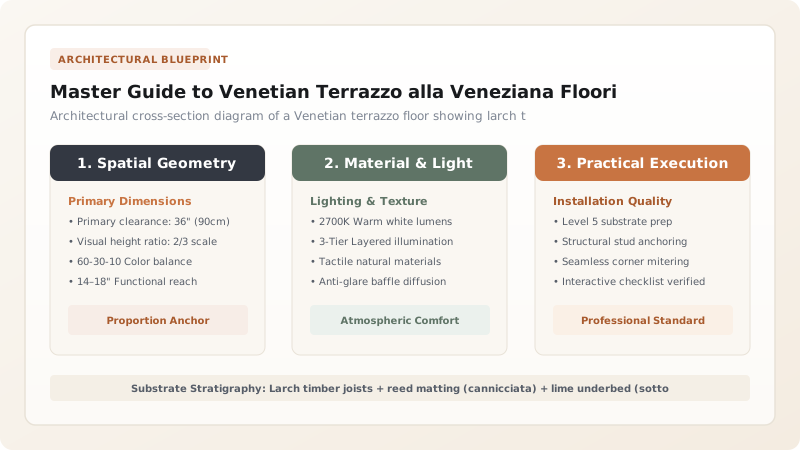
1. The Venetian Lagoon and the Genesis of Flexible Flooring
Venetian architecture exists in a permanent state of structural suspension. Palazzi along the Grand Canal rest upon millions of wooden piles driven into muddy lagoon silt. Because buildings settle differentially and oscillate with tidal shifts, rigid stone slabs or brittle ceramic tiles rapidly crack and delaminate.
In response, the Terrazzieri (Venetian terrazzo guild) developed a flexible, continuous floor system known as battuto alla veneziana or terrazzo. By floating a thick lime-and-marble matrix atop timber floorboards decoupled with reed mats (cannicciata), they created a monolithic floor that flexes safely with building movements without cracking.
2. Material Chemistry: Slaked Lime, Trass Pozzolan, and Linseed Oil
Modern commercial terrazzo uses rigid Portland cement or epoxy resins. Historic Venetian terrazzo relied strictly on grassello di calce (aged pit-slaked fat lime) mixed with crushed terracotta (cocciopesto) and volcanic pozzolana.
During the final kneading and compaction stages, the terrazzieri poured raw boiled linseed oil over the wet lime bed. The fatty acids in the linseed oil react with calcium hydroxide in the lime, saponifying into calcium linoleate soaps. This organic-mineral hybridization gives the mortar water-repellent hydrophobicity, dramatic elastic flexibility, and a deep, translucent optical depth when polished.
3. The Craft of Semina and Galoche Compaction
The hallmark of authentic terrazzo is maximum stone density: at least 75% to 80% of the finished floor surface consists of solid marble, with mortar acting only as a thin hairline binder. This is achieved through the art of semina (hand-seeding).
After the colored mortar bed is laid, master artisans fling graded marble chips across the floor by hand with rhythmic precision. The floor is then compacted using the galoche—a monumental two-wheeled iron roller steered by a long wooden pole. The rolling force drives chips deep into the matrix, forces marble facets into a coplanar horizontal orientation, and expels all trapped air bubbles.
Venetian Terrazzo Aggregate Sizing & Grading Classes
Use this reference table to calculate exact physical dimensions, ratios, and specifications before purchasing:
| Grain Size Class | Italian Trade Name | Particle Diameter (mm) | Typical Marble Variety | Floor Design Function |
|---|---|---|---|---|
| Micro-Chips (Fine) | Grana Fina | 3mm - 6mm | White Botticino / Carrara | Dense interstitial background fill |
| Medium Chips | Grana Media | 7mm - 12mm | Rosso Verona / Giallo Mori | Primary visual body & color matrix |
| Coarse Pastellone | Grana Grossa | 13mm - 25mm | Verde Alpi / Nero Torcello | Focal scattered mosaic accents |
| Monumental Spacchi | Scaglie Grandi | 30mm - 60mm hand-split slabs | Rare Greek & Roman marbles | Classical Venetian border inlays |
Logistical & Structural Constraints
Every successful decoration project must account for physical and environmental constraints:
Heavy Structural Weight
A completed 65mm thick traditional terrazzo installation weighs approx. 140 kg/m², requiring verification of timber joist load capacity.
Extended Grinding Timelines
Hand and mechanical water-grinding generates massive volumes of stone slurry that must be filtered and vacuumed continuously.
Protocol for Installing an Authentic Venetian Terrazzo Floor
Execute this professional sequence to achieve flawless results without backtracking:
Substrate Decoupling & Underbed
Lay reed mats or oiled paper over timber floor joists; trowel 40mm coarse lime-cocciopesto underbed (sottofondo); cure for 7 days.
Mortar Bed Gauging & Leveling
Mix aged fat lime putty, pozzolana, and fine marble dust; trowel 25mm colored mortar bed; screed level with wooden battens.
Manual Stone Hand-Seeding (Semina)
Broadcast graded marble chips across wet mortar by hand in uniform layers until 85% of the mortar surface is covered.
Galoche Roller Mechanical Compaction
Tamp stones with flat wooden beaters (battidori); roll with heavy iron galoche roller in intersecting diagonal passes.
Linseed Oil Saponification & Cure
Pour boiled linseed oil over compacted bed; roll again to force oil into matrix pores; allow floor to hydrate for 30 to 45 days.
Stone Grinding & Beeswax Polishing
Grind surface flat with progressive abrasive stones (carborundum/water); slurry-grout micro-pinholes; buff with pure beeswax.
Common Mistakes & Countermeasures
Avoid these costly errors that compromise aesthetics, ergonomics, and budget:
Using Portland cement to speed up terrazzo setting on timber joist floors
Applying modern polyurethane or epoxy sealers over lime terrazzo
Project Execution Checklist
Track your physical progress. Checkboxes persist automatically on this device:
Frequently Asked Questions
How does traditional Venetian terrazzo differ from modern terrazzo?
Modern terrazzo uses fast-curing Portland cement or synthetic epoxy resin with machine-vibrated aggregates, requiring metal divider strips every 2 meters to control cracking. Traditional Venetian terrazzo uses elastic slaked lime and linseed oil, allowing massive seamless rooms (up to 150 m²) with zero divider strips.
What is the tool historically used by Venetian terrazzieri to grind floors?
Historically, artisans used the 'orsetto' (little bear)—a heavy, 20-kilogram sandstone block mounted to the end of a long wooden pole, which the artisan pushed back and forth across the wet floor while standing upright.


