
Venetian Terrazzo Lime-Linseed Matrix and Stone Grinding represent the chemical consolidation and final surface revelation of the floor. The addition of raw boiled linseed oil into aged slaked fat lime triggers a chemical saponification reaction, forming water-resistant calcium soaps that impart miraculous flexibility. After a 30-to-45-day hydration period, the hardened floor is water-ground flat using a succession of natural and synthetic abrasive stones, sealed with fine marble-lime grout to fill microscopic pores, and hand-buffed with pure beeswax to unlock a luminous satin sheen.
At a Glance: Key Takeaways
- Linseed Oil Saponification: Linseed triglycerides reacting with Ca(OH)2 to synthesize flexible, hydrophobic calcium linoleate soaps.
- 30-to-45-Day Hydration Window: Allowing lime matrix to develop sufficient compressive strength before grinding.
- Progressive Water-Grinding: Step-by-step abrasive grinding from coarse 24-grit to silky 800-grit honing.
- Pinhole Slurry Grouting (Stuccatura): Packing microscopic air voids with matching colored marble-lime paste.
- Natural Beeswax Buffing: Hand-rubbing melted beeswax and turpentine to produce a warm, repairable, breathable luster.
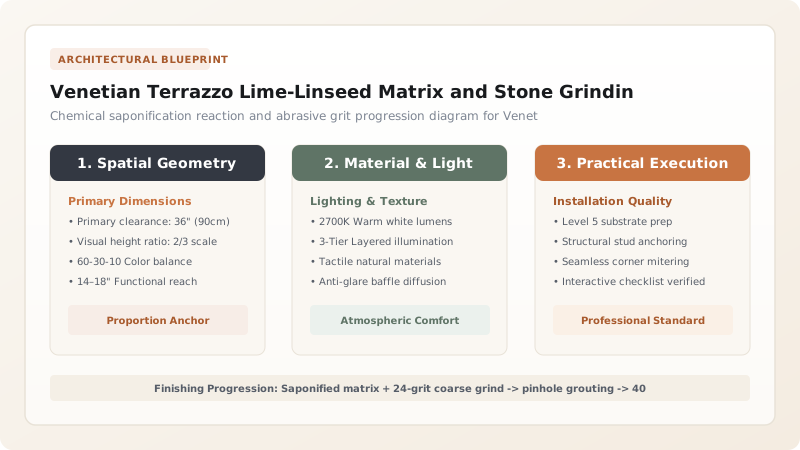
1. Saponification Chemistry: The Secret of Venetian Flexibility
The miraculous longevity of Venetian floors rests on a subtle chemical reaction. When pure slaked lime (calcium hydroxide) is kneaded with boiled linseed oil (olio di lino cotto), the alkaline environment hydrolyzes the triglyceride fatty acids (linolenic and oleic acids).
This reaction yields calcium linoleate (calcium soap) and glycerin. Rather than forming a rigid, brittle crystalline rock like pure cement, this hybrid matrix retains micro-elasticity. It absorbs the vibrations and sagging of wooden floor joists while rendering the floor naturally resistant to water, wine, and olive oil spills.
2. Progressive Water-Grinding: From Rough Stone to Honed Satin
Grinding cannot begin until the floor has hydrated for at least 30 to 45 days. Grinding too early will dislodge marble chips from the tender mortar; waiting too long allows the stones to carbonate into rock-like hardness, doubling grinding labor.
Grinding is performed strictly wet, using continuous water flooding. The process follows three distinct abrasive stages:
- Coarse Cut (Sgrossatura - 24 to 60 grit): Shaves off the crowns of the marble chips and the upper mortar crust down to a coplanar, flat plane.
- Intermediate Honing (Levigatura - 120 to 220 grit): Eliminates deep swirl scratches from the coarse grind and reveals the rich inner color of the stones.
- Fine Honing (Finitura - 400 to 800 grit): Smooths the floor to a silky, tactile satin finish ready to receive the protective wax.
3. Stuccatura (Pinhole Grouting) and Beeswax Polishing
After the intermediate honing stage, the floor will reveal thousands of microscopic pinholes and air voids exposed by the grinding stones. Artisans perform stuccatura (grouting).
A creamy paste formulated from aged lime putty, color-matched marble dust, and linseed oil is vigorously squeegeed across the floor, packing every microscopic pore. After curing for 7 days, a light final grind removes excess surface paste. Finally, the dry floor is dressed with raw yellow beeswax (cera d'api) dissolved in natural gum turpentine and buffed with wool pads, producing the deep, luminous, non-slip glow characteristic of Venetian palaces.
Venetian Terrazzo Grinding Progression & Abrasive Sequence
Use this reference table to calculate exact physical dimensions, ratios, and specifications before purchasing:
| Grinding Stage | Italian Term | Abrasive Grit / Stone | Water Lubrication | Surface Transformation |
|---|---|---|---|---|
| Rough Leveling | Sgrossatura | 24 - 36 Grit Carborundum | Continuous flood (10 L/min) | Cuts marble crowns down to coplanar bed |
| Intermediate Level | Rifinitura | 60 - 80 Grit Sandstone | Moderate water flow | Removes deep tooling gouges & scratches |
| Pinhole Stucco | Stuccatura | Lime + marble flour paste | Dry application / paste | Fills microscopic air voids between chips |
| Fine Honing | Levigatura | 220 - 400 Grit Pumice/Silicon | Light water mist | Silky matte surface ready for sealing |
| Beeswax Buff | Ceratura | Felt / Wool polishing pads | Dry buffing with melted wax | Luminous, repairable, water-repellent sheen |
Environmental & Operational Constraints
Every successful decoration project must account for physical and environmental constraints:
Massive Slurry Disposal Volumes
Grinding a 100 m² room produces hundreds of kilograms of alkaline marble-lime slurry that cannot be poured down domestic drains.
Water Damage Risks to Historic Ceilings
In historic palazzi, water used during grinding can seep through floorboards and destroy 16th-century frescoed ceilings below; floors must be sealed watertight.
Protocol for Grinding, Grouting, and Polishing a Venetian Terrazzo Floor
Execute this professional sequence to achieve flawless results without backtracking:
Cure Verification & Scratch Hardness
Verify floor has hydrated 35+ days; test lime matrix hardness with steel point to ensure chips will not pluck loose during grinding.
Coarse Wet-Grinding (Sgrossatura)
Flood floor with clean water; grind with 24-grit carborundum heads until 100% of marble chips are sheared flush and flat.
Slurry Vacuuming & Floor Washing
Continuously extract stone grinding slurry using wet-vacuum; rinse floor clean; inspect for exposed air pinholes.
Stuccatura Pinhole Grouting
Rub color-matched lime-marble putty into all surface pores using steel trowels held at 45°; cure for 5 days.
Fine Honing (Levigatura)
Wet-grind with 220-grit followed by 400-grit abrasive stones to shave away excess stucco and produce a silky matte finish.
Drying & Beeswax Thermal Buffing
Allow floor to dry for 72 hours; melt yellow beeswax into turpentine; apply in thin circular sweeps; buff to high satin sheen with wool bonnet.
Common Mistakes & Countermeasures
Avoid these costly errors that compromise aesthetics, ergonomics, and budget:
Grinding the terrazzo floor dry without continuous water lubrication
Using modern acrylic floor waxes or polyurethane lacquers
Project Execution Checklist
Track your physical progress. Checkboxes persist automatically on this device:
Frequently Asked Questions
How do you clean and maintain a traditional Venetian terrazzo floor?
Sweep regularly with a soft dust mop, and wash weekly with lukewarm water containing a capful of pure neutral olive-oil soap (Marsiglia soap). The soap nourishes the lime matrix, cleans the marble, and maintains the lustrous beeswax patina without chemical stripping.
Can historic damaged terrazzo floors be seamlessly patched?
Yes. By crushing matching marble chips from the original quarries and blending them with aged pit-slaked lime and boiled linseed oil, expert restorers can fill gouges, trenches, or settling cracks so seamlessly that the repair becomes invisible once ground and waxed.


