
In-Situ Stone Voussoir Cutting and Centerline Centering are the operational craft disciplines required to erect flawless Palladian tripartite arches. Stonemasons employ descriptive stereotomy to draft radial voussoirs radiating from a true geometric center. Timber falsework (centering) is constructed with double-curved ribs and supported on calibrated hardwood striking wedges, providing a rigid cradle during voussoir bedding until the central keystone is driven and the arch becomes structurally self-supporting.
At a Glance: Key Takeaways
- Stereotomy Drafting: Full-scale floor layout (épure) determining radial voussoir bed angles and intrados curvatures.
- Precision Stone Cutting: Sawing and chiseling tapered voussoirs to < 1.0mm tolerance across all mating contact faces.
- Rigid Timber Centering: Multi-ply laminated pine or oak centering ribs engineered for zero mid-span deflection under wet stone loads.
- Folding Striking Wedges: Paired hardwood wedges allowing controlled, millimeter-scale gradual lowering of falsework.
- Keystone Driving Dynamics: Driving the tapered keystone into the crown, inducing beneficial initial compressive pre-stress.
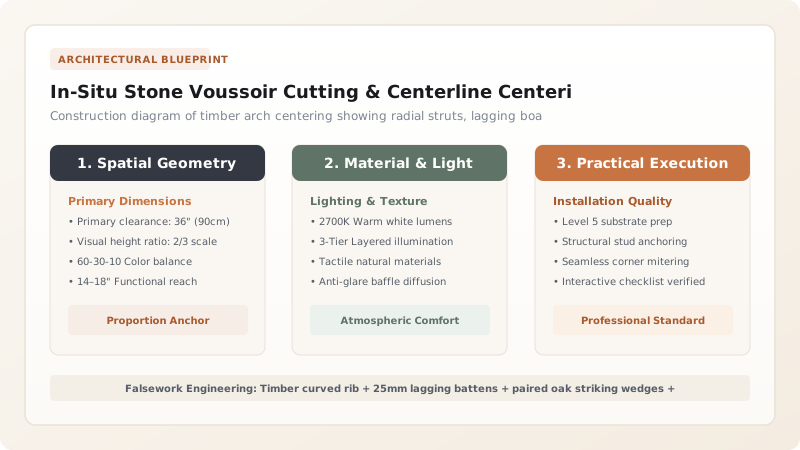
1. Stereotomy & The Full-Scale Lofting Layout (L'Épure)
The geometric cutting of stone voussoirs belongs to the mathematical science of stereotomy (stone cutting). Masons begin by clearing a flat wooden lofting floor (l'épure) where the entire Serliana arch is drafted at full 1:1 scale using steel trammeled compasses.
From the central focal point at the springing line, radial lines are projected outward to divide the semicircular arch ring into an odd number of equal voussoirs (typically 9, 11, or 13 stones). Zinc or birch-plywood templates (calibres) are cut for every unique stone profile, ensuring that joint lines converge precisely at the center point without angular error.
2. Fabrication of Rigid Timber Centering
Until the keystone is driven, individual voussoirs cannot bear their own weight. The temporary timber falsework (centering or cintre) must support the full wet weight of the arch ring without deflecting more than \(L/1000\) (less than 2mm on a 2.4m span):
- Laminated Curved Ribs: Double-layered 35mm thick timber boards cut to the exact intrados radius and staggered with bolted overlapping splices.
- Lagging Battens (Couchis): 25mm x 50mm timber strips nailed across the curved ribs at 40mm intervals to form the continuous bearing barrel.
- Strutted Spandrel Framing: Diagonal braces transferring downward stone loads directly into the supporting scaffolding towers rather than relying on beam bending.
3. Keystone Driving & Controlled Centering Striking
The voussoirs are set symmetrically from both springers upward, working in matching pairs to keep dead loads balanced across the centering. Joints are buttered with a thin, non-hydraulic lime putty (1.5mm bed joints).
The central keystone (serraglia) is dressed with a 2° to 3° taper and is sized 2mm wider than the crown opening. The mason drives the keystone home using a heavy wooden commander mallet, exerting pre-stress that tightens every joint in the ring. After curing for 7 to 14 days, the paired hardwood striking wedges at the base of the centering are gently tapped loose, lowering the centering by 5mm to transfer gravity loads smoothly to the stone arch.
Stone Voussoir Tolerances & Centering Sizing Matrix
Use this reference table to calculate exact physical dimensions, ratios, and specifications before purchasing:
| Arch Span (m) | Number of Voussoirs | Centering Rib Timber Thickness | Allowable Joint Tolerance (mm) |
|---|---|---|---|
| 1.50m - 2.00m | 9 or 11 Stones | 2 × 32mm Laminated Spruce | < 1.5mm Across Radial Beds |
| 2.00m - 2.80m | 11 or 13 Stones | 2 × 45mm Laminated Pine | < 1.0mm Across Radial Beds |
| 2.80m - 3.80m | 13 or 15 Stones | 3 × 45mm Bolted White Oak | < 0.8mm True Face Mating |
| Monumental (> 3.80m) | 15 to 19 Stones | Engineered Glulam Ribs + Steel Ties | < 0.5mm Ground Finish |
Stonemasonry & Rigging Constraints
Every successful decoration project must account for physical and environmental constraints:
Heavy Crane Sizing
Monumental keystones and springers often exceed 150 kg, requiring specialized mobile spider cranes on delicate historic floors.
Joint Thickness Precision
Traditional classical aesthetics require razor-thin joints (1.5mm to 2mm); uneven stone cutting will cause stones to touch point-to-point and chip.
Protocol for Laying Voussoirs and Striking Arch Falsework
Execute this professional sequence to achieve flawless results without backtracking:
Falsework Erection on Striking Wedges
Position timber centering on column imposts; rest base posts on paired oiled hardwood wedges with safety stop blocks.
Intrados Leveling & Center Plumb
Verify apex of centering matches designed crown height; confirm center-line string plumbs to floor datum within 0.5mm.
Symmetrical Springer Setting
Set bottom springer voussoirs on both sides simultaneously; verify bed angles using calibrated angle templates.
Alternating Ring Construction
Lay voussoirs in alternating left-right pairs toward the crown; maintain uniform 1.5mm joints using lead or slate spacers.
Keystone Driving & Compression Preload
Coat keystone with lime slurry; drive into crown void with wooden mallet until flush with extrados face.
Controlled Centering Striking
After 10 days of mortar cure, back off hardwood wedges by 2mm; inspect arch ring for settling; lower centering completely.
Common Mistakes & Countermeasures
Avoid these costly errors that compromise aesthetics, ergonomics, and budget:
Laying all voussoirs on one side of the arch before starting the other side
Using green, unseasoned timber to build arch centering
Project Execution Checklist
Track your physical progress. Checkboxes persist automatically on this device:
Frequently Asked Questions
Why does a classical arch always have an odd number of voussoirs?
An odd number of stones ensures there is a single, symmetrical keystone positioned exactly at the vertical centerline apex of the arch, providing both a structural locking wedge and a central focal point for carved architectural ornament.
How did historic masons prevent voussoirs from slipping down the steep centering during construction?
Masons used temporary timber stops, lead shims, and high-friction lime mortar, and once the voussoirs reached an angle greater than 45° (where gravity overcomes friction), stones were clamped with light wooden holding dogs until the keystone was driven.


