
Georgian and Neo-Palladian Timber and Stone Serliana Variants represent the transatlantic dissemination of Palladio's classical ideal. Introduced to Britain by Inigo Jones and codified by Lord Burlington and Colen Campbell, the Serliana became the definitive status symbol of 18th-century country houses. In British townhouses and American Colonial residences (such as Mount Vernon and Philadelphia mansions), master joiners translated heavy Italian stone stereotomy into intricate timber sash windows featuring curved radiating astragal glazing bars and lead-weighted sashes.
At a Glance: Key Takeaways
- Burlingtonian Neo-Palladianism: Pure classical stone Serlianas defining central staircase and salon facades in British estates.
- Timber Joinery Translation: Adapting stone voussoirs into steam-bent and laminated mahogany or pitch pine window frames.
- Curved Astragal Glazing: Delicate hand-molded timber glazing bars (16mm–20mm) holding mouth-blown cylinder glass panes.
- Concealed Counterbalance Pulleys: Multi-sash vertical sliding mechanisms integrating brass pulleys and lead counterweights.
- Colonial American Adaptations: Grand timber Serlianas illuminating central palladian entrance halls and riverfront facades.
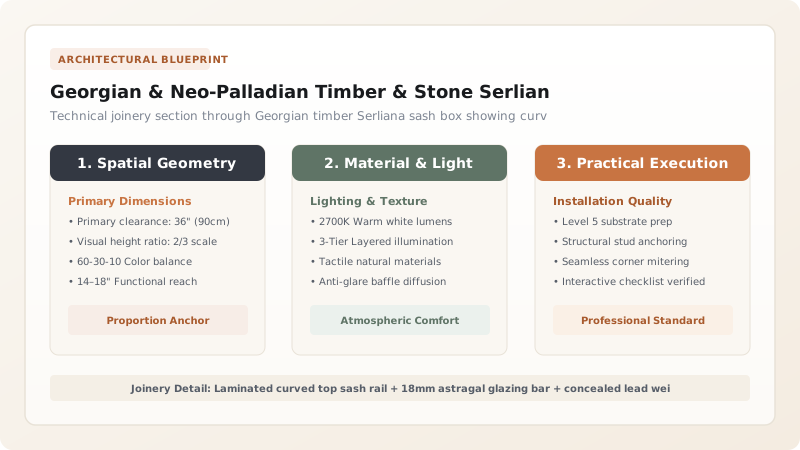
1. The British Neo-Palladian Revival: Burlington & Kent
In the early 18th century, a group of British aristocratic architects led by Richard Boyle, 3rd Earl of Burlington, and Colen Campbell (author of Vitruvius Britannicus, 1715) launched a cultural crusade against Baroque excess. They championed Andrea Palladio's strict classical rules as the epitome of enlightened Protestant order.
The Serliana—frequently referred to in English pattern books as the Venetian Window—was installed on the piano nobile of grand country houses (such as Chiswick House and Holkham Hall), instantly signifying scholarly taste and aristocratic status.
2. The Timber Translation: From Stone Ashlar to Box-Sash Joinery
While monumental British estates executed the Serliana in Portland stone or Bath limestone, urban developments in London, Bath, Dublin, and Edinburgh required timber adaptations suitable for brick cavity facades.
Master joiners engineered complex box-frame sash windows. The central arched opening posed immense craft challenges: the upper curved sash was fabricated from steam-bent or three-piece scarfed and laminated mahogany or Baltic pine. Master craftsmen carved miniature wooden Corinthian and Ionic pilasters directly onto the vertical mullion casings, transforming structural weight boxes into classical columns.
3. Transatlantic Migration: The American Colonial Serliana
Through exported British pattern books by James Gibbs and Batty Langley, the Serliana crossed the Atlantic to the American colonies. In timber-rich America, craftsmen constructed breathtaking all-wood versions.
Famous examples include the grand dining room window at George Washington's Mount Vernon (1774) and the Pennsylvania State House (Independence Hall). In these colonial masterworks, hand-carved keystones and modillion cornices were sculpted from solid white pine, painted with sand-infused linseed oil paint to simulate the appearance of dressed European stone.
Regional & Material Variants of the Serliana Window
Use this reference table to calculate exact physical dimensions, ratios, and specifications before purchasing:
| Architectural Typology | Geographic Context | Primary Material | Glazing & Operability Mechanism |
|---|---|---|---|
| Italian High Renaissance | Veneto, Italy (1550s) | Istrian Stone / Veronese Marble | Fixed unglazed opening or bronze casements |
| Burlingtonian Neo-Palladian | British Country Estates (1720s) | Portland Stone / Bath Stone | Fine timber inner sash; fixed arched stone surround |
| Georgian Urban Townhouse | London / Bath / Dublin (1760s) | Slow-grown Baltic Pine / Mahogany | Triple-hung operable sash with lead counterweights |
| American Colonial / Federal | Virginia / Philadelphia (1780s) | Carved White Pine / Pitch Pine | Operable center sash; flanking fixed side lights |
Restoration & Sourcing Constraints
Every successful decoration project must account for physical and environmental constraints:
Cylinder Glass Scarcity
Authentic hand-blown glass containing characteristic seeds (air bubbles) and gentle ream waviness must be imported from specialized European foundries.
Weight Pocket Clearance
Timber mullion boxes are narrow (often only 75mm wide); fitting paired lead weights requires custom cast slender cylindrical weights.
Protocol for Restoring an 18th-Century Timber Georgian Palladian Window
Execute this professional sequence to achieve flawless results without backtracking:
Dismantling & Sashing Documentation
Carefully remove staff beads and parting beads; extract lead weights, measure mass, and document rope pulley paths.
Paint Stripping & Wood Sounding
Strip multi-layer historic paint using low-temperature infrared heaters; inspect curved rail laminations for rot.
Curved Sash Rail Scarfing
Repair decayed curved top rails using matching seasoned quarter-sawn pine; bond stepped scarf joints with waterproof resorcinol glue.
Astragal Glazing Bar Conservation
Preserve authentic hand-molded astragal bars; bed historic cylinder restoration glass in linseed oil putty with brass glazing sprigs.
Counterbalance Lead Re-Weighting
Recalibrate lead sash weights to match new glass weight precisely; re-cord with wax-impregnated pre-stretched cotton sash cord.
Traditional Linseed Oil Paint Finishing
Apply four thin coats of traditional boiled linseed oil paint pigmented with lead-free chalk and zinc pigments; buff with bees wax.
Common Mistakes & Countermeasures
Avoid these costly errors that compromise aesthetics, ergonomics, and budget:
Replacing curved mouth-blown historic cylinder glass with modern thick float glass without re-weighting
Applying modern vinyl or silicone weatherstripping directly into historic timber grooves
Project Execution Checklist
Track your physical progress. Checkboxes persist automatically on this device:
Frequently Asked Questions
How did Georgian carpenters bend wood for the curved Serliana sash rails?
Joiners utilized two primary methods: either steam-bending green timber around rigid curved wooden formers, or laminating three to four thin layers of dry timber together with animal hide glue inside clamping jigs, followed by hand-planing with specialized curved compass planes.
Why did American colonists paint wooden Serlianas with sand mixed into the paint?
This technique, known as 'sand-painting' (or 'rustication'), involved throwing clean white quartz sand against freshly applied wet oil paint. Once dry, the coarse, matte, sparkling texture mimicked the color, texture, and visual weight of expensive cut European sandstone or marble.


