
Byzantine gold-ground smalti glass mosaics represent the zenith of late antique and medieval monumental vault decoration, perfected in Ravenna, Constantinople, and Venice between the 5th and 12th centuries. Characterized by hand-cut opaque glass tesserae (smalti), 24-karat gold leaf sandwiched between glass plates, deliberately tilted setting angles, and lime-pozzolana mortars, they transformed curved domes and apses into shimmering celestial light catchers.
At a Glance: Key Takeaways
- Vitreous Smalti Composition: Soda-lime-silica glass opacified with tin or antimony oxides and saturated with metal pigments.
- Gold Leaf Sandwich Glass: Microscopic 24K gold leaf sealed between a thick support glass disc and a paper-thin protective glass veneer (cartellina).
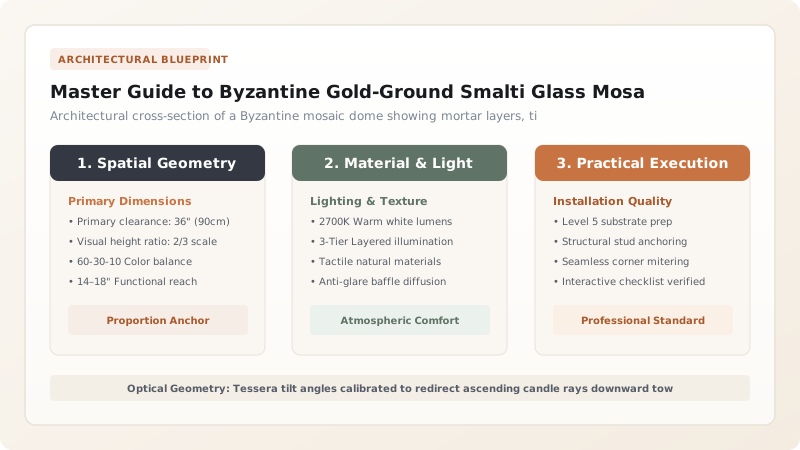
- Tilted Setting Angles: Tesserae angled 15° to 30° downward to catch ascending candlelight and project reflections onto observers below.
- Irregular Hand-Cut Facets: Chiseled with a mosaic hammer (martellina) over a hardie (tagliolo) to create light-scattering fractured edges.
- Pozzolanic Lime Setting Beds: Multi-layer hydraulic lime, crushed brick (cocciopesto), and marble dust mortar allowing slow, flexible curing on curved vaults.
In-Depth Guides in this Directory
Explore specialized subtopic blueprints, technical dimensions, and execution checklists:
Hand-Cut Vitreous Smalti Tesserae & 24K Leaf-Gold Sandwich Glass
Metallurgy, glassmaking furnace chemistry, and traditional cleaving techniques for 24K gold sandwich glass and opaque vitreous smalti tesserae.
Tilted Bedding Angles & Reflective Candlelight Optics in Byzantine Vaults
Optical engineering of Byzantine mosaics: calculating tessera tilt angles, specular candlelight reflection, and visual anti-glare geometry.
Curvilinear Vault Setting Beds & Pozzolanic Lime Mortar Chemistry
Mortar formulation, pozzolanic reactions, and structural vault adhesion for Byzantine glass mosaics on domes, apses, and squinches.
1. Material Alchemy: Smalti Formulation & Gold Sandwich Glass
The monumental power of Byzantine mosaics resides in smalti—a dense, vitreous glass paste produced by melting silica sand, soda ash, and lime at temperatures exceeding 1,250°C. Unlike transparent stained glass, smalti is rendered completely opaque through the addition of opacifying mineral agents, historically antimony trioxide (\(\text{Sb}_2\text{O}_3\)) or stannic oxide (\(\text{SnO}_2\)). Metallic oxides impart intense, lightfast pigmentation:
- Cobalt oxide (CoO): Deep celestial blues and ultramarines.
- Cupric oxide (CuO): Saturated emerald greens and Mediterranean turquoises.
- Ferrous and ferric iron (FeO / \(\text{Fe}_2\text{O}_3\)): Warm ambers, olive tones, and earthy red tesserae.
- Colloidal gold or manganese: Imperial porphyry purples and deep violets.
The luminous pinnacle of the craft is oro antico (gold leaf glass). Artisans beat pure 24-karat gold into leaf measuring merely 0.1 to 0.2 microns in thickness. The gold leaf is applied across a molten base glass disc (piastra, 6–8mm thick). A paper-thin film of molten clear glass, termed the cartellina (0.5–1.0mm thick), is immediately fused over the gold leaf, permanently sealing the precious metal against oxidation, moisture, and soot for over a millennium.

2. Optical Physics of the Gold Ground & Tilted Bedding Mechanics
A Byzantine mosaic was never intended to be viewed as a flat, static painted wall. In the dim, candle-lit sanctuaries of churches like the Basilica of San Vitale in Ravenna or Hagia Sophia in Constantinople, the mosaicist functioned as an optical engineer.
Instead of embedding tesserae flush into the mortar, Byzantine masters deliberately inclined gold and colored cubes downward at angles of 15° to 30° relative to the wall plane. This angled setting obeys Snell's Law of Reflection:
By angling tesserae downward, light from oil lamps and candles positioned below at floor level strikes the gold leaf and is reflected directly down into the eyes of worshipers below, rather than bouncing uselessly toward the vault crown. As drafts flickered the candle flames, the entire vault appeared to vibrate with living, supernatural divine energy.
Furthermore, tesserae were set with deliberate irregularity in elevation (varying depth by 1–2mm). The fractured, non-uniform edges produced by hand-cleaving with hammer and anvil scatter specular reflections into thousands of shimmering micro-points of light.
3. The Vault Setting Bed: Pozzolanic Mortar Chemistry
Affixing hundreds of tons of glass cubes to vertical walls, pendentives, and overhead soffits requires a mortar of exceptional stickiness, slow setting time, and lifelong flexibility. Standard modern Portland cement shrinks rapidly, binds too quickly for mosaic manipulation, and leaches soluble salts that cause destructive alkali-silica reactions.
Byzantine mosaic beds relied on a three-tier hydraulic lime system:
- Scratch Arriccio (Arriccio di fondo): Coarse lime mortar blended with crushed volcanic pozzolana or porous volcanic scoria (10–15mm thick), keyed heavily into the brickwork.
- Intermediate Brown Coat (Intonaco di corpo): Aged non-hydraulic slaked lime putty (calcium hydroxide, \(\text{Ca(OH)}_2\)) blended with crushed terracotta brick (cocciopesto) and washed silica sand (8–10mm thick). The reactive pozzolana in the crushed brick reacts with free lime to create calcium silicate hydrates (C-S-H), imparting hydraulic set in damp atmospheres.
- Final Setting Coat (Intonachino di posa): Pure slaked lime putty mixed with powdered white marble dust and crushed pumice (3–5mm thick). This layer remains workable for 4 to 8 hours, allowing the master mosaicist to press tesserae directly into the mortar bed according to the underdrawing (sinopia).
4. Iconographic Hierarchy & Curvilinear Vault Geometry
The placement of mosaic media reflected a strict theological and spatial hierarchy. Terrestrial ground zones and lower wall dadoes utilized flat, durable marble revetment slabs. As the architecture soared into the celestial zone—the squinches, pendentives, and hemispherical domes—flat marble gave way to vitreous smalti and reflective gold ground.
On curved dome surfaces, the spacing of tesserae had to accommodate radial foreshortening. Tessera rows (andamenti) radiated outward from the central Christ Pantocrator medallion in concentric rings. To prevent visual crowding at the crown, mosaicists utilized smaller tesserae (5mm × 5mm) at the apex, gradually enlarging them to 12mm × 12mm near the dome base to compensate for viewing perspective from 15 to 30 meters below.
Byzantine Smalti Mosaic Specifications vs Modern Commercial Tile
Use this reference table to calculate exact physical dimensions, ratios, and specifications before purchasing:
| Technical Parameter | Traditional Byzantine Smalti Standard | Modern Commercial Glass Mosaic | Conservation & Performance Impact |
|---|---|---|---|
| Glass Composition | Soda-lime silica opacified with tin/antimony | Float glass with rear screen-printed ceramic paint | 100% through-body opacity and lifetime UV permanence |
| Gold Layer Fabrication | 24K leaf sandwiched under 0.8mm cartellina | Evaporated metallic vapor film on glass backing | Impervious to moisture delamination; zero green copper tarnishing |
| Setting Angle | Deliberately raked 15°–30° downward | 100% coplanar, flush machine-mounted on mesh sheets | Dynamic candlelight refraction vs flat, sterile glare |
| Mortar Bed | Hydraulic slaked lime + cocciopesto brick dust | Polymer-modified Portland cement thin-set | Breathable, flexible vault adhesion without efflorescence salts |
| Joint Grouting | Ungrouted; tesserae pressed to 2/3 depth with exposed mortar | Filled with epoxy or Portland cement grout | Exposed shadow reveals and deep visual texture |
Structural & Environmental Constraints
Every successful decoration project must account for physical and environmental constraints:
Dead Load Capacity
Smalti mosaic assemblies weigh between 30 and 45 kg/m²; vaults must be structurally assessed for compressive dead-load capacity.
Condensation & Salt Migration
Rising damp carrying soluble nitrates or chlorides will crystallize behind the lime bed (subflorescence), pushing the mosaic off the brick substrate.
Vibration Sensitivity
Overhead vaults in urban settings require flexible lime-hydraulic binders to withstand dynamic vehicular and transit vibrations.
Direct Method Execution Sequence for Byzantine Gold Mosaics
Execute this professional sequence to achieve flawless results without backtracking:
Substrate Brickwork Preparation
Clean and rake mortar joints of the brick vault. Saturate masonry with lime water to prevent moisture suction from the bedding mortar.
Application of Hydraulic Cocciopesto Bed
Apply the 10mm intermediate mortar bed containing slaked lime and crushed brick dust; scratch horizontal keys across the curing surface.
Sinopia Full-Scale Underdrawing
Paint the iconographic composition directly onto the intermediate coat using red ochre (sinopia) and carbon black mineral pigments.
Intonachino Setting Coat Application
Apply only as much fine marble-dust lime putty as can be mosaicked in a single working day (giornata, roughly 0.5 to 1.0 m²).
Tessera Cleaving & Angle Placement
Cleave smalti pizzas into cubes using martellina and tagliolo. Press tesserae individually into the wet lime bed at calibrated 20° downward tilt angles.
Depth Inspection & Slow Carbonation
Ensure tesserae are submerged to 60–70% of their thickness, leaving exposed side facets to catch ambient light; mist with water for 14 days to complete lime carbonation.
Common Mistakes & Countermeasures
Avoid these costly errors that compromise aesthetics, ergonomics, and budget:
Setting smalti tesserae completely flat and coplanar
Filling mosaic joints with modern colored cement grout
Using rigid Portland cement mortar over curved brick vaults
Project Execution Checklist
Track your physical progress. Checkboxes persist automatically on this device:
Frequently Asked Questions
How did Byzantine mosaics survive intact for over 1,500 years?
Vitreous smalti glass is chemically inert and completely impervious to water, mold, and atmospheric oxidation. When set into flexible pozzolanic lime mortar that breathes and accommodates building settlement without cracking, the composite assembly forms an exceptionally durable inorganic skin.
Why does the gold in Byzantine mosaics never tarnish or turn green?
The gold leaf used is pure 24-karat gold, which does not oxidize. Crucially, the gold is hermetically sealed between a molten base glass plate and an ultra-thin clear glass veneer (cartellina), completely shielding the metal from air, humidity, and sulfurous candle fumes.
What is the difference between Roman and Byzantine mosaics?
Roman mosaics were primarily floor pavements (opus tessellatum / opus vermiculatum) composed of flat, polished natural marble and limestone cubes. Byzantine mosaics were wall and ceiling vault coverings crafted from vibrant, opaque vitreous glass smalti and reflective 24K gold glass, set at uneven angles to maximize light reflection.


