
Byzantine mosaic vaults rely on multi-tier pozzolanic lime mortars formulated from aged non-hydraulic slaked lime (calcium hydroxide), finely crushed terracotta brick (cocciopesto), and marble dust. The pozzolanic reaction between amorphous alumina-silica in the fired clay and free calcium hydroxide forms water-insoluble calcium silicate hydrates (C-S-H), providing high shear adhesion on curved overhead masonry.
At a Glance: Key Takeaways
- Pozzolanic Chemistry: Calcium hydroxide reacting with fired terracotta to generate insoluble C-S-H binder crystals.
- Overhead Tensile Adhesion: High shear bonding resisting shear delamination on compound spherical vaults.
- Aged Lime Putty: Slaked lime aged for minimum 6 to 12 months for ultra-fine colloidal plasticity.
- Breathable Vapor Envelope: Open-pore microstructure allowing substrate moisture to evaporate safely.
- Zero Soluble Alkalis: Prevents alkali-silica reactions (ASR) that fracture antique glass smalti.
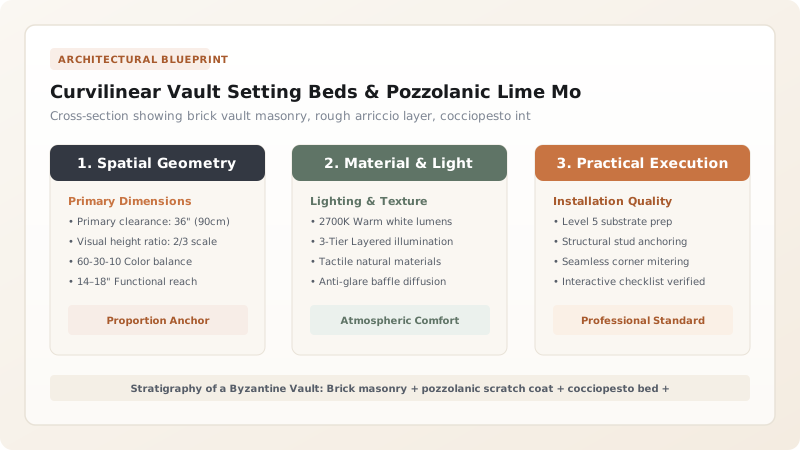
1. The Chemical Dynamics of Pozzolanic Cocciopesto Mortar
When applying hundreds of kilograms of dense glass smalti to the underside of a curved masonry dome, conventional air-lime mortar presents a fatal flaw: pure slaked lime (\(\text{Ca(OH)}_2\)) hardens solely through carbonation—the slow absorption of atmospheric carbon dioxide (\(\text{CO}_2\)). Deep inside a 25mm thick mortar bed behind impermeable glass tesserae, \(\text{CO}_2\) cannot penetrate, leaving the core soft for decades.
Byzantine engineers solved this by formulating cocciopesto—blending slaked lime with finely ground, low-fired terracotta pottery and crushed brick dust. The amorphous silica (\(\text{SiO}_2\)) and alumina (\(\text{Al}_2\text{O}_3\)) in the crushed brick react chemically with calcium hydroxide in the presence of water to synthesize hydraulic compounds:
This reaction forms insoluble calcium silicate hydrates (C-S-H) and calcium aluminate hydrates (C-A-H) throughout the entire mortar depth, hardening the bed hydraulically even in the complete absence of air, while retaining the elasticity and vapor permeability necessary to absorb building movement.
2. Multi-Tier Mortar Stratigraphy on Curved Masonry
The application onto curved vaults follows a rigorous three-layer stratigraphy totaling 25mm to 35mm in thickness:
- Layer 1: Rinzaffo / Arriccio di Fondo (12–15mm): A coarse bonding coat composed of 1 part aged fat lime putty, 1.5 parts volcanic pozzolana or coarse crushed brick (2–4mm aggregate), and 1.5 parts coarse silica river sand. Troweled firmly into raked brick joints and scratched with deep diagonal grooves.
- Layer 2: Intonaco Cocciopesto (8–10mm): A medium-fine leveling coat consisting of 1 part slaked lime putty, 2 parts finely sieved terracotta powder (< 1mm), and 1 part river sand. This layer provides the main structural shear capacity of the vault.
- Layer 3: Intonachino di Posa (3–5mm): The final setting bed, formulated from 1 part aged lime putty (minimum 12 months aged), 1 part crushed white Carrara marble dust (0.1–0.5mm), and 0.5 parts fine pozzolana. This white, silky paste holds the cleaved tesserae under direct compression.
3. Structural Adhesion Dynamics on Pendentives & Domes
On spherical surfaces such as pendentives, squinches, and domes, the mosaic assembly experiences both normal gravity loads and complex shear forces. The shear stress \(\tau\) along the mortar-masonry boundary on a vault inclined at angle \(\theta\) is expressed by:
Where \(W_{\text{mosaic}}\) is the total weight of the glass tesserae and setting mortar, and \(\theta\) is the inclination from horizontal. At the springline of a dome (\(\theta \approx 90°\)), shear stress reaches its maximum. Cocciopesto lime mortars provide a shear bond strength of 0.35 to 0.55 MPa, providing a safety factor exceeding 4.0 against gravity-induced delamination.
Mortar Mix Ratios for Byzantine Vault Mosaic Beds
Use this reference table to calculate exact physical dimensions, ratios, and specifications before purchasing:
| Mortar Layer | Binder (Slaked Lime Putty) | Pozzolanic Aggregate | Inert Mineral Filler | Curing Mechanism & Time |
|---|---|---|---|---|
| Rinzaffo (Scratch) | 1 part aged lime putty | 1.5 parts coarse crushed brick (2-4mm) | 1.5 parts washed river sand | Hydraulic set within 7 days; full carbonation 60 days |
| Intonaco (Brown) | 1 part aged lime putty | 2 parts fine terracotta dust (< 1mm) | 1 part medium quartz sand | Hydraulic reaction within 72 hours; cure 21 days |
| Intonachino (Setting) | 1 part aged micro-lime putty | 0.5 parts micro-pozzolana | 1 part white Carrara marble dust | Slow setting (4-8 hours open time); cures in situ |
Engineering Constraints
Every successful decoration project must account for physical and environmental constraints:
Temperature Limitations
Slaked lime and pozzolanic mortars must never be applied below 8°C or above 30°C, as freezing or rapid desiccation halts hydration.
Structural Deflection
Vault timber frameworks or steel sub-structures must have a maximum deflection under live load of < L/720 to prevent mosaic bed cracking.
Vault Substrate Preparation and Mortar Application Protocol
Execute this professional sequence to achieve flawless results without backtracking:
Substrate Masonry Raking & Desalination
Rake brick mortar joints to a depth of 15mm; test for soluble sulfate salts using barium chloride testing. Flush with demineralized water.
Pre-Wetting the Substrate
Saturate the brick vault thoroughly with clean water over 24 hours to prevent porous bricks from rapidly absorbing water from the fresh mortar.
Rinzaffo Scratch Coat Application
Force the coarse lime-pozzolana mix into joints with a hawk and trowel; comb deep wave keys across the wet mortar.
Cocciopesto Intermediate Layer
Apply the 10mm cocciopesto brown coat; level across curved wooden screed templates to establish true vault curvature.
Intonachino Application (Giornata)
Spread the fine lime-marble setting bed only across the section planned for mosaic placement that day, maintaining 4mm uniform depth.
Post-Installation Humidification
Mist the finished mosaic with fine water spray daily for 14 days to support the hydraulic pozzolanic crystallization cycle.
Common Mistakes & Countermeasures
Avoid these costly errors that compromise aesthetics, ergonomics, and budget:
Using modern rapid-setting Portland cement on historic brick vaults
Applying the setting bed over dry, thirsty brickwork
Project Execution Checklist
Track your physical progress. Checkboxes persist automatically on this device:
Frequently Asked Questions
What is the function of crushed brick (cocciopesto) in the mortar?
Fired terracotta contains amorphous silica and alumina that react chemically with slaked lime (calcium hydroxide) in the presence of water, producing a hydraulic set. This enables the mortar to harden even in the center of thick vault layers where air and carbon dioxide cannot penetrate.
Can cocciopesto mortar resist outdoor freeze-thaw cycles?
Yes. The porous micro-structure of cocciopesto mortar contains tiny air voids that accommodate the expansion of freezing water without fracturing the mortar matrix, providing exceptional freeze-thaw durability.


