
The dynamic luminosity of Byzantine mosaics is achieved by deliberately angling tesserae 15° to 30° downward from the vertical plane. This geometric orientation aligns with ascending light rays from floor-level candles and oil lamps, projecting intense specular reflections directly down into the viewer's field of vision while eliminating distracting overhead glare.
At a Glance: Key Takeaways
- Down-Tilted Tessera Alignment: 15° to 30° inclination capturing rising illumination from floor candelabras.
- Specular vs Diffuse Reflection: Mirror-like reflection off the 24K gold foil combined with fractured-edge refraction.
- Viewing Angle Optimization: Calibrating tilt angles against the observer's standing distance and vault apex height.
- Undulating Surface Matrix: Setting adjacent tesserae at ±5° variations to break uniform reflection into dynamic scintillation.
- Acoustic Reflection Dissipation: The irregular three-dimensional mosaic texture scatters high-frequency vocal echoes in stone vaults.
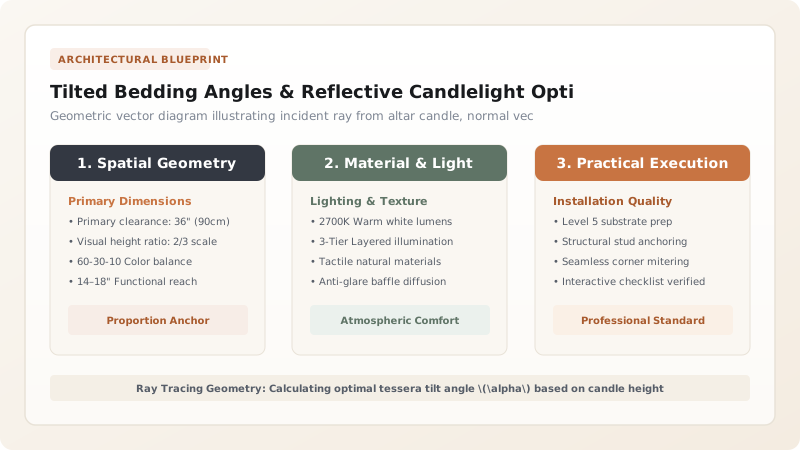
1. The Vector Physics of Byzantine Candlelight Reflection
In classical Western painting, lighting is depicted illusionistically through painted highlights and chiaroscuro. In Byzantine architectural mosaics, light is real physical radiation governed by the geometric laws of optical physics. To illuminate the dark, windowless upper vaults of early Christian basilicas, mosaicists calculated the exact geometric vector between floor-level light sources and observer eye levels.
Consider a candle at height \(h_{\text{candle}}\) located at horizontal distance \(d_1\) from the base of a vertical wall, and an observer with eye level \(h_{\text{eye}}\) located at distance \(d_2\). For a mosaic tessera installed at vault height \(H\), the optimal downward tilt angle \(\alpha\) relative to the vertical wall plane is calculated by:
In typical monumental spaces with vault heights \(H = 12\) to 20 meters, this formula yields downward tilt angles ranging from 15° to 28°. If the tessera were set flush (\(\alpha = 0°\)), the reflected light vector would bounce upward toward the opposite ceiling or sky, leaving the mosaic dark and lifeless when viewed from the nave.
2. Controlling Glare & Achieving Dynamic Scintillation
If every tessera were set at the exact same mathematical tilt angle, the entire vault would flash like a mirror in a single blinding blast of glare as a viewer walked through the focal point, followed by complete darkness. To avoid this, Byzantine masters introduced controlled chaotic variance:
- Raking Variance (±5°): Adjacent tesserae in the same row are deliberately tipped slightly left, right, up, or down from the primary vector axis.
- Elevation Staggering: Tesserae protrude 1mm to 2.5mm beyond their neighbors, creating tiny cast shadows that define the geometric outline of each cube.
- Curved Substrate Advantage: On domed apses and hemispherical cupolas, the natural curvature of the masonry automatically spreads the normal reflection vectors across an omnidirectional 180° arc.
As worshipers walk through the cathedral and as ambient air currents cause oil lamps to sway and candles to gutter, the points of maximum reflection shift continuously across the gold ground. The holy figures appear to breathe, move, and radiate uncreated divine light (the Hesychast Tabor Light).
3. The Direct-to-Mortar Hand Setting Technique
This optical magic cannot be achieved using modern indirect prefabricated mesh sheets (where tiles are glued face-down to paper in a factory and grouted flat on site). The Byzantine technique requires the direct setting method (a filo diretto):
- The artisan spreads fresh, malleable lime-marble putty (intonachino) across a 1m² work zone (giornata).
- Holding a cleaved tessera with specialized curved mosaic tweezers (mollette), the mosaicist pushes the glass cube directly into the soft mortar.
- With a gentle downward rotational flick of the wrist, the artisan angles the top edge deeper into the mortar while leaving the bottom edge protruding.
- The mortar squeezes up around the back and sides of the cube, filling approximately 60% to 70% of the tessera depth, mechanically locking it permanently in place without covering the front reflective face.
Tessera Bedding Tilt Angles by Architectural Zone
Use this reference table to calculate exact physical dimensions, ratios, and specifications before purchasing:
| Architectural Zone | Vault / Wall Geometry | Recommended Downward Tilt (\(\alpha\)) | Optical Objective |
|---|---|---|---|
| Nave Vertical Clerestory | Vertical flat planar wall | 18° to 24° downward | Redirects nave candelabra light directly to walking congregants |
| Apse Conch (Soffit) | Curved quarter-sphere dome | 10° to 15° downward toward altar | Focuses ambient sanctuary light onto the enthroned Christ or Virgin |
| Dome Apex (Pendentive Base) | Compound spherical triangle | 25° to 32° steep downward rake | Compensates for steep 60° upward line-of-sight from church floor |
| Lower Dado & Column Borders | Vertical wall at eye level | 0° to 5° nearly flush | Eliminates abrasive projecting edges; durable tactile surface |
Optical & Structural Constraints
Every successful decoration project must account for physical and environmental constraints:
Mortar Working Time
Slaked lime setting beds remain workable for only 4 to 6 hours before carbonation prevents proper tessera penetration.
Dust & Soot Accumulation
Projecting tilted tessera edges collect airborne dust over centuries; periodic non-acidic conservation cleaning is required.
Master Protocol for Angled Tessera Setting in Lime Putty
Execute this professional sequence to achieve flawless results without backtracking:
Scaffolding & Light Source Alignment
Erect stable scaffolding. Mount temporary directional halogen or candlelight simulators at the exact floor-level locations of permanent chandeliers.
Intonachino Bed Spreading
Trowel a 4mm layer of aged lime-marble dust mortar over the dampened substrate, establishing an even thickness without skinning.
Guideline Incision (Andamento)
Incise curving flow lines (andamenti) into the wet lime using a bronze stylus to guide the rhythm of tessera rows.
Tweezer Placement & Rotational Tilt
Grasp each tessera with forged tweezers; insert into mortar and apply calibrated downward wrist rotation to achieve the specified tilt angle.
Sightline Optical Verification
Check reflection alignment from below: verify that simulated floor light bounces directly into the observer cone.
Mortar Bed Consolidation
Gently tamp around the tessera bases with a small wooden block to consolidate lime paste without altering the cleaved face angles.
Common Mistakes & Countermeasures
Avoid these costly errors that compromise aesthetics, ergonomics, and budget:
Over-tamping tesserae flat with a wooden float board
Allowing wet lime mortar to smear over the front face of gold tesserae
Project Execution Checklist
Track your physical progress. Checkboxes persist automatically on this device:
Frequently Asked Questions
Why do modern mosaic replicas often look flat compared to originals in Ravenna?
Modern replicas are almost universally assembled face-down on paper in a studio and installed with flat floats and cement grout. Historical originals were pressed piece-by-piece directly into wet lime on the scaffolding, with master artisans adjusting the angle of every single tessera to catch the flickering light of candles below.
How do tilted tesserae affect church acoustics?
The thousands of protruding, angled glass edges break up sound waves striking smooth stone vaults. Instead of producing harsh flutter echoes, the textured mosaic surface acts as a high-frequency acoustic diffuser, enhancing Gregorian and Byzantine choral chanting.


