
Vitreous smalti and gold sandwich glass (oro) are artisanal glass media manufactured in high-temperature crucible furnaces. Smalti combines silica sand with metal oxide colorants and opacifiers, while gold glass permanently seals genuine 24-karat gold leaf beneath a micro-thin protective glass veneer (cartellina), cleaved by hand with a steel martellina hammer to produce light-fracturing edges.
At a Glance: Key Takeaways
- 1,250°C Furnace Fusion: High-temperature batch melting in refractory ceramic crucibles.
- Cartellina Protective Fusion: 0.5–1.0mm clear glass membrane hermetically encapsulating 24K gold leaf.
- Tin & Antimony Opacification: Microscopic crystal precipitations delivering rich, velvety light scatter.
- Martellina & Tagliolo Cleaving: Hand-chipping produces irregular conchoidal fractures that disperse light.
- Thermal Expansion Matching: Identical coefficient of thermal expansion (COE) between base glass and cartellina to prevent spalling.
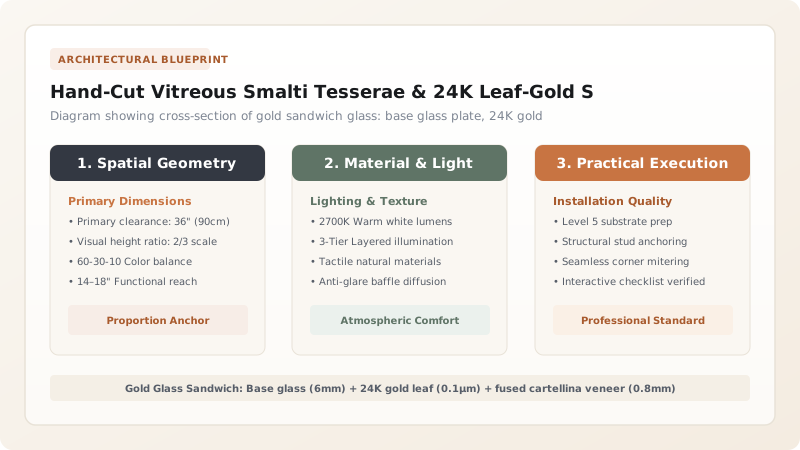
1. Glass Chemistry & Crucible Smelting of Opaque Smalti
Unlike transparent blown glass, smalti is an opaque glass paste engineered specifically for conchoidal fracture and surface reflectivity. Its chemical formula typically comprises:
- Silica sand (\(\text{SiO}_2\)): 60% to 68% (the structural glass former).
- Soda ash (\(\text{Na}_2\text{O}\)) / Potash (\(\text{K}_2\text{O}\)): 14% to 18% (flux to lower melting temperature).
- Lime (\(\text{CaO}\)): 6% to 10% (chemical stabilizer against water solubility).
- Antimony / Tin Opacifiers: 5% to 8% (induces phase separation of microscopic calcium antimonate crystals that scatter light waves).
The batch is smelted in sealed refractory ceramic crucibles at 1,200°C to 1,280°C for 24 hours. The molten glass is ladled onto thick iron casting tables and rolled into round flat discs approximately 10mm to 12mm thick, termed pizze (pizzas). These discs undergo controlled annealing in a lehr kiln over 48 hours to relieve internal tensile stresses.
2. The Fabrication of 24K Gold Sandwich Glass (Oro)
The manufacturing of gold leaf tesserae (oro) represents one of the most sophisticated feats of historical pyrotechnology:
- A molten base glass disc (piastra, 5–8mm thick), typically cast from amber or cobalt glass, is smoothed on a marver.
- Artisans apply leaves of pure 24-karat gold (beaten to 0.1–0.2 microns thickness) directly onto the hot glass surface; the heat causes the gold to adhere instantly to the soft glass.
- A gather of ultra-clear glass is blown paper-thin into a balloon, cracked open, and dropped directly over the gold leaf as a protective skin known as the cartellina (0.5–1.0mm thick).
- The composite sandwich is reheated in the furnace glory hole to 900°C, fusing the cartellina, gold leaf, and base disc into an inseparable hermetic bond.
If the coefficient of thermal expansion (\(\text{COE}\)) between the base disc and the cartellina differs by more than \(2 \times 10^{-7} / \text{K}\), thermal stress will cause the cartellina to craze, pop off, or delaminate during cooling.
3. Cleaving Dynamics: The Martellina & Tagliolo System
Smalti is never cut with modern wheeled glass cutters or tile nippers; doing so produces polished, flat edges that destroy the refractive vibrancy of the mosaic. Instead, craftsmen cleave the annealed glass discs using a martellina (a curved, double-beveled steel hammer weighing 450–950 grams) struck against a tagliolo (a hardened steel chisel wedge embedded into a massive wooden chopping block).
When the mosaicist strikes the glass disc positioned over the tagliolo, localized compressive shockwaves propagate through the glass thickness, generating a clean conchoidal fracture. This fracture leaves undulating, micro-faceted crystalline cleavage surfaces. When illuminated, each microscopic facet reflects light at a slightly different angle, producing the characteristic sparkling scintillation of historic Byzantine installations.
Smalti Cleaving & Dimension Standards
Use this reference table to calculate exact physical dimensions, ratios, and specifications before purchasing:
| Tessera Dimension | Typical Architectural Application | Martellina Weight | Viewing Distance Range |
|---|---|---|---|
| Miniature (3mm × 3mm × 6mm) | Facial features, hands, delicate flesh tones (carnagione) | 450g fine balance martellina | 1 to 3 meters (intimate chapels, icons) |
| Standard (8mm × 8mm × 10mm) | Drapery folds, garments, halos, decorative borders | 750g standard mosaic hammer | 3 to 10 meters (nave walls, lower apses) |
| Monumental (15mm × 15mm × 12mm) | Gold grounds, high dome vaults, monumental triumphal arches | 950g heavy splitting hammer | 10 to 35 meters (cathedral cupolas, basilicas) |
Material & Manufacturing Constraints
Every successful decoration project must account for physical and environmental constraints:
Hand Cleaving Waste
Hand-cutting smalti generates 15% to 22% unusable shards and fine glass splinters; order gross stock accordingly.
COE Compatibility
Never fuse scrap float glass over gold leaf; use only chemically balanced compatible enamel glasses with matching expansion curves.
Protocol for Hand-Cleaving Vitreous Smalti and Gold Glass
Execute this professional sequence to achieve flawless results without backtracking:
Annealing Inspection
Inspect the glass pizza disc using crossed-polarizing filters to verify absence of internal residual cooling stresses.
Tagliolo Positioning & Block Stability
Firmly embed the tapered tang of the hardened steel tagliolo into a dense oak or beech stump that absorbs rebound shock.
Strip Cutting (Taglio a Strisce)
Support the glass pizza across the chisel edge; strike cleanly with the martellina to cleave the disc into parallel strips (bacchette) of calibrated width.
Tessera Cube Cleaving
Feed the glass strip across the chisel edge, striking perpendicular blows to snap off uniform square cubes (tesserae).
Gold Glass Cartellina Protection
When cleaving gold sandwich glass, always orient the thin cartellina face upward toward the hammer blow to prevent delamination along the gold leaf boundary.
Sorting by Hue & Facet Angle
Sort cleaved tesserae into compartmentalized wooden trays categorized by color gradation, thickness, and cleaved surface texture.
Common Mistakes & Countermeasures
Avoid these costly errors that compromise aesthetics, ergonomics, and budget:
Using modern carbide wheeled nippers to cut smalti
Cutting gold glass with the cartellina face resting against the steel anvil
Project Execution Checklist
Track your physical progress. Checkboxes persist automatically on this device:
Frequently Asked Questions
Can smalti be used in wet environments like showers or swimming pools?
Yes. Smalti glass is completely non-porous and impervious to water, chlorine, salts, and pool chemicals. When installed with proper waterproof membranes and epoxy or hydraulic lime setting beds, it will last indefinitely without degradation.
Why is colored base glass sometimes used beneath the gold leaf?
The color of the base glass subtly shifts the visual warmth of the gold. A warm amber or red base glass imparts a rich, deep reddish-gold glow (oro rosso), while a cobalt blue or green base glass creates a cooler, ethereal lemon-gold luminescence (oro verde).


