
Vacuum press membrane bonding is the industrial joinery process of adhering delicate burl veneers to engineered wood substrates under uniform atmospheric pressure. By drawing an absolute vacuum (27 to 29 inHg) beneath a durable polyurethane or silicone elastomeric membrane, atmospheric pressure exerts 1,800 to 2,000 lbs/sq ft (approx. 100 kPa) across the assembly, curing rigid urea-formaldehyde or catalyzed cross-linking PVA adhesives without crushing delicate wood cells or allowing joint creep.
At a Glance: Key Takeaways
- Uniform Atmospheric Pressure: 28 inHg vacuum delivering 13.7 PSI (95 kN/m²) evenly across flat and curved architectural surfaces.
- Thermoset Urea Resin Chemistry: Rigid cross-linked adhesive curing rock-hard to prevent seasonal veneer joint creep and open seams.
- Balanced Substrate Physics: Matching face and back veneer species, cut, and thickness to ensure zero panel warping across seasonal RH shifts.
- Precision Spread Rates: 110 to 130 g/m² adhesive application using calibrated notched rubber rollers to eliminate glue bleed-through.
- Platen Breathability Liners: Polyethylene mesh grooved caul sheets permitting rapid air evacuation from the center of massive panels.
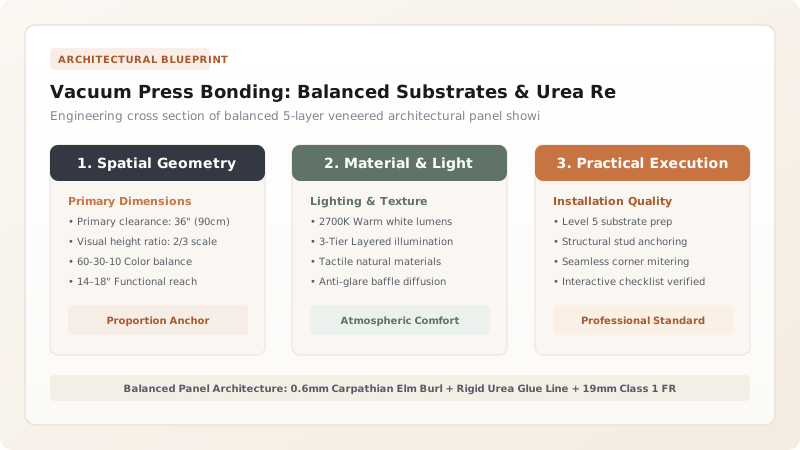
1. Pressure Mechanics: Atmospheric Clamping & Vacuum Press Dynamics
In traditional mechanical screw or hydraulic presses, localized pressure points can crush high spots on wavy burl veneer while leaving low valleys unbonded. A Vacuum Membrane Press eliminates this risk by utilizing the weight of the Earth's atmosphere.
When an industrial rotary vane vacuum pump evacuates air from beneath an airtight polyurethane membrane, atmospheric pressure (\(P_{\text{atm}} \approx 14.7\text{ PSI} / 101.3\text{ kPa}\) at sea level) pushes down uniformly on every square millimeter of the panel. The clamping pressure \(P_{\text{clamp}}\) is calculated from the vacuum gauge reading \(V\) (in inches of Mercury):
At an operating vacuum of \(28\text{ inHg}\), the clamping force equals \(13.75\text{ PSI}\) (approx. \(95\text{ kPa}\) or \(1,980\text{ lbs/sq ft}\)). On a standard \(2.4\text{m} \times 1.2\text{m}\) architectural wall panel, the total distributed clamping load exceeds \(27\text{ metric tons}\), ensuring complete intimate contact between veneer and substrate without crushing wood pore structure. Review overall panel design in the burl paneling hub.

2. Adhesive Chemistry: Urea-Formaldehyde vs Cross-Linking PVA
Wood is a dynamic material that expands and contracts with changes in ambient humidity. If a flexible adhesive is used beneath burl veneer, the high internal stresses of the swirling grain will cause the veneer joints to slide, ridge, or pull apart over time—a defect known as Creep.
Architectural burl paneling mandates Thermosetting Rigid Adhesives:
- Urea-Formaldehyde (UF) Powder Resin: Mixed with water and chemical hardeners, UF resins cure via polycondensation cross-linking. Unlike PVA glues that remain thermoplastic (rubbery), cured UF resin forms a glass-hard, crystalline matrix that is 100% rigid, preventing even microscopic movement of veneer seams.
- Long Open Assembly Time: UF glues provide 20 to 30 minutes of open working time, allowing master woodworkers to carefully position, align, and pin intricate 4-way diamond matches before vacuum pressure is applied.
- Color-Tinted Formulations: The glue powder is tinted with walnut or mahogany pigments to ensure that any microscopic glue line at spliced seams matches the natural wood color. Contrast with shellac finishing in wool fad loading and spirit charging.
3. Structural Symmetry: Balanced 5-Layer Construction
A single-sided veneered panel behaves like a bimetallic thermostat strip: as relative humidity increases, the veneer expands across its grain while the substrate core barely moves, causing the entire panel to dish or bow outward.
To guarantee permanent dimensional flatness, the panel must be engineered with Perfect Cross-Sectional Symmetry:
- Core Selection: High-density, moisture-resistant Class 1 Fire-Rated MDF (density \(750\text{ to } 800\text{ kg/m}^3\)) or calibrated multi-ply Euro-birch plywood.
- Balancing Backer Veneer: The back face must receive a veneer of the identical thickness (0.6mm) and comparable cellular density (e.g., rotary maple or plain-sliced birch). Applying cheap paper or plastic backings will fail.
- Equal Moisture Content: Both face veneer and backer veneer must be conditioned in the same environment to the exact same moisture content (\(8\% \pm 1\%\)) prior to pressing. Master diamond matching in our deep dive on four-way diamond matching.
Veneering Adhesive Technology Comparison
Use this reference table to calculate exact physical dimensions, ratios, and specifications before purchasing:
| Adhesive Type | Urea-Formaldehyde (UF) Resin | Catalyzed Cross-Linking PVA (Type 1) | Standard White/Yellow PVA Glue |
|---|---|---|---|
| Glue Line Rigidity | 100% Glass-Hard Crystalline (Zero Creep) | Semi-Rigid (Low Creep) | Thermoplastic / Rubbery (Severe Creep) |
| Moisture Resistance | High (ANSI/HPVA Type II) | Very High (Waterproof Type I) | Low (softens with humidity) |
| Open Assembly Time | 20 to 35 minutes | 8 to 12 minutes | 5 to 8 minutes (too fast for burls) |
| Risk of Glue Bleed-Through | Low (high solids; thixotropic) | Medium (watery vehicle) | Very High (bleeds through pores) |
| Press Time at 20°C | 4 to 6 hours | 45 to 60 minutes | 30 to 45 minutes |
Vacuum Pressing Hazards & Mechanical Limits
Every successful decoration project must account for physical and environmental constraints:
Trapped Air Pockets in Large Panels
On panels exceeding 2.0 meters in length, the vacuum membrane can seal tightly around the perimeter before air is evacuated from the center, leaving unbonded central bubbles. A grooved breather mesh caul must be laid across the panel to channel air to the vacuum port.
Substrate Telegraphing
High vacuum pressure presses paper-thin 0.6mm veneer into microscopic imperfections on the core. Any coarse grit marks, drywall dust, or particleboard voids on the substrate will 'telegraph' through to the polished burl surface. Substrates must be calibrated and finish-sanded with 180-grit.
Membrane Puncture from Sharp Cauls
Sharp corners on wooden press platens can pierce thick polyurethane vacuum membranes under 14 PSI pressure, causing instant pressure loss during glue curing. All caul edges must be radiused with a 6mm roundover.
Architectural Panel Vacuum Pressing Sequence
Execute this professional sequence to achieve flawless results without backtracking:
Substrate Calibration & Dust Removal
Calibrate 19mm MDF core on wide-belt sander; clean thoroughly with anti-static air blower and tack cloths to remove all debris.
Adhesive Batching & Viscosity Check
Mix urea-formaldehyde powder with water (100:60 weight ratio); add wood-tone pigment; verify creamy spreadable consistency.
Precision Mechanical Glue Spreading
Apply adhesive to both faces of substrate using ribbed rubber roller at 120 g/m²; verify even wet film thickness with glue comb.
Veneer Staging & Blue Tape Registration
Lay balancing backer on rear; position spliced 4-way burl face on front; anchor corners with low-tack registration tape to prevent slippage.
Breather Caul Insertion & Bag Loading
Enclose sandwich between smooth melamine platen cauls; lay breathable polyester mesh over assembly; slide into heavy polyurethane vacuum envelope.
Vacuum Evacuation & Press Cycle
Engage rotary vane pump; draw 28 inHg vacuum within 90 seconds; smooth out wrinkles; hold under full vacuum for 5 hours until resin polymerizes.
Common Mistakes & Countermeasures
Avoid these costly errors that compromise aesthetics, ergonomics, and budget:
Using Contact Cement for Architectural Burl Paneling
Removing the Panel from the Press Too Early
Applying Uneven Glue Spread
Project Execution Checklist
Track your physical progress. Checkboxes persist automatically on this device:
Frequently Asked Questions
Can you press curved architectural panels in a vacuum press?
Yes! This is one of the greatest advantages of a vacuum press. By placing a rigid curved MDF form inside the vacuum bag and laying flexible bending plywood and burl veneer over it, the atmospheric membrane wraps 360 degrees around the curve, pressing the veneer with uniform 14 PSI force across complex concave or convex radii without expensive matched male/female steel dies.
What is the difference between a polyurethane bag and a vinyl bag?
Vinyl bags (typically 20 to 30 mil thick) are economical but become stiff in cold weather, tear easily on sharp caul corners, and degrade from glue off-gassing. Polyurethane membranes (30 to 50 mil) offer extraordinary puncture resistance, 400% elastic elongation, and remain completely supple and pliable for decades of daily industrial shop use.
How do you detect hidden unbonded hollow spots beneath the veneer?
After pressing, glide your fingernails or a small brass tapping hammer lightly across the entire veneered surface. A solid bond produces a crisp, sharp click, while an unbonded void or blister produces a distinctly hollow, papery thud. Minor blisters can be repaired by injecting thin epoxy through a micro-hypodermic needle and clamping.


