
Wool fad loading and pumice pore filling form the foundational mechanical craft of French polishing. A teardrop-shaped pad ('tampon') is constructed from unspun wool wrapped in tightly stretched unbleached linen. Charged internally with a 1-lb or 2-lb cut shellac, it is tapped against fine FFF Italian volcanic pumice on ring-porous woods (mahogany, walnut), creating a micro-abrasive slurry that grinds wood fibers flat into the vascular pores to build a flawless glass-smooth foundation.
At a Glance: Key Takeaways
- Unspun Wool Elasticity: Raw carded sheep's wool providing natural springiness, holding 50ml of liquid without dripping.
- Wrinkle-Free Linen Sole: High-thread-count washed linen skin drawn tightly over the wool core to prevent surface scratching.
- Sub-Surface Spirit Injection: Opening the linen flap and dosing shellac directly onto the wool core—never pouring onto the exterior sole.
- FFF Italian Volcanic Pumice: Sub-micron calcined pumice acting as a cutting abrasive to pack wood fibers into open grain vessels.
- Circular Swirling Friction: Continuous interlocking figure-eight and circular orbits distributing slurry evenly across the panel.
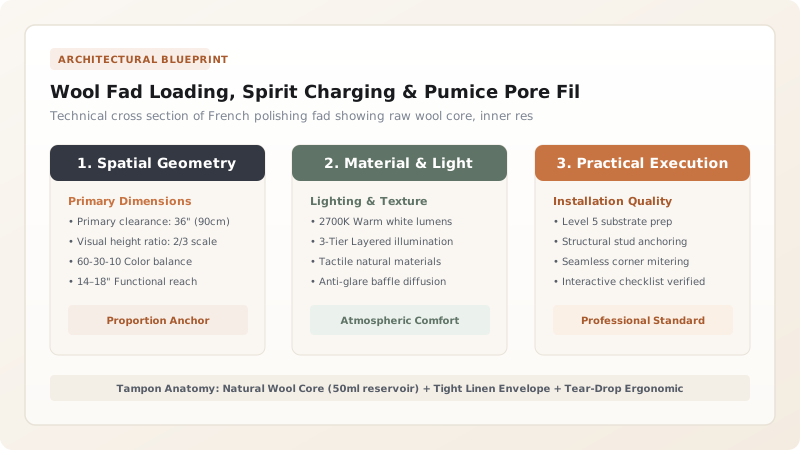
1. Tool Geometry: Anatomical Fabrication of the Wool Fad
The Fad (known in French as le tampon) is the heart of the polisher's craft. Commercial foam pads or rags fail because they lack hydraulic regulation. A proper fad consists of two distinct components:
- The Heart (Core): A fist-sized wad of raw, carded unspun sheep's wool or surgical cotton wool. Wool is superior because its natural scales and high keratin elasticity act as a pressurized fluid reservoir, releasing shellac steadily only when compressed.
- The Skin (Linen Envelope): A \(250\text{ mm} \times 250\text{ mm}\) square of washed, lint-free unbleached linen or high-thread-count handkerchief cotton. Linen is preferred over cotton because linen fibers are long and strong, resisting fraying under heavy friction.
- The Grip & Sole: The corners of the linen are pulled upward, twisted, and held tightly in the palm of the hand. The bottom contact face (sole) must be completely flat and smooth, with zero wrinkles, folds, or loose threads that would score the wet shellac film. Explore dissolution chemistry in our guide to shellac dissolution and alcohol ratios.

2. Fluid Dynamics: Internal Charging vs External Flooding
A fatal mistake in French polishing is pouring shellac directly onto the working face of the fad. This floods the linen, creating wet puddles that dissolve underlying coats.
The correct method is Internal Core Charging:
- Unfold the linen wrapper and expose the wool core.
- Using a glass squeeze bottle, pour \(15\text{ to } 20\text{ ml}\) of 2-lb cut shellac directly into the center of the wool.
- Fold the linen back over the core, grip the twisted tail, and tap the fad firmly against the back of your hand or a clean scrap board.
- This hydraulic tap forces shellac outward through the linen weave. The sole should feel cool and damp to the touch, leaving a faint wet vapor trail when pressed against paper, but never dripping liquid drops. Master cloud clearing in our deep dive on spiriting-off and cloud elimination.
3. Surface Leveling: Volcanic Pumice Slurry & Pore Packing
Hardwoods like Honduran mahogany, rosewood, and black walnut have deep open vascular pore canals (diameter \(100\text{ to } 250\, \mu\text{m}\)). If coated with shellac directly, the finish sinks into these depressions, leaving an uneven 'orange peel' texture.
To achieve a mirror finish, pores are filled using FFF Grade Italian Volcanic Pumice (pure amorphous aluminum silicate):
- The polisher dusts the raw wood lightly with pumice through a cloth pounce bag.
- A fad charged with pure ethanol (no shellac) is worked firmly across the surface in small circular orbits.
- The sharp microscopic pumice shards shear off microscopic wood cellulose fibers. The combination of pulverized wood dust, transparent pumice, and alcohol forms an abrasive slurry paste that is packed into the open pores.
- Because volcanic pumice has an optical refractive index virtually identical to cured shellac, the pumice turns completely transparent once dry, sealing pores invisibly without the muddy discoloration caused by commercial chemical paste fillers. Compare with veneer craftsmanship in bookmatched burl paneling.
Wood Pore Filling Method Comparison
Use this reference table to calculate exact physical dimensions, ratios, and specifications before purchasing:
| Pore Filling Technique | Traditional Volcanic Pumice Slurry | Oil-Based Chemical Paste Wood Filler | Multiple Thick Lacquer Spray Passes |
|---|---|---|---|
| Optical Transparency | 100% transparent (refractive index matched) | Opaque / muddy (obscures wood grain) | Glassy but lacks cellular 3D depth |
| Color Matching | Self-matching (uses wood's own sanded fibers) | Requires chemical pigment tint matching | Clear plastic look |
| Shrinkage & Creep Over Time | Zero shrinkage (mineral rock particles) | High shrinkage (solvent/oil evaporates) | Severe shrinkage into pores over 12 months |
| Reversibility | 100% reversible with alcohol | Difficult to remove once hardened | Requires chemical stripping |
| Labor Effort | High (demands physical hand rubbing) | Low to Medium (trowel on, wipe off) | Low (automated spray booth) |
Pad Craft & Pore Filling Hazards
Every successful decoration project must account for physical and environmental constraints:
Excessive Pumice Building Surface Haze
Using too much pumice creates a gritty grey buildup across the surface of the wood that clouds the grain. Pumice must be used sparingly—barely a ghost-like dusting—and completely worked into pores until the surface is wiped clean.
Dry Fad Drag Scratches
When the wool core runs out of alcohol, the dry linen skin drags across the tacky shellac, tearing the film and leaving gouged canvas weave marks. The polisher must monitor the vapor trail and re-charge the core before dryness occurs.
Linen Lint Contamination
New unwashed linen sheds microscopic fibers that become embedded in the wet shellac, creating thousands of white specks. Linen must be pre-boiled, laundered three times, and ironed before use.
Pumice Pore Filling Execution Procedure
Execute this professional sequence to achieve flawless results without backtracking:
Linen & Wool Tampon Assembly
Form a tennis-ball-sized wad of carded sheep's wool into an egg shape; place in center of 250mm linen square; draw corners taut and twist into comfortable palm grip.
Pounce Bag Pumice Dusting
Fill a cotton pounce bag with Grade FFF volcanic pumice; tap lightly over wood surface to deposit a faint, barely visible dusting of mineral powder.
Spirit Charging of Wool Core
Open linen; inject 15ml of 99.5% anhydrous ethanol into wool; close linen and tap against scrap wood until sole is damp.
Circular Slurry Rubbing
Rub in tight circular and figure-eight patterns with moderate downward pressure, creating a creamy paste of pumice and wood dust that shears into pores.
Cross-Grain Grain Shearing
Work pad perpendicular across the wood grain to pack pores tightly; gradually increase speed and lighten pressure as the alcohol evaporates.
Clean-Off & Surface Inspection
Skin pad with clean linen; make brisk straight-line passes to wipe all residual pumice off the wood surface; inspect under glancing raking light to verify pores are 100% level.
Common Mistakes & Countermeasures
Avoid these costly errors that compromise aesthetics, ergonomics, and budget:
Pouring Shellac or Alcohol Directly on the Workpiece
Using Coarse Building-Grade Pumice
Failing to Keep the Fad in Motion
Project Execution Checklist
Track your physical progress. Checkboxes persist automatically on this device:
Frequently Asked Questions
How long does it take to fill the pores on a dining table?
For a standard 8-foot mahogany or walnut dining table, thorough pore filling with pumice takes approximately 3 to 5 hours of continuous, concentrated hand rubbing, often divided into two separate sessions with an overnight drying interval between passes.
Can you use pumice on closed-pore woods like maple or cherry?
No. Diffuse-porous hardwoods like hard maple, cherry, and birch have microscopic pores that do not require grain filling. On these woods, pumice is omitted entirely, and the polisher proceeds directly to the bodying-up stage with a shellac-charged fad.
How do you store a fad between polishing sessions?
Because shellac dries by solvent evaporation, a loaded fad can be stored indefinitely in an airtight glass jar with a rubber gasket. When you are ready to resume polishing, simply remove the fad from the jar, inject 5ml of alcohol into the wool core, and it is ready to use within 30 seconds.


