
French polishing is a traditional 18th-century wood finishing technique that builds a mirror-like high-gloss finish through the progressive hand application of button shellac dissolved in denatured alcohol using a linen-wrapped wool pad ('fad' or 'tampon'). Rather than spraying a single thick synthetic coat, the polisher builds hundreds of microscopically thin shellac layers, filling wood pores with pumice powder, lubricating the pad with raw linseed oil, and 'spiriting off' residual oil with pure alcohol to create an optically transparent, three-dimensional chatoyance.
At a Glance: Key Takeaways
- Natural Resinous Origin: Secretion of the Kerria lacca insect refined into pure, de-waxed button shellac flakes containing natural polyhydroxy aliphatic acids.
- Two-Pound Cut Standard: 2 lbs of shellac dissolved per 1 gallon of 99.9% pure anhydrous ethanol (240g per 1 Liter) providing optimal film-building viscosity.
- Pumice Pore Filling: Micro-abrasive FFF Italian volcanic pumice slurry grinding wood fibers into pores to create a perfectly flat glass-like substrate.
- Raw Linseed Oil Lubrication: Micro-drops of pure flaxseed oil preventing the friction pad from grabbing or dragging across sticky drying shellac.
- Spiriting Off Stage: Progressive alcohol-only friction passes eliminating residual surface lubricating oil to reveal optical depth and chatoyance.
In-Depth Guides in this Directory
Explore specialized subtopic blueprints, technical dimensions, and execution checklists:
Shellac Flake Dissolution: Pound-Cuts & Alcohol Purity
Finishing chemistry guide for shellac dissolution: pound-cut weight ratios, anhydrous ethanol purity standards, mechanical agitation methods, and shelf-life esterification kinetics.
Wool Fad Loading, Spirit Charging & Pumice Pore Filling
Craft guide for French polishing fads: wool core construction, linen wrapping tension, spirit charging mechanics, and FFF volcanic pumice pore filling slurry techniques.
Spiriting-Off Shellac: Cloud Elimination & Micro-Friction
Master finishing guide for spiriting off French polish: eliminating lubricating oil bloom, high-speed micro-friction kinematics, 0.5-lb cut spirits, and mirror-gloss chatoyance.
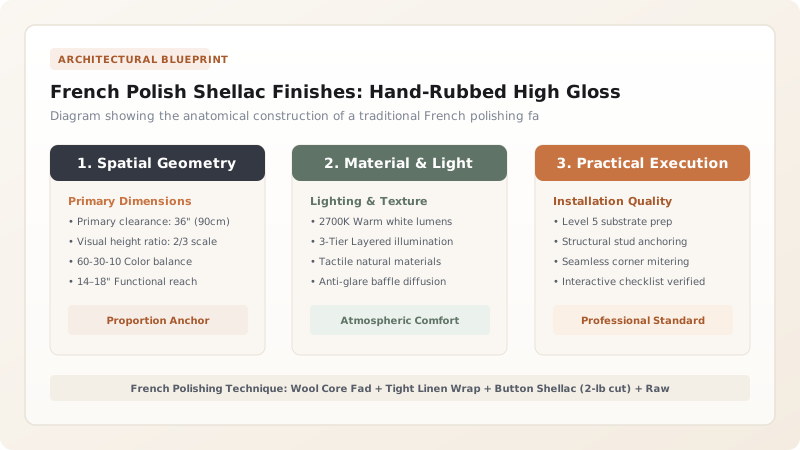
1. Optical Physics & Chemistry: Refractive Index & Chatoyance
Modern polyurethane and conversion varnishes form a plastic film over the wood surface with a refractive index of \(n \approx 1.45\). This synthetic film scatters light at the surface, muting the figure and creating an artificial 'cased-in-plastic' look.
In contrast, natural de-waxed shellac possesses a refractive index of \(n = 1.52\text{ to } 1.54\)—virtually identical to the optical refractive index of dry cellulose and lignin wood fibers (\(n = 1.53\)). Light penetrating the shellac does not reflect off an artificial barrier; instead, it travels into the crystalline cell walls of curly maple, crotch mahogany, or walnut burl, creating the mesmerizing optical phenomenon known as Chatoyance (The Cat's Eye Effect).
The chemical composition of shellac is a complex polyester network of inter-esterified aliphatic hydroxy acids (primarily aleuritic acid and shelolic acid). Dissolving these natural resins in 200-proof anhydrous ethanol yields a reversible, perfectly repairable finish that never yellows or turns brittle with age. Explore flake dissolution formulas in our guide to shellac dissolution and alcohol purity.

2. Tool Craft & Pore Filling: The Wool Fad & Volcanic Pumice Slurry
French polishing uses no brushes or spray guns. The entire finish is applied using a Fad (or Tampon):
- Internal Wool Core: Unspun raw sheep's wool or surgical cotton acts as an internal reservoir holding up to 50ml of shellac solution. Wool is preferred for its natural spring elasticity and progressive fluid release.
- Outer Linen Envelope: Tightly woven, lint-free unbleached linen or washed handkerchief cotton wrapped tautly around the core with no wrinkles on the bottom sole.
- Pore Filling with Volcanic Pumice: Ring-porous hardwoods (walnut, mahogany, oak) possess open vascular vessels that must be leveled flat. The polisher sprinkles finely ground Grade FFF or FFFF Italian Pumice onto the wood, charges the pad with pure alcohol, and rubs in circular motions. The pumice acts as an abrasive, grinding wood cell fibers into a micro-paste that packs deep into pores, sealing them invisibly without cloudy wood filler pastes. Detailed pad craft in wool fad loading and pumice filling.
3. The Culmination: Spiriting-Off, Oil Clearing & Mirror Friction
During the heavy 'bodying-up' phase, the polisher adds micro-drops of Raw Linseed Oil to the sole of the fad to reduce friction. Without oil, the alcohol in the pad would soften underlying coats, causing the pad to stick, tear, and gouge the film.
However, this lubricating oil rises to the surface, creating an oily grey haze (known as 'bloom' or 'cloud'). The final and most delicate stage of French polishing is Spiriting Off:
- The polisher takes a freshly skinned fad charged exclusively with 99.9% pure ethanol, squeezed nearly dry (damp to the touch, not wet).
- Moving in swift, continuous straight-line strokes with the wood grain, the polisher applies light, fast pressure. The alcohol lifts and absorbs the micro-droplets of oil off the shellac surface, evaporating instantly into the room air.
- The result is a hard, dry, mirror-like gloss with 100% optical transparency and zero cloudiness. Master the friction dynamics in our deep dive on spiriting-off and cloud elimination. Compare with veneer pressing in our guide to bookmatched burl paneling.
Architectural Wood Finishing Technology Comparison
Use this reference table to calculate exact physical dimensions, ratios, and specifications before purchasing:
| Finishing Medium | Traditional French Polish Shellac | Conversion Varnish (Acid-Cure) | Waterborne Polyurethane |
|---|---|---|---|
| Refractive Index (n) | 1.52 - 1.54 (identical to wood fibers) | 1.44 - 1.47 (synthetic barrier) | 1.42 - 1.45 (plastic appearance) |
| Chatoyance & Optical Depth | Unmatched 3D depth and warmth | Flat, glassy surface reflection | Dull, cool milky undertone |
| Reversibility & Repairability | 100% reversible with alcohol anytime | Irreversible (requires toxic chemical stripping) | Irreversible (requires heavy sanding) |
| Application Method | Hand-rubbed wool pad (no overspray) | High-pressure toxic spray booth | Brush, roller, or HVLP spray |
| VOC Off-Gassing | Non-toxic (pure ethanol vapor) | Severe (releases toxic formaldehyde) | Low VOC (glycol ethers) |
| Heat & Water Resistance | Moderate (sensitive to alcohol/hot cups) | Very High (industrial kitchen grade) | High (resists domestic water spills) |
Environmental & Chemical Finishing Constraints
Every successful decoration project must account for physical and environmental constraints:
High Ambient Humidity ('Blushing' Hazard)
Applying French polish in relative humidity exceeding 65% causes rapid ethanol evaporative cooling, which chills the surface below the dew point. Water vapor condenses into the wet shellac, forming permanent milky white haze ('blushing'). Polishing must occur in conditioned 45%–55% RH.
Alcohol Purity & Denaturants
Using commercial hardware store denatured alcohol containing high percentages of methanol or water ruins shellac. Water slows evaporation and causes blushing, while methanol poses extreme neurotoxic health hazards. Exclusively use 99.9% anhydrous ethanol denatured with isopropanol.
Stopping the Pad in Contact with Wood
Allowing the pad to come to a stationary rest while touching the wood instantly creates a 'burn mark' where concentrated alcohol dissolves through all underlying shellac layers down to bare wood in 2 seconds. The pad must land and take off like an airplane on an active runway.
Traditional French Polishing Execution Sequence
Execute this professional sequence to achieve flawless results without backtracking:
Substrate Sanding & Surface De-Whiskering
Progressively dry-sand timber from 150 to 320-grit; raise grain with damp distilled water sponge; allow to dry and de-whisker with 400-grit paper.
Button Shellac Dissolution & Cut Filtration
Dissolve de-waxed blonde or garnet button shellac flakes in 99.9% pure ethanol to a 2-lb cut (240g/L); strain through fine cheesecloth into dispenser bottles.
Pumice Pore Filling & Slurry Grinding
Sprinkle Grade FFF Italian pumice across wood; charge linen fad with pure alcohol; rub in firm circular swirls to grind wood fiber slurry deep into open pores.
Bodying Up Shellac Layers
Charge wool fad core with 2-lb cut shellac; add one drop of raw linseed oil to the sole; apply continuous figure-eight and circular strokes, building 20 to 30 micro-passes per session.
Interstage Curing & Light Flatting
Allow finish to cure for 24 hours between bodying sessions; lightly flat with 1000-grit silicon carbide paper lubricated with mineral spirits to remove dust nibs.
Spiriting Off & Oil Evaporation
Wrap fad with clean linen; charge with pure ethanol; apply light, high-speed straight strokes with the grain to clear surface oil and bring finish to crystalline mirror gloss.
Common Mistakes & Countermeasures
Avoid these costly errors that compromise aesthetics, ergonomics, and budget:
Using Waxy Button Shellac for Base Coats
Using Too Much Lubricating Oil
Applying Shellac Directly with a Brush
Project Execution Checklist
Track your physical progress. Checkboxes persist automatically on this device:
Frequently Asked Questions
Can you put hot coffee cups or alcohol glasses on a French polished table?
No. Shellac is an organic natural resin that softens around 65°C–70°C and dissolves instantly in alcohol. Hot cups will leave white heat rings, and spilled bourbon or perfume will dissolve the finish down to bare timber. French polished furniture should always be protected with felt-backed coasters and placemats.
How long does a French polish finish last?
When cared for properly, a French polish finish can last over 200 years. Unlike modern synthetic varnishes that eventually turn cloudy, yellow, and delaminate (requiring complete chemical stripping and aggressive sanding), shellac can be refreshed and rejuvenated at any time simply by 'spiriting over' the existing finish with a fresh shellac fad.
What is the difference between blonde, garnet, and button shellac?
The colors reflect natural processing and filtration. Garnet and button shellac are minimally refined, retaining rich ruby, amber, and deep molasses tones that impart antique golden warmth to dark woods like mahogany and walnut. Super Blonde and Platinum shellac have been chemically de-colorized, creating a crystal-clear, water-white film ideal for curly maple, burl ash, and light woods.


