
Bookmatched burl wood architectural paneling is a master joinery wall cladding system created from sequential leaves of rare burl veneers (such as Carpathian elm, California walnut, or madrone burl). Because burls feature chaotic swirling grain with extreme internal tension, leaves are flattened with chemical plasticizers, spliced with perforated veneer tape, bonded in high-tonnage vacuum presses (1,800 lbs/sq ft) using rigid thermosetting urea resins to balanced MDF or multi-ply substrates, and hung using concealed aluminum Z-clips to create seamless symmetrical murals.
At a Glance: Key Takeaways
- Natural Burl Genesis: Abnormal swirling tree outgrowths yielding rare, wild eye cluster patterns and iridescent chatoyance.
- Chemical Flitch Plasticizing: Alcohol, glycerin, and water conditioning solutions relaxing brittle dry burl leaves flat without shattering.
- Four-Way Diamond Symmetry: Precision guillotine trimming and taped veneer splicing aligning leaf centroids into monumental 4-way kaleidoscopic patterns.
- Rigid Thermoset Adhesive Bonding: Urea-formaldehyde or cross-linking PVA adhesives providing rock-hard glue lines that eliminate veneer creep.
- Balanced Substrate Architecture: Equal-species and equal-thickness backer veneers pressed to panel rears to prevent seasonal cupping and warping.
In-Depth Guides in this Directory
Explore specialized subtopic blueprints, technical dimensions, and execution checklists:
Burl Flitch Flattening & Perforated Tape Splicing
Veneer engineering guide for burl wood: glycerin plasticizing formulations, heated platen caul pressing, joint edge shooting, and perforated paper tape splicing.
Vacuum Press Bonding: Balanced Substrates & Urea Resins
Architectural veneering guide for vacuum pressing: polyurethane membrane table mechanics, rigid urea-formaldehyde resin chemistry, balanced core engineering, and glue spread rates.
Four-Way Diamond Matching: Burl Grain Alignment & Centering
Veneer geometric layout guide for four-way diamond matching: flitch sequence indexing, optical crosshair alignment, radial eye centroid symmetry, and miter edge shooting.
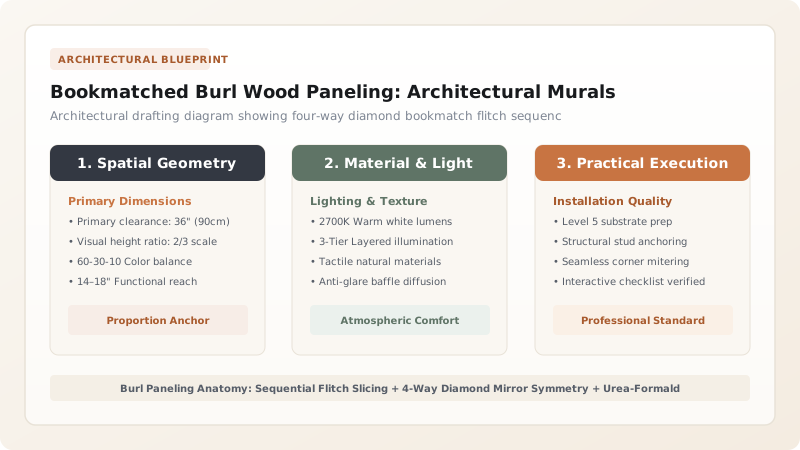
1. Botanical Genesis & Figure Physics: The Chaos of the Burl
Unlike straight-grained trunk timber where wood fibers run parallel to the tree axis, a Burl (or Burr) is an abnormal, cancerous-like hemispherical growth on the trunk or root crown caused by viral, fungal, or insect disruption of the vascular cambium.
Within a burl, millions of dormant adventitious bud clusters and contorted xylem vessels grow in tight, swirling eddies. When sliced into paper-thin architectural veneers (\(0.6\text{ mm}\) thickness):
- End-Grain & Tangential Grain Mosaics: Slicing through a burl exposes both transverse end-grain pore openings and tangential longitudinal cells within millimeters of each other. This creates radical differential absorption of light and finishing oils, producing dazzling 3-dimensional optical depth.
- Internal Residual Stress: Because burl cells grow in chaotic directions without uniform longitudinal orientation, drying causes severe differential shrinkage, making raw burl leaves buckle into brittle, wavy 'potato chips' with internal stress:
Flattening these brittle sheets requires chemical conditioning before pressing. Master the chemistry in our guide to burl flitch flattening and splicing.

2. Substrate Mechanics: Balanced Assemblies & Vacuum Pressing
A classic woodworking disaster is veneering only the front face of a wall panel. Wood veneer constantly pulls moisture in from the air; without an equal counter-pull on the rear, the panel curls into a bow within days.
Architectural burl panels adhere to the Strict Balanced Construction Principle:
- Substrate Core: Engineered Class 1 Fire-Rated Medium Density Fiberboard (MDF) or multi-ply Euro-birch plywood (19mm thickness) offering isotropic dimensional stability.
- Equalized Backer Veneer: The back of the panel is pressed with an identical thickness and species-density veneer leaf simultaneously with the decorative face.
- Atmospheric Vacuum Pressing: The sandwich is loaded into a heavy polyurethane vacuum membrane table. Evacuating air to \(27\text{ to } 29\text{ inches of Mercury (inHg)}\) applies uniform atmospheric pressure of \(13.5\text{ to } 14.2\text{ PSI}\) (approx. \(95\text{ to } 100\text{ kPa}\)) across every square centimeter, ensuring 100% glue contact across wavy burl contours. Learn press engineering in vacuum press membrane bonding.
3. Symmetrical Geometry: Bookmatching, Diamond Matching & Z-Clips
Sequential leaves sliced from the same burl log (a 'flitch') are turned like pages in a book to create mirror reflections:
- Two-Way Bookmatching: Two adjacent leaves opened side-by-side create symmetrical cathedral arches or butterfly wings.
- Four-Way Diamond Matching: Four consecutive leaves are cut into triangles or quadrants and joined at a central focal crosshair, creating an explosive diamond medallion pattern. Detailed alignment protocols in four-way diamond matching.
- Concealed Aluminum French Cleats (Z-Clips): Panels are hung onto perimeter wall studs using interlocking continuous extruded aluminum Z-clips. This allows the panels to float 6mm off the wall, permitting air circulation behind the panel while concealing all mechanical fasteners. Contrast with French polish finishes in our guide to French polish finishes.
Architectural Burl Veneer Species Comparison
Use this reference table to calculate exact physical dimensions, ratios, and specifications before purchasing:
| Burl Species | Carpathian Elm Burl | American Walnut Burl | Amboyna / Redwood Burl |
|---|---|---|---|
| Geographic Provenance | Central & Eastern Europe | North America (California/Midwest) | Southeast Asia / Pacific Northwest |
| Natural Color Tone | Golden honey to reddish-cognac | Rich dark chocolate, violet swirls | Deep burnt orange to crimson red |
| Eye Cluster Density | Extremely dense, tight clusters | Loose swirls with open crotch figure | Microscopic pinpoint bird's-eye clusters |
| Brittleness & Buckling | Very High (requires heavy plasticizing) | Moderate to High | Extreme (highly friable; requires mesh backing) |
| Chatoyance Under Finish | Sensational golden 3D radiance | Warm, dignified depth | Vibrant, electric iridescent flash |
Fabrication & Environmental Burl Constraints
Every successful decoration project must account for physical and environmental constraints:
Adhesive Glue Bleed-Through
Because burl veneer contains open end-grain pores, standard watery PVA glue will bleed straight through to the decorative face under press pressure. Bleed-through seals the wood, preventing stain and finish penetration and leaving permanent white blotches. Highly viscous urea-formaldehyde glue with chalk extenders must be used.
Differential Ambient Humidity Warping
If a large wall panel (e.g., 2.8m x 1.2m) is installed in a building without active HVAC climate control, the face veneer absorbs room moisture while the unventilated back stays dry, causing severe panel cupping. Continuous aluminum Z-clip standoffs with perimeter airflow slots are mandatory.
Veneer Flitch Shattering During Cutting
Attempting to slice brittle, unconditioned burl veneer with a utility knife or table saw shatters the delicate edges into jagged shards. Veneers must be chemically plasticized and clamped firmly between hardwood cauls before cutting with veneer saws.
Architectural Burl Wall Panel Fabrication Workflow
Execute this professional sequence to achieve flawless results without backtracking:
Flitch Selection & Grain Reading
Inspect sequential flitch leaves on light table; number each leaf sequentially; select dominant eye clusters for diamond alignment.
Chemical Plasticizing & Caul Pressing
Spray leaves with softening solution (water, alcohol, glycerin); sandwich between Kraft paper and heavy MDF cauls under weights for 48 hours until glass-flat.
Precision Rotary Trimming & Splicing
Clamp four flattened leaves between aluminum straightedges; trim true square edges using precision veneer saw; pull joints tight using perforated paper veneer tape.
Substrate & Glue Spread Calibration
Roll rigid urea-formaldehyde resin (tinted to match wood tone) onto 19mm MDF substrate core using notched glue spreader at 120 g/m² spread rate.
Vacuum Membrane Pressing
Lay balanced backer veneer on bottom, core in middle, and spliced burl face on top; draw 28 inHg vacuum in heavy vinyl press bag; cure for 6 hours under pressure.
Tape Removal, Sanding & Z-Clip Mounting
Lightly moisten paper tape to scrape off; hand-sand with 220-grit on hard felt block; route rear recesses and bolt extruded aluminum Z-clips for wall hanging.
Common Mistakes & Countermeasures
Avoid these costly errors that compromise aesthetics, ergonomics, and budget:
Using Yellow PVA Carpenter's Glue for Burl
Omitting a Balanced Backer Veneer
Sanding with Soft Sponge Blocks
Project Execution Checklist
Track your physical progress. Checkboxes persist automatically on this device:
Frequently Asked Questions
Why is burl wood so expensive compared to normal lumber?
Burls are rare natural anomalies occurring in fewer than 1 in 10,000 mature trees. Harvesting them without destroying the log requires immense labor, and slicing thin veneers yields fragile, wavy sheets with significant waste (up to 40% loss during flattening and square trimming). Only master craftsmen have the tooling and skills to flatten and press them successfully.
What is the difference between bookmatching and slipmatching?
In bookmatching, alternating leaves are flipped over like the pages of a book, creating mirror-image symmetrical patterns. In slipmatching, consecutive leaves are simply slid side-by-side without flipping. Straight-grained wood can be slipmatched, but burl wood is almost always bookmatched or four-way diamond matched to showcase dramatic mirror symmetry.
Can burl wood panels be installed in humid climates?
Yes, provided the panels are engineered with balanced construction on moisture-resistant MDF (MR-MDF) cores, sealed with waterproof epoxy or polyurethane on all 6 sides (including edges and back), and mounted with ventilated standoffs in climate-controlled interiors.


