
Four-way diamond matching is an advanced architectural veneering layout technique where four consecutive, sequential leaves sliced from the same burl log flitch are arranged into a double-mirrored quadrant. By flipping two leaves across the horizontal axis and two across the vertical axis with their central grain features converging at a common focal point, the chaotic natural burl eyes form an explosive, perfectly balanced geometric diamond medallion.
At a Glance: Key Takeaways
- Four-Leaf Flitch Sequence: Selecting four consecutive veneer leaves (numbered 1, 2, 3, 4) sliced within 2.5mm of log depth.
- Dual-Axis Mirror Symmetry: Symmetrical reflection across both X (horizontal) and Y (vertical) centerlines.
- Light-Table Crosshair Alignment: Backlit glass registration mapping identical growth ring landmarks to within 0.25mm tolerance.
- Radial Miter Joint Cutting: 45-degree diamond cuts or 90-degree quadrant cuts executed with precision clamping cauls.
- Kaleidoscopic Optical Effect: Transforming irregular organic swirling burls into mesmerizing classical architectural centerpieces.
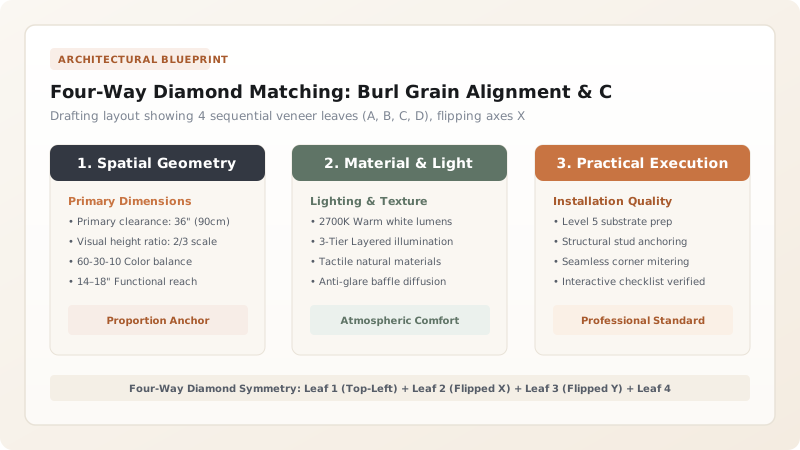
1. Symmetrical Geometry: Flitch Slicing & Quadrant Transformations
In standard two-way bookmatching, adjacent leaves are flipped across a single axis (\(y = -x\)). A Four-Way Diamond Match (also called a 'Reverse Diamond' or 'Box Match') expands symmetry across two perpendicular Cartesian axes:
Let four sequential leaves sliced from a burl log flitch be designated \(L_1, L_2, L_3, L_4\). Because commercial veneer slicing takes cuts of \(0.6\text{ mm}\) thickness, the anatomical cell structures across four leaves differ by less than \(2.4\text{ mm}\) of log depth, preserving nearly identical eye cluster contours.
The geometric quadrant mapping is arranged as:
- Quadrant I (Top Right): Leaf \(L_1\) (Face Up, Original Orientation).
- Quadrant II (Top Left): Leaf \(L_2\) (Flipped horizontally across Y-axis).
- Quadrant III (Bottom Left): Leaf \(L_3\) (Flipped horizontally and vertically across X & Y axes).
- Quadrant IV (Bottom Right): Leaf \(L_4\) (Flipped vertically across X-axis).
When joined at the common origin point \((0,0)\), the radiating grain lines explode outward like a kaleidoscopic mandala. Explore raw flitch conditioning in our guide to burl flitch flattening and splicing.

2. Layout Protocol: Light-Table Alignment & Grain Centering
The artistic impact of a four-way diamond match depends on selecting the ideal Focal Centroid:
- Backlit Glass Inspection: The four leaves are inspected on a full-size drafting light table. The woodworker identifies a prominent visual feature—such as a dense cluster of tight burl eyes or a swirling flame vortex.
- Mylar Crosshair Overlay: A transparent Mylar sheet with printed 90-degree crosshairs and 45-degree diagonal diamond guidelines is placed over the master leaf. The crosshair intersection is pinned directly onto the focal feature.
- Pin-Prick Indexing: Using a micro-fine drafting needle (0.3mm), the woodworker pricks a tiny registration hole through the identical visual landmark in all four leaves. When assembling the quadrants, sliding a sewing needle through these four pinpricks guarantees 100% mathematical alignment of the converging seams. Learn press cycles in vacuum press membrane bonding.
3. Precision Cutting: 90-Degree Quadrant Miters & Taping Sequence
If the cut edges deviate from true 90 degrees by even \(0.2^\circ\), the cumulative angular error across four quadrants will produce a gaping pie-shaped void (\(\Delta \theta = 0.8^\circ\)) at the fourth joint.
- Stacked Package Clamping: All four leaves are stacked in exact registered alignment between two 19mm phenolic-faced plywood clamping cauls.
- Guillotine / Precision Track Saw Cut: Both perpendicular intersecting edges (the X and Y cut lines) are cut simultaneously through the entire 4-leaf stack in a single pass using a festool track saw with a fine 48-tooth crosscut blade or a heavy veneer guillotine. Because all four leaves are cut simultaneously, any microscopic deviation in angle is identical across all four pieces, canceling out angular errors.
- Sequential Butterfly Taping: The leaves are assembled in pairs: Leaf 1 is taped to Leaf 2 along the vertical axis; Leaf 4 is taped to Leaf 3. Finally, the two half-panels are folded together, the long horizontal seam is taped, and the central crosshair is locked with cross-taped perforated veneer tape. Connect to master paneling in the burl paneling hub.
Veneer Architectural Matching Format Comparison
Use this reference table to calculate exact physical dimensions, ratios, and specifications before purchasing:
| Matching Pattern | Two-Way Bookmatch | Four-Way Diamond Match | Eight-Way Sunburst Match |
|---|---|---|---|
| Flitch Leaves Required | 2 consecutive leaves | 4 consecutive leaves | 8 to 16 consecutive leaves |
| Visual Dynamic | Bilateral symmetry (butterfly wings) | Radial kaleidoscope diamond medallion | Circular radiating starburst mandala |
| Layout Complexity | Moderate (single centerline joint) | Very High (dual-axis center crosshair) | Extreme (multiple compound wedge miters) |
| Flitch Thickness Budget | 1.2mm log depth consumed | 2.4mm log depth consumed | 5.0mm to 10mm log depth consumed |
| Typical Architectural Use | Cabinet doors, passage doors | Feature boardroom walls, dining tables | Round conference tables, grand rotunda ceilings |
Geometric & Aesthetic Layout Constraints
Every successful decoration project must account for physical and environmental constraints:
Tight-Side vs Loose-Side Refraction Differences
When veneer is sliced from a log, the side facing the knife experiences micro-fractures ('loose side'), while the opposite side remains smooth ('tight side'). In bookmatching, every alternating leaf exposes the loose side. Staining will penetrate more deeply on the loose side, creating subtle 'barber-poling' color shading unless sealed with a wash-coat of shellac first.
Runout of Burl Eyes Across Thick Flitches
If the veneer leaves are not truly sequential (e.g., if a leaf was damaged or discarded by the mill), the burl eye patterns will not match at the center crosshair, destroying the illusion of seamless kaleidoscopic symmetry.
Center Crosshair Overlap Puckering
Where four pieces of veneer tape converge at the central crosshair, the built-up thickness of multiple tape layers can emboss an indentation into the wood under 14 PSI vacuum press pressure. The tape must be trimmed into a star with zero overlapping tape layers at the exact center.
Four-Way Diamond Match Execution Sequence
Execute this professional sequence to achieve flawless results without backtracking:
Sequential Leaf Numbering & Inspection
Number four consecutive flattened burl leaves 1, 2, 3, 4 with chalk on their edges; inspect on light table to locate dominant eye cluster centroid.
Needle Pin-Prick Landmark Registration
Push a 0.3mm drafting needle through the identical focal burl eye on all four leaves; mark back sides with pencil circles around pin holes.
Stacked Package Caul Clamping
Stack all four leaves with pinpricks aligned on reference pin; clamp stack firmly between thick phenolic clamping cauls along the layout cut line.
Perpendicular Crosscut & Edge Shooting
Trim both perpendicular edges of the stack in single passes using guide rail saw; shoot edges with jointer plane to achieve 100% light-tight seams.
Pair Splicing & Centerline Taping
Butt Leaf 1 to Leaf 2; tape seam with perforated paper tape. Butt Leaf 3 to Leaf 4; tape seam; allow animal glue to shrink and dry for 30 minutes.
Final Crosshair Lock & Quadrant Assembly
Fold the two halves together, inserting reference needle through central vertex; tape the long center horizontal seam and cross-tape the center intersection.
Common Mistakes & Countermeasures
Avoid these costly errors that compromise aesthetics, ergonomics, and budget:
Cutting Leaves Individually Instead of in a Stack
Overlapping Tape Layers at the Central Crosshair
Ignoring Wood Fiber Grain Direction
Project Execution Checklist
Track your physical progress. Checkboxes persist automatically on this device:
Frequently Asked Questions
What is the visual difference between a diamond match and a reverse diamond match?
In a standard diamond match, the grain lines angle outward toward the corners of the panel, creating a pattern that appears to radiate outward from the center. In a reverse diamond match, the grain lines angle inward toward the center, creating a framing effect where the figure converges into the focal point.
How large of a panel can be made from a four-way burl match?
Because natural burl growths are rarely larger than 60cm to 90cm (24 to 36 inches) in diameter, four leaves joined together typically produce a finished medallion panel measuring between 1.2m x 1.2m and 1.5m x 1.8m. For larger wall murals, master woodworkers surround the four-way diamond medallion with complementary bookmatched burl border panels or ebony inlay banding.
Can four-way diamond matching be done with straight-grained wood instead of burl?
Yes! Four-way matching is frequently executed with straight-grained or figured woods such as quartersawn mahogany, walnut, or satinwood. When done with straight grain, the cuts are made at 45-degree angles to the grain, creating striking geometric V-chevron diamond designs often seen on classical French commodes and Federal table tops.


