
Burl flitch flattening and splicing is the specialized preparation process required to turn brittle, severely buckled raw burl veneer leaves into glass-flat, seamlessly joined sheets ready for pressing. Leaves are sprayed with a plasticizing solution (distilled water, denatured alcohol, and glycerin) that softens lignin without dissolving starches, flattened between absorbent Kraft paper and heavy cauls under progressive clamping, jointed dead-straight using veneer shooting boards, and spliced with moisture-activated perforated paper tape that shrinks as it dries to pull seams invisibly tight.
At a Glance: Key Takeaways
- Tri-Solvent Plasticizing: Distilled water (hydrating fibers), ethanol (accelerating penetration), and glycerin (retaining cell wall pliability).
- Progressive Caul Clamping: Absorbent newsprint blotters exchanged every 4 hours under heavy screw-press weights to prevent mold growth.
- Hardwood Caul Edge Shooting: Clamping veneer packages between rigid maple cauls and shooting edges with a razor-sharp low-angle jointer plane.
- Perforated Paper Tape Tension: Water-activated animal-glue tape contracting by 1.5% upon drying, pulling veneer joints mechanically tight.
- Zero Glue Ingress at Seams: Solid paper backing preventing press adhesives from oozing through perforations to contaminate decorative faces.
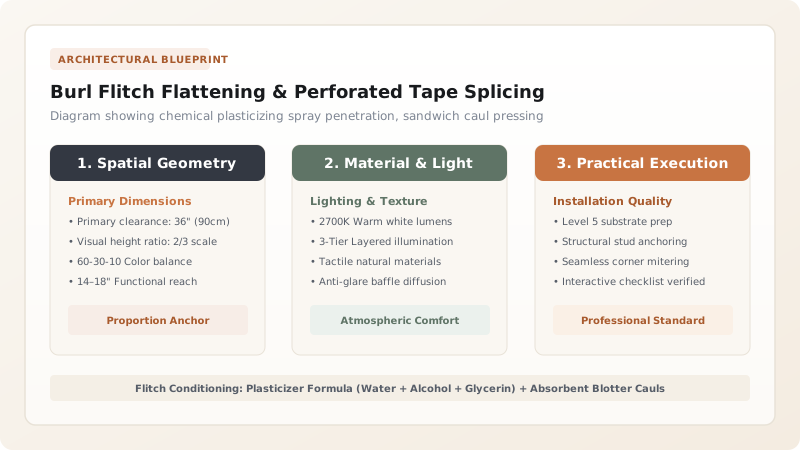
1. Wood Polymer Chemistry: Plasticizers & Lignin Glass Transition
In natural wood, cellulose microfibrils are bound together by an amorphous, highly cross-linked aromatic polymer known as Lignin. At ambient temperature and moisture content, lignin is in its glassy, brittle state, making buckled burl veneer shatter like potato chips when pressed.
To flatten the veneer without breaking cell walls, the polisher must lower the Glass Transition Temperature (\(T_g\)) of lignin. This is achieved using a specialized Veneer Softening Solution:
- 3 Parts Distilled Water: Hydrates dry cellulose, swelling the secondary cell walls.
- 2 Parts Denatured Alcohol (Ethanol): Reduces the surface tension of the solution, allowing rapid capillary penetration deep into dense burl eye clusters.
- 1 Part Pure Glycerin (Glycerol): A non-volatile hygroscopic polyol that integrates between lignin polymer chains, acting as a molecular lubricant that keeps wood fibers pliable even after the water evaporates.
- 1 Part Waterborne Acrylic Resin (Optional): Adds structural reinforcement to fragile, micro-fractured burl voids. Review master paneling in the burl paneling hub.

2. Progressive Flattening: Blotters, Cauls & Moisture Cycling
Simply wetting the veneer and clamping it between sheets of plastic will cause mold to bloom and leaves to rot. Flattening requires Controlled Moisture Extraction:
- Both sides of the wavy burl leaves are misted evenly with softening solution until damp and pliable.
- Leaves are layered in an alternating sandwich: \(\text{MDF Caul} \to \text{Kraft Blotter Paper} \to \text{Veneer Leaf} \to \text{Kraft Paper} \to \text{MDF Caul}\).
- Heavy clamping pressure (or vacuum pressing) is applied for 45 minutes.
- The wet blotters are removed and replaced with completely dry sheets of absorbent Kraft paper. Clamping is reapplied. This cycle is repeated 3 times over 24 hours. By the final cycle, the leaves emerge dry, pliable, and as flat as sheet glass. Learn vacuum press cycles in vacuum press membrane bonding.
3. Seam Engineering: Edge Shooting & Perforated Tape Tensile Pull
To join two burl leaves invisibly, the mating edges must be true straight lines within 0.05mm across their entire length:
- Veneer Shooting Board: The flattened leaves are clamped between two rigid hardwood clamping cauls. A master woodworker passes a heavy No. 7 or No. 8 Jointer Plane (fitted with an A2 tool-steel iron sharpened to 8000-grit) along the shooting track, taking micro-shavings until the joint line is dead flat and light-tight.
- Perforated Veneer Tape: Modern plastic packing tapes or masking tapes stretch under pressure and leave gummy residues that ruin finishes. True craftsmanship utilizes Perforated Kraft Paper Veneer Tape coated with water-activated animal hide glue. As the wet glue cures, the paper contracts by \(1.5\%\), exerting continuous mechanical tension that pulls the joint tightly together during pressing. Connect to diamond matching in four-way diamond matching.
Veneer Edge Jointing Tool Comparison
Use this reference table to calculate exact physical dimensions, ratios, and specifications before purchasing:
| Tooling Method | Hand Shooting Board with Jointer Plane | Rotary Track-Saw with Scoring Blade | Commercial Veneer Guillotine |
|---|---|---|---|
| Joint Accuracy | Exceptional (< 0.02mm light-tight) | Good (0.05mm - 0.10mm) | Superior (< 0.01mm across 3m length) |
| Tear-Out Risk on Burls | Extremely Low (fine micro-shavings) | Moderate (blade teeth can chip brittle eyes) | Zero (pure vertical scissor shear) |
| Tooling Investment | Moderate ($300 - $600) | High ($1,200 - $2,500) | Very High ($15,000+ industrial plant) |
| Max Leaf Length Capacity | Up to 1.8 meters (6 ft) | Up to 3.0 meters (10 ft) | Up to 3.6 meters (12 ft) |
| Suitability for Small Studios | Ideal (custom studio standard) | Good for large panels | Commercial manufacturing only |
Flitch Conditioning & Splicing Hazards
Every successful decoration project must account for physical and environmental constraints:
Black Mold Outbreak from Trapped Moisture
If wet burl veneer is left clamped between non-breathable cauls for more than 12 hours without changing blotter papers, Aspergillus mold spores germinate, leaving permanent black blotches throughout pale elm or ash burls.
Excessive Glycerin Preventing Adhesive Bond
Using more than 15% glycerin in the softening formula leaves an oily residue in the wood cell pores, which interferes with urea-formaldehyde glue curing and causes catastrophic veneer delamination.
Tape Applied to Wrong Side of Veneer
Perforated paper tape must ALWAYS be applied to the decorative show face (the outside). If taped on the back, the paper gets trapped between veneer and substrate, creating an unbonded blister.
Burl Flitch Flattening & Splicing Protocol
Execute this professional sequence to achieve flawless results without backtracking:
Softening Solution Batching
Mix 300ml distilled water, 200ml denatured alcohol, and 100ml vegetable glycerin in a spray mister; shake thoroughly.
Burl Leaf Misting & Saturation
Lay wavy burl leaves on clean bench; mist both sides with fine spray until evenly damp; allow 5 minutes for capillary absorption.
Blotter Sandwich & Initial Clamping
Stack leaves between unprinted Kraft newsprint and 19mm MDF cauls; clamp with heavy bar clamps or draw 25 inHg in vacuum bag for 1 hour.
Blotter Exchange Cycles
Remove damp blotters; insert fresh bone-dry blotter sheets; clamp for 6 hours; repeat exchange until leaves are completely dry and glass-flat.
Veneer Shooting Board Jointing
Clamp paired leaves between hardwood straightedges; shoot edges with razor-sharp No. 7 jointer plane until zero light passes between edges.
Perforated Tape Application & Drying
Butt edges together on flat bench; moisten perforated paper tape with damp sponge; stretch tape across joint every 100mm and apply continuous center strip.
Common Mistakes & Countermeasures
Avoid these costly errors that compromise aesthetics, ergonomics, and budget:
Using Ironing Heat Directly on Wet Burl
Using Blue Painter's Masking Tape for Splicing
Aggressive Dry Sanding to Remove Paper Tape
Project Execution Checklist
Track your physical progress. Checkboxes persist automatically on this device:
Frequently Asked Questions
Can you flatten burl veneer using only pure water?
Water alone will temporarily swell and soften the wood, but as the water evaporates during clamping, the extreme internal tensions of the burl return, causing the veneer to buckle and split again. Glycerin is essential because its non-volatile molecules remain inside the wood cells, keeping the fibers flexible and flat permanently.
Why does veneer tape have holes (perforations)?
Perforations allow moisture from the wet glue to evaporate quickly, accelerating tape drying and shrinking. Additionally, during pressing, the perforations allow any small pockets of air or steam to escape rather than forming unbonded blisters beneath the tape.
How long do flattened burl leaves remain flat before pressing?
Once properly plasticized and conditioned with glycerin, flattened burl leaves will remain flat for several weeks if stored in a climate-controlled workshop (45%–55% RH) under light weight or between sheets of cardboard.


