
Crushed Terracotta Cocciopesto Hydraulic Mortar Matrices represents the genius of Roman synthetic pozzolana technology. By grinding low-fired terracotta tiles (tegulae), bricks, and discarded amphorae into graded aggregate and fine reactive dust, Romans transformed non-hydraulic fat slaked lime into an underwater-curing hydraulic cement. When blended with calcium hydroxide, the amorphous aluminosilicates in the terracotta undergo a chemical pozzolanic reaction, precipitating insoluble calcium silicate hydrate (C-S-H) gels that bind sand and stone into a monolithic, frost-resistant, and completely waterproof pavement matrix.
At a Glance: Key Takeaways
- Low-Fired Terracotta Source: Bricks and roof tiles calcined at 650°C–850°C maximizing amorphous silica content.
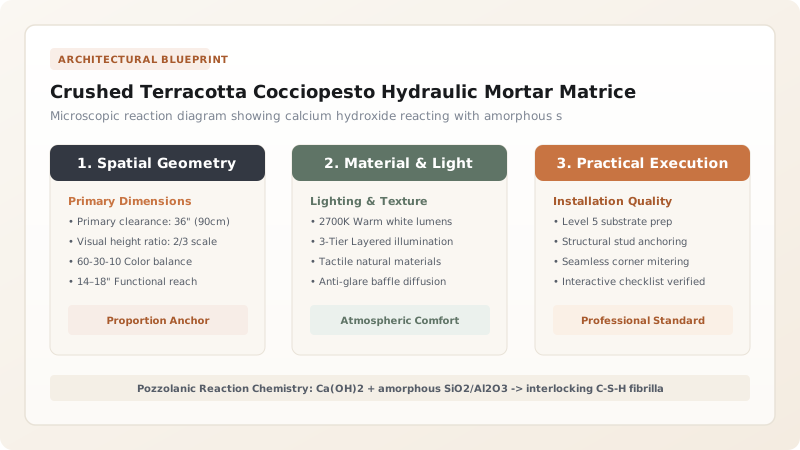
- Hydraulic Pozzolanic Reaction: Ca(OH)2 + SiO2 + Al2O3 + H2O -> C-S-H and C-A-H crystal networks.
- Graded Aggregate Sieve Curve: Combining 0.1mm micro-dust with 1mm–4mm angular terracotta granules.
- Natural Water-Resistant Matrix: Reducing capillary porosity to < 8%, preventing liquid water penetration.
- Shock-Absorbing Elasticity: Lower modulus of elasticity compared to modern cement, accommodating ground settlement.
- Natural Salmon-Pink Coloration: Permanent terracotta mineral pigmentation that never fades or bleaches under sun.
1. Material Science: Why Unfired Clay Fails and Low-Fired Clay Excels
Not all ceramic material acts as a pozzolan. Raw, unbaked clay contains crystalline kaolinite that does not react with lime; modern vitrified stoneware fired at 1,200°C has crystallized into mullite, which is chemically inert. Roman builders specifically selected low-fired earthenware (fired between 650°C and 850°C).
At this temperature, water is driven out of the clay crystal lattice, collapsing it into an amorphous, highly reactive state known as metakaolin. When crushed and mixed with wet slaked lime (calcium hydroxide), the amorphous silica and alumina readily dissolve in the alkaline pore water, reacting with calcium ions to precipitate insoluble calcium silicate hydrates (C-S-H) and calcium aluminate hydrates (C-A-H). The mortar gains true hydraulic properties, setting even under standing water without atmospheric CO2.
2. Aggregate Engineering: The Multi-Stage Sieve Curve
The strength of a cocciopesto mortar depends on particle packing. If only fine terracotta dust is used, the mix requires excessive gauging water, leading to severe shrinkage cracks; if only coarse gravel is used, there is insufficient reactive surface area.
Roman masons employed a continuous Fuller-type particle grading curve:
- Reactive Fines (0.05mm to 0.2mm): 30% by weight; microscopic reactive flour that drives the chemical hydraulic reaction.
- Medium Sand Fraction (0.5mm to 1.5mm): 40% by weight; sharp ceramic and silica grains that form the compressive skeletal backbone.
- Coarse Aggregates (2mm to 5mm): 30% by weight; angular broken terracotta chips that arrest micro-cracks and provide visual textural character.
3. Rheology: Compaction Mechanics and Water Reduction
Modern concrete is poured wet and soupy so it self-levels; this excess water creates high capillary porosity that makes concrete vulnerable to frost and water penetration. Roman cocciopesto was mixed with the absolute minimum gauging water—a stiff, semi-dry earth-moist consistency.
To consolidate this stiff mix, Roman masons used fistucae (heavy wooden pestles weighing 12 to 18 kg). Pounding the bed for hours compresses the ceramic aggregate into intimate contact, forcing entrapped air to escape and reducing total porosity to under 8%. Capillary pores become so microscopic that surface tension prevents liquid water from penetrating, creating an impermeable pavement that endures 2,000 years.
Roman Cocciopesto Mortar Mix Proportions
Use this reference table to calculate exact physical dimensions, ratios, and specifications before purchasing:
| Application / Exposure | Crushed Terracotta Ratio | River Sand Ratio | Slaked Lime Putty Ratio | Compressive Strength (28d) |
|---|---|---|---|---|
| Domestic Atrium Pavement | 2.0 parts graded terracotta | 1.0 part sharp sand | 1.0 part fat lime putty | 14 - 18 MPa |
| Bathhouse / Cistern Lining | 3.0 parts fine terracotta dust | 0.5 parts volcanic pozzolana | 1.0 part fat lime putty | 20 - 25 MPa (Waterproof) |
| Threshold Mosaic Bedding | 2.5 parts screened terracotta | 0.5 parts marble dust | 1.0 part fat lime putty | 16 - 20 MPa |
| Sub-Floor Concrete (Rudus) | 1.5 parts crushed brick chips | 2.5 parts gravel | 1.0 part fat lime putty | 10 - 12 MPa |
Labor & Sourcing Constraints
Every successful decoration project must account for physical and environmental constraints:
Heavy Crushing Labor
Grinding tons of hard terracotta tiles into graded powder by hand with cast-iron pestles requires immense manual labor or commercial ball milling.
Water Evaporation Sensitivity
In hot Mediterranean climates, dry wind accelerates water loss before the pozzolanic reaction completes; floors must be shaded and kept continuously damp.
Protocol for Formulating and Compacting a Cocciopesto Bed
Execute this professional sequence to achieve flawless results without backtracking:
Terracotta Crushing & Sifting
Crush clean low-fired terracotta roof tiles with iron pestles; sift through graded screens into coarse (3mm), medium (1mm), and flour (<0.2mm) fractions.
Dry Blend Homogenization
Blend 2 parts graded terracotta aggregate with 1 part sharp washed river sand on wooden mixing platform until uniformly pink.
Lime Putty Integration
Add 1 part mature non-hydraulic fat lime putty (CL90-S); chop and beat with iron shovels without adding standing water until stiff plastic dough forms.
Screeding & Leveling
Spread 35mm thick layer over pre-wetted rudus sub-base; screed flat using wooden straightedge spanning screed rails.
Fistuca Pestle Compaction
Pound the entire surface systematically with heavy 15kg wooden rammers; repeat 3 passes until lime-terracotta slurry sweats to surface.
Moist Hydraulic Curing
Cover compacted floor with damp straw or burlap; mist with clean water daily for 14 days to complete calcium silicate hydrate crystallization.
Common Mistakes & Countermeasures
Avoid these costly errors that compromise aesthetics, ergonomics, and budget:
Adding excessive mixing water to make the cocciopesto easy to trowel like modern self-leveling screed
Using terracotta crushed from chimneys or modern clinker pavers
Project Execution Checklist
Track your physical progress. Checkboxes persist automatically on this device:
Frequently Asked Questions
How did Roman cocciopesto waterproof municipal cisterns and aqueducts?
In addition to the hydraulic C-S-H crystal growth that fills microscopic pore spaces, Roman cistern plasterers rounded all interior 90° corners into smooth quarter-round concave fillets (cordoni). This eliminated stress concentrations and prevented shrinkage cracks at wall-floor junctions, while burnishing the final paste with hot irons and olive oil formed an impenetrable hydrophobic barrier.
Why does cocciopesto have a distinctive pink color?
The reddish-pink color is entirely natural, imparted by iron oxide (hematite, Fe2O3) present in the alluvial clays used to make Roman roof tiles and terracotta amphorae. When ground into fine aggregate and blended with white slaked lime, the red ceramic particles tint the white matrix into an enduring warm salmon-pink that never fades under ultraviolet light.


