
Ancient Roman Opus Signinum and Tessellated Threshold Flooring represents one of classical antiquity's most durable and widespread flooring technologies. Originating in the Roman Republic and perfected in Pompeii, Herculaneum, and Ostia, opus signinum (known in Italian as cocciopesto) consists of fat slaked lime mixed with crushed terracotta tiles, amphorae, and volcanic pozzolana. The amorphous silica and alumina in the ceramic react chemically with calcium hydroxide to form a water-impervious hydraulic mortar. Master mosaicists embedded geometric patterns of white and black marble tesserae directly into the pink-red matrix, culminating in dramatic entrance threshold mosaics (such as the famous Cave Canem dog) that greeted visitors with protective apotropaic power.
At a Glance: Key Takeaways
- Hydraulic Cocciopesto Matrix: Fat slaked lime reacted with crushed pottery pozzolans for waterproof durability.
- Warm Terracotta Color Palette: Naturally pigmented warm reddish-pink ground from crushed brick and amphora sherds.
- Inlaid White Marble Tesserae: Hand-knapped limestone and marble cubes arranged in lozenges, meanders, and stars.
- Heavy Wooden Rammer Pounding: Compacting the mortar bed repeatedly to eliminate air voids and maximize density.
- Apotropaic Threshold Mosaics: Celebrated entrance mosaics (Cave Canem, Salve) warding off evil at the domus vestibule.
- Linseed Oil & Wax Burnishing: Saturating cured floors with hot linseed oil and beeswax buffed to an eggshell sheen.
In-Depth Guides in this Directory
Explore specialized subtopic blueprints, technical dimensions, and execution checklists:
Crushed Terracotta Cocciopesto Hydraulic Mortar Matrices
Technical materials manual for Roman cocciopesto mortars: low-fired terracotta pozzolanic reactions, amorphous silica reactivity, graded particle sizing, and compaction mechanics.
Inlaid White Marble Geometric Tesserae Grids
Archaeological manual for Roman tessellated opus signinum floors: white limestone and marble tesserae knapping, lozenge and meander layouts, and beater tamping.
Cave Canem Entrance Salve Mosaics and Vestibule Transitions
Archaeological analysis of Roman entrance mosaics: the Pompeian Cave Canem watchdog, Salve hospitality emblems, black-and-white tessellation, and vestibule thresholds.
1. Classical Origins: Vitruvius and the Art of the Hydraulic Pavement
Recorded by the Roman architect Vitruvius in his 1st-century BC treatise De Architectura (Book VII), opus signinum (named after the town of Signia, famous for its terracotta tiles) was Rome's premier waterproof flooring. While wealthy aristocrats laid solid marble slabs, opus signinum was the universal flooring of choice for domestic atriums, triclinia, peristyles, and public thermal baths.
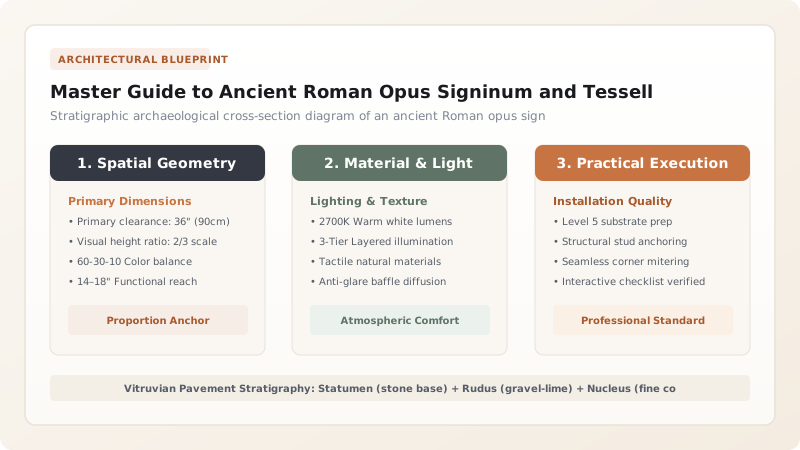
Vitruvius specified a rigorous four-tier geological foundation: the statumen (large fist-sized stones), the rudus (crushed stone and lime tamped with heavy rammers), the nucleus (crushed ceramic and lime), topped by the finished opus signinum layer, compacted until water was squeezed from the pores.
2. Chemical Engineering: The Hydraulic Pozzolanic Reaction
Pure slaked lime (calcium hydroxide) is non-hydraulic; it requires atmospheric carbon dioxide to harden and remains water-soluble until carbonated. In damp cisterns and ground-floor atriums, pure lime fails to cure and washes away.
Roman builders unlocked hydraulic engineering by adding crushed terracotta (cocciopesto). Clay fired at 600°C to 900°C undergoes mineral breakdown, leaving reactive amorphous silica (SiO2) and alumina (Al2O3). When mixed with wet lime, these minerals react chemically to form calcium silicate hydrates (C-S-H) and calcium aluminate hydrates (C-A-H)—the exact chemical binding phases of modern Portland cement. The floor cures under water, resists rising groundwater salts, and attains rock-like compressive strength.
2. Apotropaic Iconography: The Threshold of the Domus
In Roman domestic religion, the entrance doorway (limen) was a sacred, spiritually vulnerable threshold guarded by the god Janus. To cross the threshold was to transition from the chaotic public street into the sacred domestic sanctuary.
In the entrance vestibule (fauces), Roman mosaicists embedded bold figurative mosaics directly into the opus signinum or black-and-white tessellated beds. The most celebrated is the Cave Canem ('Beware of the Dog') mosaic from the House of the Tragic Poet in Pompeii. Depicting a chained, snarling black Molossian mastiff against a white ground, the mosaic served both as a literal warning to thieves and a magical apotropaic charm deflecting the evil eye (fascinum).
Roman Pavement Stratigraphy & Material Ratios (Vitruvian Standards)
Use this reference table to calculate exact physical dimensions, ratios, and specifications before purchasing:
| Stratum Layer | Latin Name | Thickness (mm) | Material Formulation | Compaction Tool |
|---|---|---|---|---|
| Sub-Base Rubble | Statumen | 150mm - 200mm | Fist-sized basalt / limestone rocks packed dry | Hand-packed by foot |
| Coarse Concrete Bed | Rudus | 100mm - 120mm | 3 parts broken stone : 1 part fat slaked lime | Heavy wooden rammers (fistuca) |
| Fine Ceramic Bedding | Nucleus | 40mm - 50mm | 3 parts crushed pottery : 1 part fat lime | Wooden float screeding |
| Tessellated Finish | Opus Signinum | 15mm - 25mm | Micro-fine terracotta dust + lime + marble cubes | Polishing stones & linseed oil |
| Threshold Mosaic | Emblema / Fauces | Flush with floor | Hand-cut black & white limestone tesserae | Tamped flush with wooden block |
Material & Labor Constraints
Every successful decoration project must account for physical and environmental constraints:
Tremendous Manual Compaction
True Vitruvian ramming requires teams of masons pounding with 15kg wooden pestles for hours across every square meter.
Slow Carbonation & Hydraulic Cure
While initial hydraulic set occurs within 72 hours, complete crystal curing and drying requires 6 to 12 weeks before heavy usage.
Protocol for Laying a Roman Opus Signinum Floor with Marble Inlays
Execute this professional sequence to achieve flawless results without backtracking:
Statumen Base Compaction
Excavate floor; lay 150mm bed of fist-sized stone blocks; fill voids with gravel; tamp until immovable underfoot.
Rudus Mortar Ramming
Mix 3 parts crushed limestone with 1 part lime putty; spread 100mm layer; ram vigorously with heavy wooden pestles to eliminate air pockets.
Nucleus Cocciopesto Layering
Mix 3 parts crushed terracotta tile (2mm–5mm grit) with 1 part aged lime putty; spread 40mm bed; screed dead flat.
Marble Tesserae Insertion
While nucleus is soft, press hand-cut white marble tesserae (10x10x10mm) into surface to form geometric stars and lozenge grids.
Wooden Block Tamping & Beating
Beat the embedded marble cubes flush with the pink mortar surface using a flat wooden beater board; ensure zero protruding edges.
Linseed Oil Saturation & Burnishing
Allow 28 days hydraulic cure; saturate floor with boiled linseed oil and melted beeswax; buff vigorously with quartz river stones.
Common Mistakes & Countermeasures
Avoid these costly errors that compromise aesthetics, ergonomics, and budget:
Using modern high-fired vitrified porcelain tile scraps instead of low-fired terracotta for cocciopesto
Failing to tamp the rudus and nucleus layers with heavy wooden rammers
Project Execution Checklist
Track your physical progress. Checkboxes persist automatically on this device:
Frequently Asked Questions
What is the meaning of the Latin greeting 'SALVE' found on Roman thresholds?
'Salve' is the classical Latin greeting meaning 'Welcome' or 'Hail' (literally 'be well/in good health'). Embedded in black-and-white marble tesserae at the entrance threshold of the Roman domus, it extended formal hospitality to invited guests while symbolically wishing prosperity and health upon everyone who crossed the threshold.
Why did Romans use cocciopesto for floors instead of solid marble slabs?
Solid marble slabs were imported from distant quarries across Greece, Africa, and Asia Minor at immense expense. Opus signinum used locally available clay roof tiles and lime, was drastically cheaper, completely waterproof, and created a seamless, crack-resistant monolithic floor that felt pleasantly warm underfoot compared to cold solid marble.


