
Anchor heavy iron balusters into stone or marble stair treads by diamond core-drilling a 25mm diameter × 50mm deep socket with an undercut dovetail cavity. For historic restorations, pour molten pure lead into the pre-heated hole and hand-caulk with a cold chisel. For modern luxury builds, inject high-strength structural epoxy (Hilti HIT-RE 500 V3).
At a Glance: Key Takeaways
- Traditional Molten Lead Anchoring: Pure lead expands slightly upon solidifying, forming a ductile, shock-absorbing metallic wedge.
- Modern Pure Epoxy Systems (Hilti HIT-RE 500 V3): Delivers 2,500+ PSI bonding strength without heating or open flames.
- Undercut Dovetail Socket Geometry: Reverse-tapered hole prevents the hardened anchor plug from pulling out vertically.
- Fishtail Baluster Stem Notching: Barbed notches cut into the bottom of the iron stem lock mechanically inside the socket core.
- Stone Thermal Shock Protection: Pre-heating stone sockets with hot air prevents cold marble from cracking during molten lead pours.
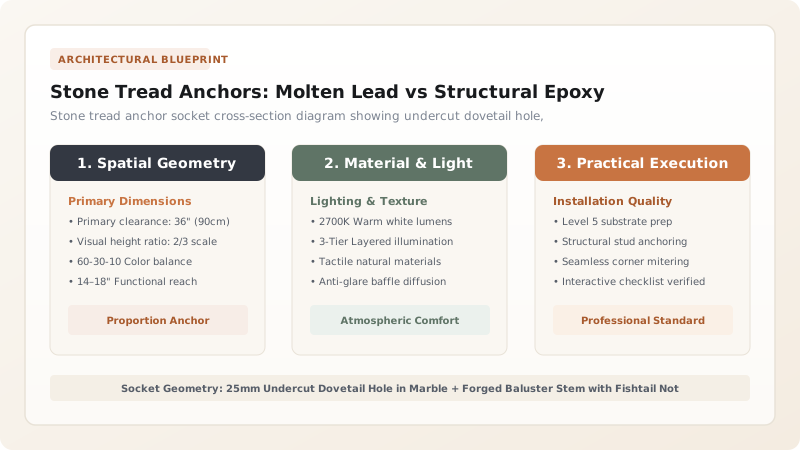
1. Historic Metallurgy: Molten Lead Solidification & Cold-Caulking
For centuries, European palace staircases (Versailles and Georgian townhouses) anchored iron railings into marble using Molten Lead Caulking. Pure lead melts at \(621^{\circ}\text{F} (327^{\circ}\text{C})\). When poured into a stone socket containing a notched iron baluster, the lead flows into every microscopic stone crevice.
Because lead is ductile, masons use a Caulking Chisel and Hammer to pack the cold lead firmly around the iron stem, expanding the metal laterally against the undercut stone hole walls to create an unbreakable mechanical lock. For baluster spacing codes, review 4-inch sphere spacing math.

2. Modern Pure Epoxy Engineering: Zero Flame & Extreme Bond
In modern interior renovations where open torches and molten lead are prohibited due to fire and lead-dust safety regulations, architects specify Slow-Cure Structural Pure Epoxy (such as Hilti HIT-RE 500 V3 or Simpson Strong-Tie SET-3G).
Unlike polyester glues that shrink and crack, pure epoxy exhibits 0.0% curing shrinkage and over 2,500 PSI tensile bond strength to stone. Pair with solid brass handrail caps and explore under-stair features in under-stair joinery.
Molten Lead vs Structural Epoxy Anchoring Systems
Use this reference table to calculate exact physical dimensions, ratios, and specifications before purchasing:
| Anchoring System | Bond Strength to Stone | Installation Safety | Historic Authenticity |
|---|---|---|---|
| Structural Pure Epoxy (Hilti HIT-RE 500) | 2,500+ PSI Chemical Bond | 100% Safe (No heat / Cold injection) | Modern luxury standard |
| Traditional Molten Lead Caulking | Mechanical Wedged Interlock | Requires open flame & PPE for lead fumes | 100% Authentic historic restoration |
| Expanding Hydraulic Cement (Rockite) | Compressive Grip Only | Safe (Water mixed) | FAILS: Expands over years and cracks marble |
| Standard Silicone / Construction Adhesive | Low (Spongy & flexible) | Safe | DANGEROUS: Railings pull loose |
Expanding Hydraulic Cement Marble Shattering Constraints
Every successful decoration project must account for physical and environmental constraints:
Using Expanding Anchoring Cement (Rockite) Cracking Expensive Marble Treads
Fast-setting anchoring cements expand continuously with humidity, exerting thousands of PSI outward force that shatters fragile marble tread corners; strictly prohibit expanding cements in natural stone; use only non-expansive structural pure epoxy or molten lead.
How to Anchor Balusters into Stone Treads with Epoxy
Execute this professional sequence to achieve flawless results without backtracking:
Core-Drill 25mm Hole in Stone Tread
Use a diamond wet core bit to drill 25mm diameter × 50mm deep hole 3 inches back from tread edge.
Undercut Hole Bottom with Carving Bur
Flare the bottom of the hole slightly wider (dovetail profile) using a reverse diamond rotary bur.
Blow Dust and Clean Hole with Wire Brush
Vacuum debris, scrub hole walls with round steel wire brush, and blow clean with oil-free compressed air.
Cut Fishtail Notches on Baluster Stem
Use an angle grinder to cut three 2mm deep notched barbs into the bottom 40mm of the iron stem.
Inject Structural Pure Epoxy to 2/3 Depth
Dispense Hilti HIT-RE 500 epoxy into the hole using a static mixing nozzle to prevent air pockets.
Insert Baluster and Allow 24-Hour Cure
Twist baluster stem into epoxy until plumb; clamp to top core rail and let cure fully before tensioning.
Common Mistakes & Countermeasures
Avoid these costly errors that compromise aesthetics, ergonomics, and budget:
Failing to Clean Stone Dust from the Drilled Hole
Project Execution Checklist
Track your physical progress. Checkboxes persist automatically on this device:
Frequently Asked Questions
Can you remove an epoxy-anchored baluster if it needs repair?
Yes. Heating the iron baluster stem with a focused micro-induction heater or heat gun to 300°F (150°C) softens the structural epoxy, allowing the baluster to be pulled cleanly out of the stone without damaging the tread.


