
Venetian Pastellone (also known as cocciopesto flooring) is the ancient seamless, breathable mineral floor of the Venetian Republic. Predating modern terrazzo, it is formulated from aged non-hydraulic lime putty (grassello di calce) blended with pozzolanic crushed terracotta brick (cocciopesto) and natural earth pigments. Hand-compacted with wooden beaters (battidori), leveled with steel floats, and burnished with boiled linseed oil and beeswax, it forms a jointless, elastic floor capable of flexing over wooden palazzo joists without cracking.
At a Glance: Key Takeaways
- Seamless Monolithic Surface: Continuous jointless floor spanning entire palace salons without expansion joints.
- Pozzolanic Cocciopesto Chemistry: Reactive amorphous alumina-silica in crushed Roman brick forming water-resistant hydraulic C-S-H binders.
- Aged Grassello di Calce: High-calcium slaked lime putty aged 12 to 24 months for maximum colloidal plasticity.
- Dynamic Wooden Subfloor Flexure: Low elastic modulus accommodating building settlement and lagoon timber pile movement.
- Boiled Linseed Oil & Carnauba Patina: Deep penetrating oil saturation followed by hard beeswax burnishing to achieve a satin marble luster.
In-Depth Guides in this Directory
Explore specialized subtopic blueprints, technical dimensions, and execution checklists:
Crushed Pozzolanic Terracotta Aggregate & Aged Slaked Lime Chemistry
Pozzolanic reactivity, particle grading, and calcium silicate hydrate (C-S-H) synthesis in Venetian cocciopesto mortars.
Boiled Linseed Oil & Natural Wax Compacted Burnishing Protocols
Mechanical stone burnishing, heated steel trowel compaction, and boiled linseed oil-carnauba wax finishing for Venetian Pastellone.
Flexible Timber Subfloor Decoupling & Crack Mitigation
Structural engineering of timber subfloor decoupling, reed matting lath, and shear crack mitigation for Venetian Pastellone floors.
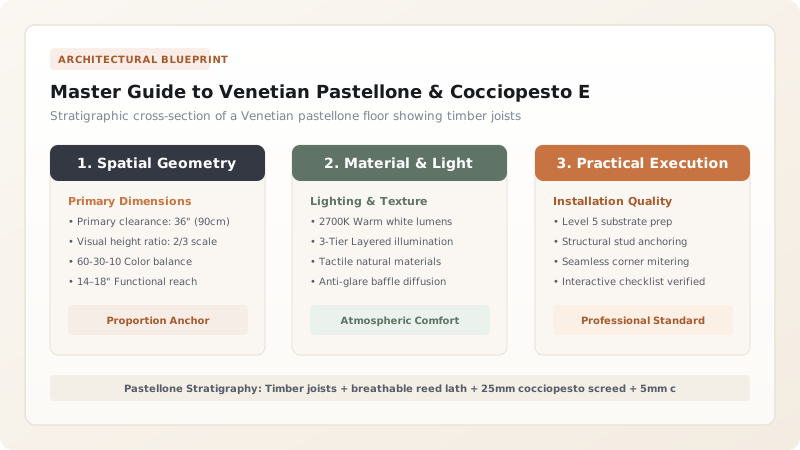
1. History & The Engineering of Venetian Elasticity
Venice is a city built on water, resting upon hundreds of thousands of submerged wooden pine and alder piles driven into soft lagoon mud. Because these foundations settle continuously, and because palace floors span across flexible heavy timber joists (travature), rigid stone slabs or modern Portland cement screeds would crack and shear away within years.
Venetian master floor-layers (terrazzieri) solved this structural dilemma through Pastellone—a refined derivative of the ancient Roman opus signinum. With a total thickness of only 25mm to 35mm, Pastellone combines high structural density with a remarkably low modulus of elasticity (\(E \approx 4\text{ to }7\text{ GPa}\)). The floor moves, flexes, and breathes in dynamic harmony with the building's wooden skeleton.
2. Pozzolanic Hydration: Slaked Lime and Crushed Brick
Pastellone relies on an ancient chemical reaction between aged slaked lime putty (grassello di calce) and cocciopesto (finely crushed low-fired terracotta brick dust):
Pure slaked lime is non-hydraulic, requiring atmospheric carbon dioxide to carbonate. Deep within a 30mm thick floor bed, \(\text{CO}_2\) cannot penetrate. The reactive amorphous silica (\(\text{SiO}_2\)) and alumina (\(\text{Al}_2\text{O}_3\)) within the crushed terracotta react with the calcium hydroxide in the lime putty:
This reaction creates an internal hydraulic set that hardens the floor from within, transforming the paste into a water-resistant artificial stone with compressive strength between 8 and 14 MPa.
3. Compaction Physics: The Battidori Beaters
The exceptional hardness and marble-like density of Pastellone is not achieved by chemicals, but by intense human mechanical compaction. Masons compact the wet mortar using battidori—heavy flat wooden tamping mallets or rollers weighing 10 to 15 kg.
Compacting the floor for hours collapses capillary air channels, forces excess water to bleed to the surface where it is sponged away, and increases aggregate packing density by over 35%. The final pass is executed with specialized heated steel trowels (ferri caldi) lubricated with authentic liquid black soap (sapone di Marsiglia), which chemically saponifies free calcium into a silky, water-repellent calcium oleate skin.
Venetian Pastellone vs Modern Polished Concrete & Terrazzo
Use this reference table to calculate exact physical dimensions, ratios, and specifications before purchasing:
| Technical Metric | Authentic Venetian Pastellone | Modern Epoxy Terrazzo | Polished Portland Concrete |
|---|---|---|---|
| Primary Binder | Aged slaked lime putty (CL90) + cocciopesto | Epoxy resin polymer matrix | Type I/II Portland cement clinker |
| Modulus of Elasticity | 4 to 7 GPa (ultra-flexible) | 10 to 15 GPa (semi-rigid) | 25 to 35 GPa (extremely rigid; cracks easily) |
| Expansion Joints | Zero required; seamless across 100m² salons | Divider strips required every 3 to 5 meters | Control saw cuts mandatory every 4 meters |
| Vapor Breathability | 100% breathable (μ ≈ 12); prevents wood rot | 0% breathability; creates synthetic vapor trap | Low breathability; promotes damp bubbling |
| Surface Feel | Warm, velvety, non-slip natural tactile sheen | Cold, plastic, high-gloss synthetic sheen | Cold, hard, industrial concrete feel |
Curing & Environmental Constraints
Every successful decoration project must account for physical and environmental constraints:
Extended Curing Window
Pastellone cures via slow atmospheric carbonation; heavy furniture must not be loaded onto the floor for at least 30 days.
Water Evaporation Balancing
Rapid forced-air heating during the first 14 days will induce spiderweb shrinkage cracks; maintain natural ambient drying.
Protocol for Installing a Seamless Venetian Pastellone Floor
Execute this professional sequence to achieve flawless results without backtracking:
Subfloor Decoupling & Reed Lath
Lay breathable kraft paper and woven river-reed matting (canniccio) over timber subfloor planks to decouple movement.
Cocciopesto Base Screed (Massetto)
Spread a 25mm screed of aged lime putty, coarse crushed brick (2–5mm), and river sand; compact with wooden battidori.
Pastellone Skim Application
Apply a 5mm finish coat of lime putty, micronized terracotta dust, and natural mineral ochres (rosso Verona, terra di Siena).
Mechanical Troweling & Saponification
Trowel repeatedly with flexible steel spatulas; apply warm Marseille black soap solution to induce calcium oleate surface sealing.
Controlled Carbonation Curing
Cover floor with damp burlap sheets for 14 days to support slow, microcrystalline lime carbonation without shrinkage cracking.
Linseed Oil & Carnauba Burnishing
Apply 2 coats of heated boiled linseed oil diluted with turpentine; allow 7 days to polymerize, then buff with carnauba paste wax.
Common Mistakes & Countermeasures
Avoid these costly errors that compromise aesthetics, ergonomics, and budget:
Adding Portland cement to Pastellone to accelerate drying
Pouring Pastellone directly onto flexible plywood without decoupling layers
Project Execution Checklist
Track your physical progress. Checkboxes persist automatically on this device:
Frequently Asked Questions
How did Venetian palazzi keep pastellone floors from cracking over water?
Venetian builders decoupled the mineral floor from the building's timber frame using layers of woven marsh reeds (canniccio) and sand. Because pastellone has a very low modulus of elasticity and high natural tensile ductility from animal hair fibers, it flexes like a tough leather skin over settling timber joists.
How do you clean and maintain an authentic Pastellone floor?
Never clean with vinegar, bleach, ammonia, or commercial acid descalers. Routine cleaning requires warm water and authentic linseed oil black soap (savon noir / sapone all'olio di lino). The natural soap cleans while constantly nourishing the protective wax and calcium oleate patina.


