
Laying a seamless mineral floor over flexible wooden floor joists requires mastering decoupling engineering. Venetian masons prevented cracking by installing multi-tier decoupling membranes: slip-sheet kraft paper, traditional woven river reed lath (canniccio), and animal hair tensile reinforcement that isolate the mineral Pastellone from horizontal joist flexure and seasonal timber expansion.
At a Glance: Key Takeaways
- Canniccio Reed Lath: Woven marsh reed mats providing an elastic, three-dimensional uncoupling substrate.
- Uncoupling Slip Sheets: Heavy unbonded kraft paper or geotextile fleece allowing timber planks to slide beneath the mortar.
- Tensile Fiber Reinforcement: Chopped cow or horse hair (15mm to 30mm) dispersed throughout the lime matrix.
- Subfloor Deflection Standards: Joist systems engineered to L/480 or stiffer under full dead and live load.
- Perimeter Cork Margins: 8mm compressible cork expansion buffers concealed behind perimeter wainscot paneling.
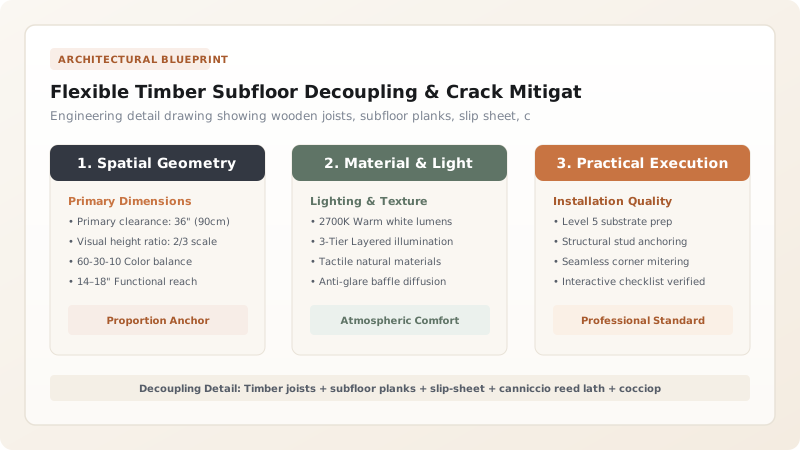
1. The Structural Problem: Timber Deflection vs Mineral Rigidity
Wooden floors in historic Venetian palazzi are dynamic structures. Joists deflect vertically under furniture and pedestrian live loads, while wood floor planks expand and contract across their grain by up to 3% to 5% with changing lagoon humidity.
If a 30mm mineral lime screed is bonded directly to these moving wood planks, the lateral shear stress \(\tau\) along the contact interface will exceed the tensile shear strength of the lime mortar (\(f_t \approx 0.8\text{ MPa}\)). The mortar will crack directly along every plank seam, shattering the seamless floor into loose, wobbling fragments.
2. The Canniccio Reed Lath & Uncoupling Slip-Sheet
Venetian floor-layers solved this through the canniccio (marsh reed lath) system:
- A layer of heavy, unbonded oiled kraft paper or breathable geotextile fleece is laid loosely across the wooden subfloor planks, creating a complete mechanical slip plane.
- Over this slip sheet, artisans roll out mats of woven freshwater marsh reeds (Phragmites australis), stitched together with natural galvanized wire or hemp cord.
- The hollow, ribbed profile of the marsh reeds acts as a flexible 3D truss: the lower half allows the timber substrate to slide independently, while the upper half embeds firmly into the cocciopesto mortar, locking the mineral floor into a monolithic, floating structural plate.
3. Tensile Reinforcement with Animal Hair
To resist flexural tension across the center of wide floor spans, master masons incorporated scutch (chopped cow, horse, or goat hair) into the cocciopesto mortar at a rate of 3 to 5 kg per cubic meter.
The keratin hair fibers (20mm to 40mm long) have a high tensile strength (approx. 150 to 200 MPa). Dispersed three-dimensionally throughout the wet paste, the microscopic fibers bridge micro-cracks before they can coalesce into visible fissures, giving the cured Pastellone the ductile toughness required to survive centuries of palace celebrations.
Subfloor Decoupling Systems for Pastellone Floors
Use this reference table to calculate exact physical dimensions, ratios, and specifications before purchasing:
| Decoupling Method | Primary Substrate | Deflection Tolerance | Heritage Conservation Status |
|---|---|---|---|
| Traditional Canniccio Reed Lath | Solid timber planks over joists | L/480 (absorbs large deflections) | Approved historic Venetian standard; 100% reversible |
| Modern Geotextile Fleece Slip-Sheet | Tongue-and-groove plywood / OSB | L/600 (requires stiff joists) | Standard for contemporary residential installations |
| Dimpled Polyethylene Uncoupling Mat | Modern concrete or plywood | L/480 | Good crack isolation; non-breathable (risk of rot under wood) |
| Direct Bond (No Decoupling) | Timber planks or joists | Zero tolerance (GUARANTEED CRACKING) | STRICTLY FORBIDDEN across all timber substrates |
Structural Constraints
Every successful decoration project must account for physical and environmental constraints:
Total Assembly Weight
A 30mm pastellone floor weighs approx. 60 kg/m²; structural engineers must verify that historic timber joists can support this dead load.
Threshold Transitions
The 30mm thickness requires beveling or ramping wooden thresholds at doorways into adjacent rooms.
Protocol for Preparing a Timber Subfloor for Pastellone
Execute this professional sequence to achieve flawless results without backtracking:
Subfloor Joist Stiffening
Inspect joists for rot; add blocking between joists to achieve minimum L/480 deflection stiffness under 2.5 kN/m² live load.
Plank Re-Securing
Screw down loose subfloor planks using countersunk screws; sand down proud edges to within 2mm flat tolerance.
Slip-Sheet Kraft Paper Laying
Roll out breathable kraft paper or geotextile slip-sheet across planks with 100mm lapped joints (unbonded).
Canniccio Reed Mat Placement
Lay woven marsh reed mats perpendicular to subfloor planks; staple lightly with stainless steel staples solely to hold position.
Perimeter Cork Buffer Installation
Install continuous 8mm natural cork expansion strips along all perimeter walls, columns, and pipe penetrations.
Cocciopesto Floating Screed Pour
Spread hair-reinforced cocciopesto mortar directly over the reed lath, compacting firmly into the hollow reed valleys.
Common Mistakes & Countermeasures
Avoid these costly errors that compromise aesthetics, ergonomics, and budget:
Fastening the canniccio reed lath rigidly to the joists with long screws
Omitting compressible perimeter expansion strips along walls
Project Execution Checklist
Track your physical progress. Checkboxes persist automatically on this device:
Frequently Asked Questions
Can Pastellone be installed over modern radiant floor heating?
Yes. Pastellone has excellent thermal conductivity and warmth. When installing over hydronic radiant floor tubing, the tubes are embedded in the cocciopesto base screed over an uncoupling membrane, with heating brought up to temperature slowly at 2°C per day after 60 days of curing.
What happens if a crack does appear in a Pastellone floor?
Unlike modern resin floors that cannot be repaired seamlessly, hairline cracks in Pastellone can be carefully routed out, injected with fresh color-matched lime-cocciopesto paste, and burnished with a warm trowel and wax, blending almost invisibly into the antique patina.


