
Transforming matte cocciopesto plaster into the silky, reflective marble floor known as Pastellone requires a multi-stage burnishing protocol. Compacting the wet surface with heated steel trowels (ferri caldi) and Marseille soap induces surface saponification. Once cured, successive penetrating applications of heated boiled linseed oil and pure carnauba-beeswax paste are machine-burnished to achieve deep, liquid luster.
At a Glance: Key Takeaways
- Heated Steel Troweling (Ferri Caldi): Warm steel trowels compressing surface pores while pulling fine lime paste to the surface.
- Marseille Soap Saponification: Olive oil black soap reacting with calcium to create an insoluble, silky calcium oleate barrier.
- Graduated Linseed Oil Saturation: Heated boiled linseed oil penetrating 2mm to 4mm into mineral pores to form durable linoxin.
- Carnauba & Beeswax Buffing: Hard Brazilian palm wax providing scratch resistance and mirror-like light reflection.
- Non-Slip Satin Sheen: High wet slip resistance despite a visually glossy, liquid-like surface appearance.
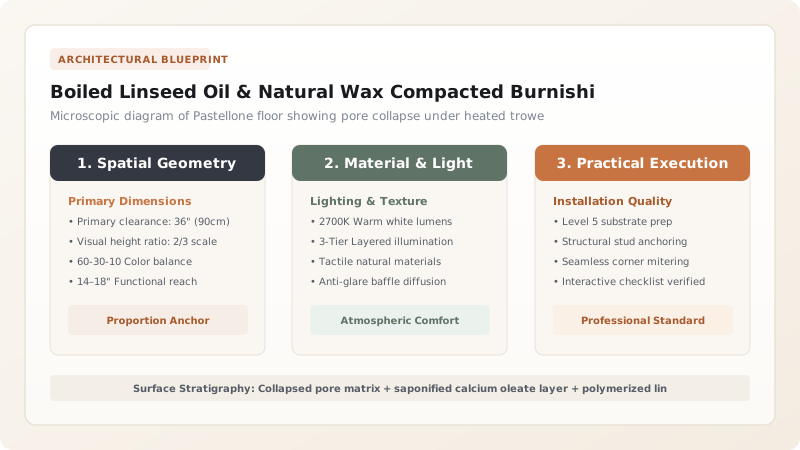
1. The Physics of Heated Trowel Compaction (Ferri Caldi)
Unlike modern plaster finishing which relies on chemical acrylic hardeners, authentic Venetian Pastellone achieves surface hardness through physical thermal compaction. When the 5mm finish coat reaches leather-hard consistency (approx. 4 to 6 hours after troweling), the artisan uses ferri caldi (heated steel trowels).
Trowels are gently heated over charcoal braziers to approximately 60°C to 80°C. As the warm steel is burnished across the damp plaster, three physical reactions occur simultaneously:
- Capillary Water Expulsion: Localized heat evaporates excess surface moisture, accelerating the precipitation of microscopic calcium carbonate crystals.
- Crystal Plate Realignment: The intense pressure and heat force flat calcite and clay platelets into parallel planar orientation, creating a smooth optical plane that reflects ambient light specularly.
- Surface Densification: Compressive surface density increases by over 45%, rendering the top 1mm of the floor as hard as natural limestone.
2. Saponification with Pure Marseille Soap
During the final trowel passes, the artisan lubricates the warm steel blade with a solution of genuine Marseille soap (sapone di Marsiglia)—made from 100% saponified olive oil and soda ash.
The sodium and potassium oleates within the soap react immediately with the free calcium hydroxide in the damp lime paste, precipitating calcium oleate directly inside the microscopic surface pores. This insoluble metallic soap acts as a natural water-repellent primer, preventing the lime from drying out prematurely while creating the characteristic silky, soapstone-like hand feel of historic Venetian floors.
3. The Linseed Oil & Carnauba Wax Sealing Cycle
After 28 days of natural carbonation curing, the floor moisture content drops below 3%. The floor is now ready for deep organic saturation:
- Heated Boiled Linseed Oil: Applied hot (45°C) diluted 50/50 with pure gum spirits of turpentine. The mixture penetrates 3mm into the mineral pores, where it polymerizes into solid linoxin over 7 days, locking the pigments into permanent UV stability.
- Carnauba & Beeswax Paste: A paste of 70% Brazilian carnauba wax (for scratch resistance) and 30% yellow beeswax (for elasticity) is applied in an ultra-thin coat.
- High-Speed Rotary Buffing: Buffed using a rotary floor machine fitted with a natural horsehair or felt polishing pad. Friction heat melts the wax into the pores, delivering a deep, glowing patina that reflects chandeliers like calm canal water.
Pastellone Finishing & Maintenance Schedule
Use this reference table to calculate exact physical dimensions, ratios, and specifications before purchasing:
| Finishing Stage | Material Applied | Timing / Curing Interval | Technical Objective |
|---|---|---|---|
| Heated Troweling (Serraggio) | Heated steel trowels (ferri caldi) | Leather-hard state (4–8 hrs post-lay) | Collapses voids; aligns calcite crystals into mirror plane |
| Soap Saponification | 10% Marseille olive soap solution | During final trowel passes | Forms water-repellent calcium oleate hydrophobic barrier |
| Linseed Oil Saturation | Heated boiled linseed oil + turpentine | 28 days post-installation | Polymerizes within pores into durable linoxin binder |
| Carnauba Paste Wax | 70% Carnauba / 30% Beeswax | 7 days post-oiling | Hard abrasion seal; water droplet beading and satin sheen |
Operational Constraints
Every successful decoration project must account for physical and environmental constraints:
Footwear Restrictions
Workers must wear clean, soft cotton shoe covers during the entire 28-day curing window to prevent oil staining.
Chemical Sensitivity
Acidic spills (wine, lemon juice, vinegar) must be wiped up promptly; if etched, buff out with fine steel wool and paste wax.
Protocol for Burnishing and Waxing a Pastellone Floor
Execute this professional sequence to achieve flawless results without backtracking:
Leather-Hard Assessment
Press thumb onto finish coat; begin burnishing when surface yields 0.5mm with zero wet paste transfer.
Heated Trowel Serraggio
Warm steel spatulas to 70°C; burnish across the floor in sweeping arced strokes under heavy body pressure.
Marseille Soap Application
Mist warm Marseille olive soap solution over the surface; continue troweling until a mirror sheen develops.
28-Day Carbonation Window
Allow the floor to carbonate undisturbed for 4 weeks under stable temperature (15°C–22°C).
Hot Linseed Oil Saturation
Brush heated boiled linseed oil diluted 50/50 with turpentine; wipe all standing puddles bone-dry after 20 minutes.
Carnauba Wax Machine Buffing
Apply thin coat of carnauba paste wax; burnish with a 175 RPM rotary floor machine fitted with natural horsehair pad.
Common Mistakes & Countermeasures
Avoid these costly errors that compromise aesthetics, ergonomics, and budget:
Applying linseed oil before the lime floor has cured for 28 days
Applying topical polyurethane or epoxy clear coats over Pastellone
Project Execution Checklist
Track your physical progress. Checkboxes persist automatically on this device:
Frequently Asked Questions
How often does a Pastellone floor need to be re-waxed?
In residential living rooms, a light application of carnauba paste wax every 1 to 2 years is sufficient. High-traffic commercial dining areas or hallways may require re-buffing every 6 months to maintain water beading and mirror luster.
Is a polished Pastellone floor slippery when wet?
Surprisingly, no. Because the floor is polished with natural waxes and oils rather than synthetic polyurethane plastics, the surface retains a microscopic mineral texture that provides a wet dynamic coefficient of friction (DCOF > 0.42), making it safer underfoot than polished porcelain tile.


