
Size LED power drivers by summing the total strip wattage and applying an 80% National Electrical Code (NEC) continuous load derating factor (e.g., a 60W LED load requires at least a 75W driver). Install Class 2 drivers in a centralized, ventilated remote gang box (pantry or utility closet), running 18/2 AWG in-wall CL2 wire under 30 feet to prevent voltage drop.
At a Glance: Key Takeaways
- 80% NEC Continuous Load Rule: Continuous loads (on >3 hours) must not exceed 80% of driver maximum rated capacity (\(W_{\text{load}} \le 0.8 \times W_{\text{driver}}\)).
- 24V DC vs 12V DC Architecture: 24V systems draw half the amperage of 12V, allowing 2x longer wire runs with zero noticeable voltage drop.
- Voltage Drop Tolerance (<3% Drop): Keeping line loss under 0.7V on 24V systems ensures identical brightness across all cabinet runs.
- Class 2 Power Supply Safety: Limited to 96W maximum at 24V (4A), preventing electrical fires and eliminating heavy conduit requirements.
- Remote Accessibility: Mounting drivers behind access panels or in pantries ensures simple replacement if drivers fail after 10 years.
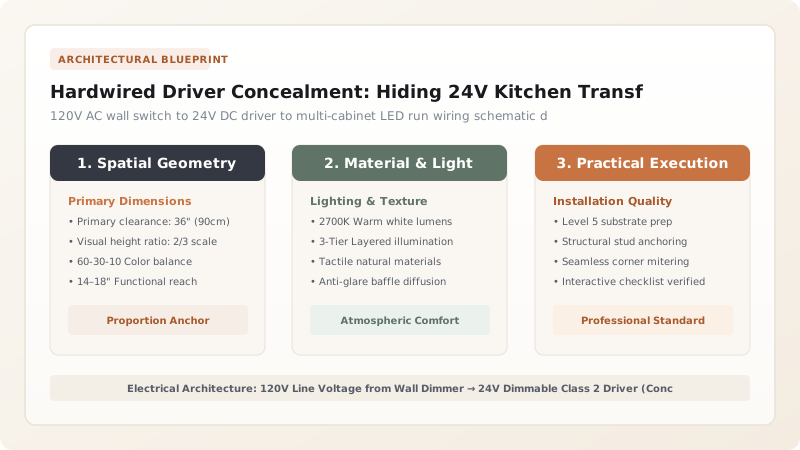
1. Electrical Engineering: Total Wattage & 80% Derating Calculations
Running an LED power supply at 100% capacity causes internal capacitors to overheat, leading to premature driver failure and irritating high-pitched coil whine.
The National Electrical Code (NEC Article 210.20) mandates that continuous loads must not exceed 80% of rated capacity. The minimum required Driver Wattage (\(W_{\text{driver}}\)) for total strip wattage (\(W_{\text{total}}\)) is calculated by:
$$W_{\text{driver}} = \frac{W_{\text{total}}}{0.8} = W_{\text{total}} \times 1.25$$
For a kitchen with 20 feet of 4.5W/ft strip tape (\(90\text{W total}\)), you need a minimum 120W Driver (or two 60W Class 2 drivers). Explore channel profiles in under-cabinet lighting.

2. Low-Voltage Distribution: Voltage Drop & 18/2 vs 16/2 AWG Sizing
Low-voltage DC current experiences electrical resistance over long wire runs, causing lights at the end of the line to appear dim and warm.
For 24V Systems, use 18/2 AWG In-Wall Rated (CL2/CL3) Cable for runs up to 30 feet, and upgrade to 16/2 AWG for runs between 30 and 60 feet. Review color rendering in 95+ CRI culinary illumination.
24V Wire Gauge vs Maximum Run Distance (<3% Voltage Drop)
Use this reference table to calculate exact physical dimensions, ratios, and specifications before purchasing:
| Wire Gauge (AWG) | Max Load on Run | Max Safe Wire Distance (24V) | Recommended In-Wall Cable Spec |
|---|---|---|---|
| 18/2 AWG CL2 (Standard) | 48 Watts (2.0 Amps) | Up to 32 Feet (10 meters) | UL Rated In-Wall Direct Burial |
| 16/2 AWG CL2 (Long Runs) | 48 Watts (2.0 Amps) | Up to 50 Feet (15 meters) | Oxygen-free stranded copper |
| 14/2 AWG CL2 (Heavy Load) | 96 Watts (4.0 Amps) | Up to 75 Feet (23 meters) | Commercial architectural grade |
| 22/2 AWG Thin Wire (Avoid) | 48 Watts (2.0 Amps) | FAILS over 10 Feet (Severe drop) | Low-quality speaker wire / Avoid |
Dimmer Incompatibility Strobing Constraints
Every successful decoration project must account for physical and environmental constraints:
TRIAC Forward-Phase Wall Dimmer Causing Rapid LED Flickering at Low Dims
Traditional wall dimmers designed for incandescent bulbs chop AC sine waves improperly for electronic LED drivers, causing rapid strobing below 30% brightness; install Universal Reverse-Phase (ELV - Electronic Low Voltage) or dedicated 0-10V dimmers paired with smooth-dimming Lutron or ERP drivers.
How to Calculate, Wire, and Commission a Remote LED Driver System
Execute this professional sequence to achieve flawless results without backtracking:
Measure Total Linear Footages Across Cabinet Zones
Sum total linear feet of LED strip across all upper cabinets (e.g., 8ft main run + 6ft island = 14ft).
Calculate Total Wattage and Apply 80% Derating
Multiply length by tape wattage (14ft × 4W/ft = 56W); divide by 0.8 = 70W minimum driver requirement.
Select 24V Class 2 Electronic Dimming Driver
Specify a 96W 24V Class 2 dimmable driver compatible with reverse-phase ELV or 0-10V dimming protocols.
Install Metal Gang Box in Pantry / Utility Closet
Mount ventilated steel junction box in accessible location near 120V AC feed from wall dimmer switch.
Pull 18/2 AWG CL2 In-Wall Cable to Cabinets
Fish 18-gauge low-voltage cables from driver box through wall framing into upper cabinet corners.
Terminate Wiring with WAGO Lever Nuts
Connect parallel feeds using WAGO 221 lever nuts; verify 24.0V DC with digital multimeter before powering on.
Common Mistakes & Countermeasures
Avoid these costly errors that compromise aesthetics, ergonomics, and budget:
Burying Drivers Inaccessibly Inside Drywall
Project Execution Checklist
Track your physical progress. Checkboxes persist automatically on this device:
Frequently Asked Questions
Why is 24V DC preferred over 12V DC for under-cabinet lighting?
24V systems operate at half the current (amperage) of 12V systems for the exact same wattage (\(P = V \times I\)). Lower amperage reduces resistive heat loss, allows wire runs twice as long without dimming, and supports longer continuous strip runs (up to 32 feet on a single feed).


