
Specify 95+ CRI LED strip lighting with an R9 saturated red score greater than 80 for kitchen under-cabinet fixtures. Standard 80 CRI LEDs lack deep 660nm red wavelengths, making fresh meats and produce look dull gray and giving white marble countertops a sickly greenish tint.
At a Glance: Key Takeaways
- Color Rendering Index (CRI / Ra): Measures how accurately a light source reveals object colors compared to natural daylight (scale 0–100).
- The Critical R9 Value (Saturated Red): General CRI (Ra) only tests pastels (R1–R8); R9 specifically measures saturated red spectrum reproduction.
- TM-30-18 Advanced Metrics: Measures Color Fidelity (\(R_f \ge 92\)) and Color Gamut (\(R_g \approx 100\)) across 99 modern color samples.
- Stone Countertop Vein Enhancement: Full-spectrum light brings out gold, rust, and charcoal veins in Calacatta marble and quartz.
- Culinary Safety & Aesthetics: High R9 light ensures meats, fish, and vegetables are judged with perfect freshness accuracy during prep.
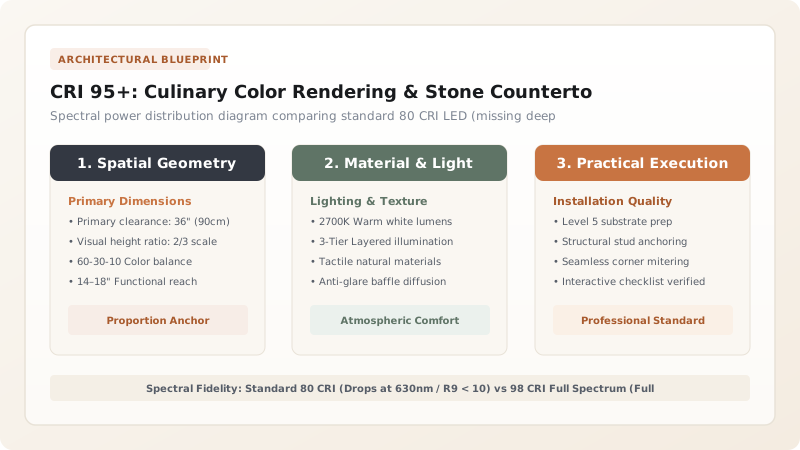
1. Color Science: General CRI (Ra) vs Saturated Red (R9) Values
Most commercial builders install cheap 80 CRI LED Strips because they are inexpensive. However, the standard 80 CRI test only averages 8 muted pastel color swatches (R1 through R8), completely ignoring R9 (Saturated Red).
Cheap 80 CRI LEDs often have an R9 score near zero (or even negative), meaning they produce zero light at the 660nm red wavelength. This makes ripe strawberries look brown, cuts of raw meat look gray, and warm cherry wood cabinets look sickly green. In luxury culinary architecture, specify CRI \(\ge 95\) with \(R9 \ge 80\). Learn joinery routing in recessed router channels.

2. TM-30 Metrics & Calibrating Light for Natural Stone Countertops
Modern lighting designers evaluate light using IES TM-30-18, which evaluates Fidelity Index (\(R_f\)) and Gamut Index (\(R_g\)).
For luxury marble, quartzite, and wood countertops, select fixtures with \(R_f \ge 92\) and \(R_g \approx 100\) at 3000K. Review overall layouts in under-cabinet millwork lighting.
LED Color Rendering Tiers for Kitchen Environments
Use this reference table to calculate exact physical dimensions, ratios, and specifications before purchasing:
| CRI Tier | CRI (Ra) | R9 (Saturated Red) | Visual Quality in Kitchen |
|---|---|---|---|
| Museum / Culinary Grade (Optimal) | CRI 95 to 98 | R9 > 85 (Full deep red) | 100% Rich vibrant food & crisp white marble |
| High-End Residential Standard | CRI 90 to 94 | R9 > 50 (Good red balance) | Accurate colors / Pleasing warm tones |
| Commercial Office Grade (Avoid) | CRI 80 to 85 | R9 = 0 to 10 (Zero red) | FAILS: Meats look gray / Marble looks greenish |
| Low-Cost Economy Strip (Avoid) | CRI < 75 | R9 < 0 (Negative red) | FAILS: Severe color distortion / Eye fatigue |
High CRI Luminous Efficacy Tradeoff Constraints
Every successful decoration project must account for physical and environmental constraints:
High CRI 95+ LEDs Producing 15% Lower Lumens Per Watt Than 80 CRI
Broadband red phosphors in 95+ CRI LEDs absorb more blue light, reducing efficiency from 120 lm/W to 95 lm/W; increase LED tape power density from 3.5W/ft to 4.5W–5.0W/ft to maintain vibrant 350 lm/ft countertop task illuminance.
How to Specify and Verify High CRI Kitchen LED Lighting
Execute this professional sequence to achieve flawless results without backtracking:
Check Manufacturer Photometric Cut Sheet
Verify specification sheet lists CRI (Ra) >= 95 and specifically calls out R9 >= 80 (not just generic CRI).
Verify TM-30-18 Fidelity Index (Rf)
Confirm TM-30 testing shows Rf >= 92 and Gamut Index Rg between 98 and 102 for neutral saturation.
Select 3000K Color Temperature for Warm Natural Tones
Specify 3000K CCT within 3-Step MacAdam Ellipse (SDCM < 3) for absolute color consistency across runs.
Calculate Wattage for Target Lux (500 Lux on Countertop)
Size 4.5W/ft strip to deliver 350–400 lumens per linear foot through the satin opal diffuser.
Test with Color Checker Card on Countertop
Perform on-site inspection with X-Rite color checker card to confirm vivid reds, greens, and skin tones.
Common Mistakes & Countermeasures
Avoid these costly errors that compromise aesthetics, ergonomics, and budget:
Trusting '90 CRI' Marketing Claims Without Checking the R9 Score
Project Execution Checklist
Track your physical progress. Checkboxes persist automatically on this device:
Frequently Asked Questions
What is the MacAdam Ellipse and why does it matter for under-cabinet lighting?
The MacAdam Ellipse (SDCM) measures color consistency between different LED batches. A 2-Step or 3-Step MacAdam Ellipse guarantee ensures that two separate strips installed on opposite sides of a kitchen have zero visible color difference.


