
Eliminate LED hotspots and diode dot reflections in tray ceiling coves by mounting continuous Chip-on-Board (COB) 24V LED tape inside a 45-degree angled aluminum extrusion with an opal frosted diffuser lens. Position the channel 1 inch back from the 3.5-inch cove lip, aiming the light beam upward and inward.
At a Glance: Key Takeaways
- 45-Degree Angled Extrusion: Sweeps light across the central ceiling plane rather than creating a harsh line on the vertical riser.
- Chip-on-Board (COB) LED Technology: 480+ micro-LEDs per meter create a seamless continuous phosphor glow line with zero diode dots.
- High Color Rendering (90+ CRI / 2700K): Renders natural wood furniture, fabrics, and skin tones with warm, flattering accuracy.
- Class 2 24V DC Low-Voltage Power: Prevents voltage drop and dimming fade across long 50-foot continuous cove runs.
- 0.1% Smooth Dimming (PWM / 0-10V): Eliminates flicker when transitioning from daytime ambient to cozy evening mood lighting.
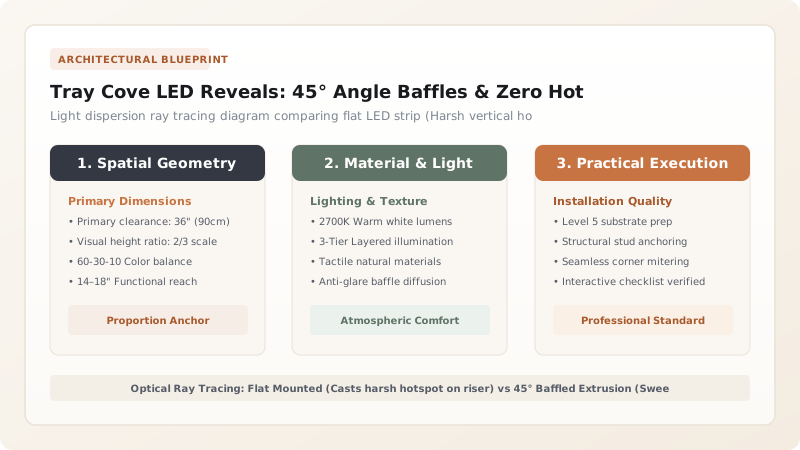
1. Solid-State Optics: COB (Chip-on-Board) vs Traditional SMD Diodes
Traditional LED tape uses spaced SMD (Surface Mount Diode) chips (typically 60 to 120 LEDs per meter). When placed in a ceiling cove, each individual diode casts a distinct bright scallop, creating the dreaded 'Dot-Matrix Effect' on ceiling drywall.
Modern architectural lighting specifies COB (Chip-on-Board) LED Strip. Packed with over 480 microscopic diode chips per meter beneath a continuous phosphor coating, COB tape emits a completely seamless, unbroken ribbon of light that looks like a neon gas tube. Pair with smart circadian 2700K–4000K automation.

2. Cove Trough Geometry: The 3.5" Light Lip & 45° Extrusion
To ensure total visual comfort, the light source must remain 100% invisible to standing and seated room occupants (*Cut-Off Angle*).
Milling a 3.5-inch (90mm) horizontal drywall light lip provides the perfect optical baffle. Placing the 45-degree aluminum extrusion 1 inch behind the lip shields the fixture while directing 95% of emitted lumens upward across the central recessed tray ceiling.
Cove LED Tape Types & Optical Diffusion Ratings
Use this reference table to calculate exact physical dimensions, ratios, and specifications before purchasing:
| LED Tape Specification | Diode Density (LEDs/m) | Hotspot Visibility | Visual Luxury Rating |
|---|---|---|---|
| 24V COB Seamless LED Tape (Optimal) | 480 - 528 LEDs/m | 0% (Completely seamless line) | Maximum (High-end architectural) |
| High-Density SMD 2835 | 240 LEDs/m + Frosted lens | 5% - 10% (Faint dotting) | High |
| Standard SMD 5050 (Budget) | 60 LEDs/m | 60% (Visible harsh dots) | FAILS: Looks cheap & patchy |
| RGB Multicolor Rope Light (Toy) | 30 LEDs/m | 100% Dot scallops | POOR: Uneven color casting |
Voltage Drop Dimming Fade Constraints
Every successful decoration project must account for physical and environmental constraints:
Long 60-Foot Perimeter Cove LED Strips Getting Dimmer at Far Corners
12V LED strips suffer severe electrical resistance voltage drop over runs >16 feet, causing the far end of the ceiling to look dark and discolored; strictly specify 24V DC systems, and inject power at both ends (ring circuit) for runs over 30 feet.
How to Install and Wire Zero-Hotspot Cove LEDs
Execute this professional sequence to achieve flawless results without backtracking:
Paint Cove Trough Interior Flat White
Paint the inside of the cove trough with high-reflectance flat white paint (LRV > 85) to maximize light bounce.
Mount 45° Aluminum Corner Channels
Screw 45-degree V-shaped aluminum extrusions along the inside corner of the cove lip.
Adhere 24V High-CRI COB LED Strip
Peel 3M thermal adhesive backing and press COB LED tape firmly into the aluminum heat sink channel.
Snap Opal Frosted Diffuser Lenses
Click frosted polycarbonate covers into the extrusion to protect LEDs from dust and blend output.
Connect Dual-End Low-Voltage Power Leads
Solder or clip 18/2 Class 2 power feeds to both ends of the run to prevent voltage drop fade.
Common Mistakes & Countermeasures
Avoid these costly errors that compromise aesthetics, ergonomics, and budget:
Sticking Bare LED Tape Directly to Raw Drywall Without Aluminum Channels
Project Execution Checklist
Track your physical progress. Checkboxes persist automatically on this device:
Frequently Asked Questions
What color temperature is best for bedroom and living room tray ceilings?
2700K (Warm White) with a 90+ CRI is the international luxury residential standard. It produces an inviting golden amber glow that relaxes the nervous system and complements warm hardwood and linen furnishings.


