
Design a smart architectural lighting system using Lutron Caséta Clear Connect RF dimmers (or 0-10V low-voltage dimming drivers) for 100% flicker-free 1% dimming. Program circadian schedules that automatically shift light color temperature from 4000K in the morning down to 2200K at night to support natural sleep rhythms.
At a Glance: Key Takeaways
- Lutron Clear Connect RF: Ultra-reliable 434 MHz radio frequency protocol that operates independently of home Wi-Fi crashes.
- 1% Smooth Dimming Curve: Eliminates LED flickering, stepping jumps, and buzzing at low nighttime light levels.
- Automated Circadian Kelvin Shifting: Tunable white LEDs shift dynamically from 4000K morning focus to 2200K evening candlelight.
- Multi-Zone Scene Keypads: Replaces 4-gang wall clutter with a single clean 4-button architectural engraved keypad.
- 10% Pathway Motion Nightlights: Automatically illuminates baseboard and under-vanity LEDs at 10% brightness during night hours.
In-Depth Guides in this Directory
Explore specialized subtopic blueprints, technical dimensions, and execution checklists:
0-10V vs Lutron Caséta: Dimming Waves, ELV & 1% Smoothness
Master architectural smart dimming engineering: 0-10V low-voltage control vs Lutron Caséta Clear Connect, forward vs reverse phase ELV waveforms, and eliminating LED buzzing.
Circadian Lighting: 2200K–4000K Automated Kelvin Shifts
Master circadian lighting automation: melanopic lux calculations, automated 2200K to 4000K tunable white schedules, astronomical sunset triggers, and sleep hygiene.
Smart Pathway Lighting: 10% Lux Motion Sensor Night Zones
Master smart nightlight pathway automation: 10% low-lux under-vanity and baseboard motion zones, passive infrared (PIR) beam masking, and sleep-safe nighttime navigation.
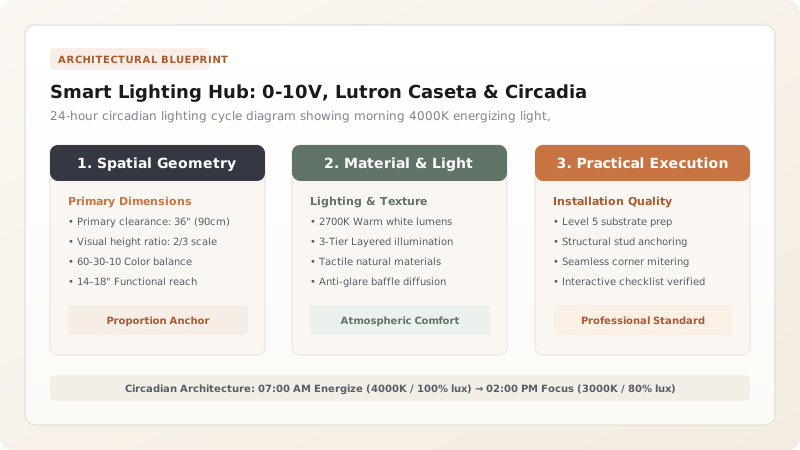
1. Wireless Architecture: Clear Connect RF vs Wi-Fi vs Zigbee/Matter
Cheap smart Wi-Fi lightbulbs from big-box retailers create heavy 2.4 GHz router congestion, lag during scene triggering, and stop functioning entirely when internet service drops.
Professional luxury lighting automation relies on Lutron Clear Connect RF (434 MHz Sub-Gigahertz Frequency) or Hardwired 0-10V / DALI-2 Control. Operating on dedicated frequencies outside congested Wi-Fi bands guarantees instantaneous (<30ms) scene execution and 100% offline reliability.

Smart Lighting Control Protocols & Performance
Use this reference table to calculate exact physical dimensions, ratios, and specifications before purchasing:
| Control Protocol | Transmission Frequency | Dimming Range & Quality | System Reliability |
|---|---|---|---|
| Lutron Caséta / RA3 (Optimal) | 434 MHz Proprietary RF | Continuous 1% to 100% (Zero flicker) | Maximum (100% Offline operation) |
| Hardwired 0-10V Low Voltage | Dedicated 2-wire DC (0-10V) | Smooth 0.1% to 100% Studio Dimming | Maximum (Commercial grade) |
| Matter / Thread Protocol | 2.4 GHz IPv6 Mesh | 5% to 100% (Bulb dependent) | High (Self-healing mesh) |
| Budget Wi-Fi Smart Bulbs | 2.4 GHz Standard Wi-Fi | 10% to 100% (Prone to step jumps) | POOR: Fails if Wi-Fi reboots |
Neutral Wire Old House Constraints
Every successful decoration project must account for physical and environmental constraints:
Older Homes Lacking Neutral Wires in Wall Switch Boxes
Pre-1980s homes lack white neutral wires required to power smart switches; specify 'Lutron Caséta No-Neutral Dimmers (PD-6WCL)' which harvest micro-currents through the load circuit without requiring neutral wires.
How to Program Architectural Smart Lighting Scenes
Execute this professional sequence to achieve flawless results without backtracking:
Replace Wall Switches with Smart Dimmers
Install Lutron Caséta or RA3 smart dimmers with reverse-phase electronic low-voltage (ELV) drivers.
Group Fixtures into Logical Lighting Zones
Create distinct zones: Zone 1 (Cove Ambient), Zone 2 (Art Accent Spots), Zone 3 (Table Pendants).
Program 'Entertain' Scene
Set Cove Ambient to 60%, Art Spots to 80%, and Table Pendants to 35% for warm dinner ambiance.
Program 'Cinema' Scene
Fade all ceiling downlights to 0%, keeping cove indirect wash at 8% deep 2200K amber glow.
Set Circadian Sunset Automation
Enable astronomical clock automation to shift color temperature from 3000K to 2400K at local sunset.
Common Mistakes & Countermeasures
Avoid these costly errors that compromise aesthetics, ergonomics, and budget:
Mixing Forward-Phase and Reverse-Phase Dimmers on Modern LED Drivers
Project Execution Checklist
Track your physical progress. Checkboxes persist automatically on this device:
Frequently Asked Questions
What is the difference between dim-to-warm and tunable white LEDs?
Dim-to-Warm LEDs automatically drop from 3000K to 2200K as you lower the dimmer (simulating incandescent filaments). Tunable White LEDs have two independent circuits, allowing you to change color temperature independently of brightness.


