
Choose Lutron Caséta PRO (with Reverse-Phase Trailing-Edge ELV dimming) for residential retrofits to achieve 1% flicker-free dimming over existing wiring. Choose 0-10V hardwired control for new commercial-grade architectural builds with long LED tape runs and high-wattage cove drivers.
At a Glance: Key Takeaways
- Reverse-Phase (ELV) Trailing Edge: Cuts the back half of the AC sine wave smoothly, eliminating buzzing in electronic LED drivers.
- 0-10V Analog DC Control: Uses dedicated purple/gray 0-10V signal wires to throttle driver output directly from 10V (100%) to 1V (10%).
- 1% True Low-End Trim: Calibrates the lowest dimming threshold to prevent LEDs from suddenly snapping off.
- Clear Connect 434 MHz RF: Lutron's rock-solid wireless protocol guarantees instant response without Wi-Fi dropouts.
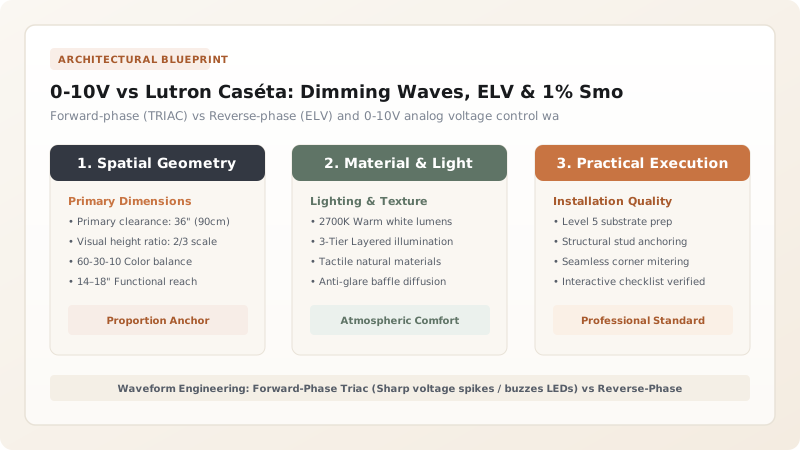
1. Electrical Physics: Forward-Phase Triac vs Reverse-Phase ELV
Traditional 1970s wall dimmers use Forward-Phase (TRIAC) leading-edge dimming. The dimmer chops off the front of each AC half-wave, creating sharp, violent voltage spikes (\(120\text{V} / \mu\text{s}\)) that cause electronic LED capacitors to vibrate and emit an annoying high-pitched acoustic buzz.
Modern luxury architecture uses Reverse-Phase (Trailing-Edge ELV) or 0-10V Low-Voltage Control. Trailing-edge dimming turns on smoothly at zero voltage and cuts off gently at the back of the wave, delivering 100% silent operation and buttery-smooth 1% low-end dimming.

Dimming Technologies Comparison
Use this reference table to calculate exact physical dimensions, ratios, and specifications before purchasing:
| Dimming Standard | Control Wiring Needed | Low-End Dimming Depth | Acoustic Buzz Risk |
|---|---|---|---|
| Reverse-Phase ELV (Lutron PRO) | Standard 120V + Neutral wire | 1.0% Smooth Low-End | 100% Silent (Zero buzz) |
| 0-10V Hardwired Low-Voltage | 120V Line + 2 Low-Voltage wires | 0.1% - 1.0% Ultra-Deep | 100% Silent (Commercial grade) |
| Forward-Phase (Standard TRIAC) | Standard 2-wire (No neutral) | 10% - 15% (Snaps off early) | HIGH (Audible buzzing) |
| DALI-2 Digital Addressable | 2-wire digital bus (Polarity free) | 0.1% Individual fixture control | 100% Silent (Ultra-luxury) |
LED Driver Low-End Pop-On Constraints
Every successful decoration project must account for physical and environmental constraints:
LEDs 'Popping On' at 15% Brightness When Turned On from Dim
Cheap LED drivers have high startup voltage thresholds, popping brightly before dimming down; strictly specify 'Architectural-Grade Class 2 Drivers (like Lutron Hi-lume or eldoLED SOLOdrive)' that guarantee smooth fade-up from 0.1%.
How to Calibrate Low-End Trim on a Smart Dimmer
Execute this professional sequence to achieve flawless results without backtracking:
Enter Dimmer Calibration Mode
Press and hold Tap and Down buttons on the Lutron dimmer for 6 seconds until LEDs flash.
Lower Light Output to Minimum
Press the Down button repeatedly until the connected LED fixtures begin to flicker or shut off completely.
Raise 2 Steps Above Flicker
Tap the Up button 2 times to find the lowest stable, non-flickering light level (typically 1.5% to 2%).
Save Low-End Threshold
Press and hold the Off button for 6 seconds to lock the permanent low-end trim into firmware memory.
Test Fade-Up from Zero
Turn light off, then turn back on at lowest level to verify smooth, flicker-free ignition.
Common Mistakes & Countermeasures
Avoid these costly errors that compromise aesthetics, ergonomics, and budget:
Connecting 0-10V Control Wires Inside the Same Conduit as 120V AC Lines
Project Execution Checklist
Track your physical progress. Checkboxes persist automatically on this device:
Frequently Asked Questions
Can Lutron Caséta control magnetic low-voltage (MLV) landscape lights?
Yes! The Lutron Caséta PRO dimmer (model PD-10NXD) is rated for magnetic low-voltage (MLV), electronic low-voltage (ELV), and standard LED loads.


