
Yemeni Qadad is an ancient hydraulic waterproofing plaster renowned for protecting water cisterns, palace facades, and the roof parapets of Shibam's mudbrick towers. Compounded from wood-calcined limestone slaked for months and crushed volcanic scoria cinder (dums), Qadad is applied in multi-tier coats and pounded continuously for two to three weeks with smooth basalt stones. The application of hot rendered sheep tallow chemically reacts with calcium hydroxide to form insoluble calcium stearates, producing a vitreous, self-healing, hydrophobic white shield that withstands torrential monsoon rains for over two centuries.
At a Glance: Key Takeaways
- Binder Chemistry: Wood-calcined pure Calcium Oxide (CaO), pit-slaked 3 to 12 months
- Hydrophobic Sealant: Rendered mutton tallow (Dahn) rubbed into hot burnished pores
- Labor Protocol: Continuous stone hammering (Daqq) for 14 to 21 days
- Pozzolanic Aggregate: Crushed volcanic scoria/pumice cinder (Dums, 1-5mm grain size)
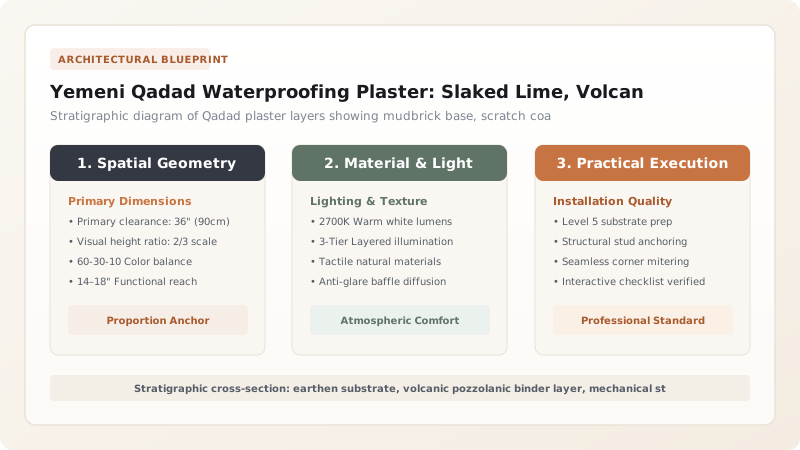
The Chemistry of Qadad: Lime Calcination and Volcanic Dums
Practiced across southern Arabia since the Himyarite Kingdom (8th century BC), the art of Qadad is one of the world's most sophisticated vernacular hydraulic plasters. The foundation of Qadad begins with pure limestone quarried from regional cliffs and burned in wood-fired kilns for several days to drive off carbon dioxide, producing quicklime (calcium oxide, CaO).
The lime is then slaked in water pits and aged for anywhere from three months to a full year. This extended wet-aging transforms coarse lime into microscopic colloidal calcium hydroxide crystals. When mixed with Dums—finely crushed volcanic scoria and pumice cinders rich in amorphous reactive silica and alumina—a powerful pozzolanic reaction occurs. The silica dissolves in the alkaline lime water, forming calcium silicate hydrates (C-S-H) that cure into an insoluble artificial stone that sets even underwater.
Mechanical Compaction: The Stone Hammering Ritual (Daqq al-Qadad)
Unlike modern plasters that are simply troweled on and left to dry, Qadad requires relentless mechanical compaction. The mortar is applied to the earthen wall in three successive coats over a coarse lime-rubble scratch coat. Once the final coat reaches leather-hardness, the team of plasterers begins the process of Daqq (hammering).
Holding smooth, rounded basalt river stones (Muhashshah) in both hands, the artisans strike the damp plaster with rapid, rhythmic, overlapping taps. This hammering continues for hours every day for two to three weeks, with the surface lightly misted with lime water to prevent flash drying. The immense localized compressive pressure collapses all microscopic air pockets, forces water to the surface, and aligns the volcanic platelets into an ultra-dense, non-porous crystalline matrix.
Chemical Saponification: Rendered Mutton Tallow and Stearate Sealing
The final stage transforms water-absorbing lime into a completely waterproof membrane. While the surface is still warm from the sun and friction, the craftsman applies warm rendered sheep or goat tallow (Dahn) mixed with wild sesame or castor oil.
Using flat polished agates or smooth hardwood blocks, the fat is burnished aggressively into the microscopic pores. The fatty acids (primarily stearic and oleic acid) in the animal fat undergo a chemical saponification reaction with the abundant free calcium hydroxide in the plaster, creating insoluble calcium stearate—the exact chemical basis of modern industrial water-repellent admixtures. The resulting surface is smooth as polished marble, blindingly white, and sheds tropical rain like glass.
Heritage Conservation: Replacing Qadad and Preventing Delamination
Because authentic Qadad requires immense manual labor and months of preparation, 20th-century builders frequently attempted to repair damaged Shibam roofs with modern Portland cement. The results were universally catastrophic: cement creates a rigid, vapor-impermeable barrier that traps moisture behind it, rotting the sun-dried mudbrick beneath and causing massive sheets of plaster to peel and crash into the streets below.
Modern UNESCO conservation projects in Shibam and Sana'a have revived traditional Qadad guilds. Conservators remove cracked cement patches, clean the unbaked earth substrate, and reapply authentic volcanic lime plasters. While labor-intensive, an authentic Qadad roof requires virtually zero maintenance for 50 to 100 years, requiring only a light rub with tallow every decade.
Yemeni Qadad Multi-Coat Application Specifications
Use this reference table to calculate exact physical dimensions, ratios, and specifications before purchasing:
| Plaster Stratum | Mix Ratio (Lime : Volcanic Cinder) | Aggregate Sizing (mm) | Application Thickness | Compaction / Curing Protocol |
|---|---|---|---|---|
| Base Scratch Coat (Tasrib) | 1 : 2.5 (Aged lime : Coarse cinders) | 3.0 – 6.0 mm sharp scoria | 15 – 20 mm | Cross-hatched keying; cured 7 days under damp mats |
| Intermediate Coat (Batnah) | 1 : 2.0 (Aged lime : Medium cinders) | 1.5 – 3.0 mm graded volcanic ash | 10 – 12 mm | Initial stone tamping; misted with lime water daily |
| Finish Body Coat (Zahrah) | 1 : 1.5 (Colloidal lime : Fine powder) | 0.2 – 1.0 mm fine pulverized pumice | 5 – 8 mm | 14 days continuous basalt stone pounding (Daqq) |
| Saponified Seal (Sayqal) | Pure tallow + boiled linseed oil | Non-particulate liquid lipid | Sub-surface penetration (~2mm) | Friction burnishing with smooth river agates |
Practical Constraints
Every successful decoration project must account for physical and environmental constraints:
Colossal Labor Intensity and High Cost of Manual Stone Hammering
A single roof terrace requires hundreds of hours of manual stone pounding, tempting building owners to use cheap modern cement. Solution: Organize cooperative neighborhood plastering guilds (Ta'awun) and develop pneumatic stone-compaction tools for large projects.
Extreme Desert Evaporation Causing Premature Shrinkage Checks
Blistering 45°C midday sun evaporates water before hydraulic pozzolanic reactions can take place, causing plaster crazing. Solution: Cover fresh Qadad installations with soaked burlap sacks and woven palm mats, applying water misting twice daily during curing.
Execution Blueprint & Craftsmanship Sequence
Execute this professional sequence to achieve flawless results without backtracking:
Wood-Fired Quicklime Calcination and Long Slaking
Fire high-purity limestone in wood kilns for 4 days; quench in clean water; age submerged in pit troughs for minimum 90 days.
Volcanic Scoria Crushing and Particle Grading
Quarry black volcanic scoria (Dums); crush with iron hammers; sift through brass screens into coarse (4mm) and fine (1mm) aggregate batches.
Substrate Wetting and Base Scratch Coat Application
Dampen the earthen mudbrick wall; apply a 15mm coarse Qadad scratch coat; rake horizontal bonding grooves; wet-cure 7 days.
Body Coat Application and Initial Tamping
Trowel on intermediate and finish Qadad layers; tamp lightly with flat wooden floats to bring lime cream to the surface.
Two-Week Stone Hammering (Daqq al-Qadad)
Pound the leather-hard plaster rhythmically with rounded basalt stones for 14 days, misting with lime water to maintain hydration.
Rendered Tallow Saponification and Agate Burnish
Warm surface with sun; brush hot mutton tallow across pores; burnish with agate stones until a glossy, watertight polish is achieved.
Common Mistakes & Countermeasures
Avoid these costly errors that compromise aesthetics, ergonomics, and budget:
Pounding Qadad When the Plaster Is Too Dry or Fully Carbonated
Applying Petroleum-Based Mineral Oils Instead of Animal Tallow
Project Execution Checklist
Track your physical progress. Checkboxes persist automatically on this device:
Frequently Asked Questions
Why does Qadad last for centuries while modern cement plaster cracks in a few years?
Modern Portland cement contains high levels of soluble alkalis and forms a brittle, rigid mass with high shrinkage rates that cracks under thermal cycling. Qadad cures via slow pozzolanic reactions between lime and volcanic silica. It remains slightly elastic, matches the thermal expansion of the earthen mudbrick wall, and undergoes 'autogenous self-healing'—rainwater dissolves free lime within hairline cracks and re-crystallizes as calcite, sealing the breach automatically.
Can Qadad be applied to vertical walls as well as flat roofs?
Yes. While predominantly used on flat roofs, parapets, and water cisterns where standing water is an issue, Qadad is also applied to the exterior window surrounds, water drainage spouts, and kitchen splash zones of high-rise towers in Shibam and Sana'a.
What is the role of volcanic cinders (Dums) in the mix?
Volcanic cinders serve as a natural pozzolan. When pulverized, the amorphous glass and reactive aluminosilicates in the volcanic cinder react with calcium hydroxide in the slaked lime to form calcium silicate hydrate crystals. This gives non-hydraulic lime the ability to set hydraulically and develop immense compressive hardness.
Why is sheep tallow used instead of plant oils like olive or linseed oil?
Rendered mutton tallow contains extraordinarily high concentrations of saturated stearic and palmitic fatty acids. When rubbed into lime plaster, these saturated fats form dense, stable calcium stearate soaps that do not turn rancid, yellow, or break down under intense tropical ultraviolet sunlight.


