
In Shibam's high-rise mudbrick towers, passive climate control is achieved through an integrated system of projecting wooden Mashrabiya lattices and vertical internal lightwells (Qasabah). Hand-carved from native Tamarisk (Ithil) and Jujube (Sidr) timber, the latticework screens shade rooms from intense solar radiation while compressing incoming breezes via the Venturi effect. The accelerated air flows across unglazed porous earthenware water jugs (Sharbah) to provide evaporative cooling before rising through central multi-story lightwells via thermal stack buoyancy.
At a Glance: Key Takeaways
- Evaporative Element: Porous unglazed terracotta water jars (Sharbah) placed in airflow
- Lattice Joinery: Turned wooden bobbin joints assembled without glue or metal pins
- Passive Airflow Physics: Venturi air acceleration + stack-effect vertical thermal buoyancy
- Window Timber: Native Tamarisk (Tamarix aphylla / Ithil) & Wild Jujube (Sidr)
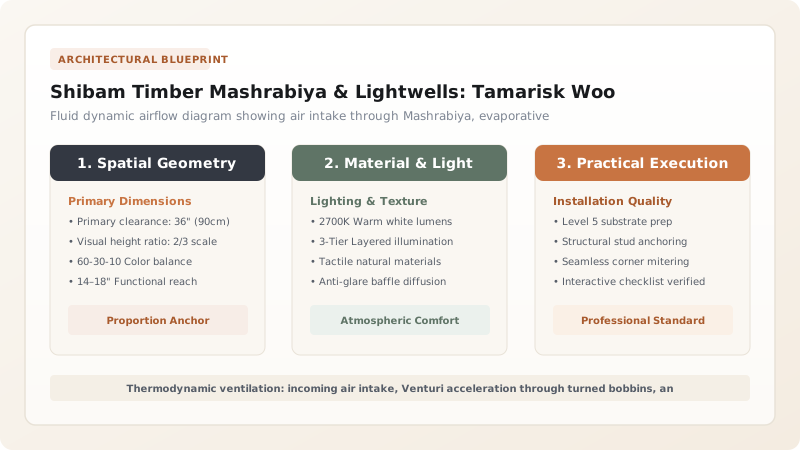
The Mashrabiya Latticework: Geometry and Tamarisk Woodcraft
Projecting from the fourth through seventh stories of Shibam's towers are the masterworks of Yemeni carpentry: the Mashrabiya (locally termed Rawshan or Kharajah). In an arid desert region where long, straight timber is a scarce luxury, carpenters utilized Tamarisk (Tamarix aphylla, known as Ithil) and Wild Jujube (Ziziphus spina-christi, or Sidr).
These indigenous desert hardwoods are exceptionally dense, bitter to wood-boring insects, and resist warping under 10% relative humidity. Master joiners turn short timber lengths into cylindrical bobbins (Mawaheel) connected by rounded knuckles. Assembled entirely without glue or metallic nails, the lattice pieces interlock like universal joints, accommodating seasonal expansion and contraction without cracking.
Thermodynamics of the Screen: Venturi Airflow and Glare Attenuation
A Mashrabiya is not merely decorative; it is a sophisticated aerodynamic instrument. In the scorching Hadramawt valley, ambient summer winds can be gentle and dry. As hot air approaches the projecting lattice, the narrow apertures between the turned bobbins compress the airflow.
By the Venturi principle, this constriction increases wind velocity as it enters the room, producing a sensible cooling effect on human skin. Simultaneously, the cylindrical contours of the wooden bobbins scatter direct sunlight: light striking the curved surface is diffused into a soft, ambient glow, eliminating harsh glare while maintaining complete one-way visual privacy for women and families inside.
The Qasabah Chimney: Central Lightwells and Stack-Effect Ventilation
Deep within the core of every multi-story Shibam tower house runs a vertical light and ventilation shaft known as the Qasabah. Extending from the ground floor up to the open sky on the roof terrace, the Qasabah functions as a thermal chimney.
Because the sun bakes the upper open portion of the chimney while lower floors remain shaded within deep urban alleyways, a natural temperature and pressure differential is established. Warm air inside the upper rooms rises and exhausts freely out the top of the Qasabah. This upward thermal draft draws fresh, cooler air through the Mashrabiya screens on the lower windward facades, creating continuous 24-hour air circulation even on windless days.
Evaporative Cooling: Porous Sharbah Jars and Humidity Conditioning
The name Mashrabiya is derived from the Arabic root sharaba (to drink), historically denoting the 'place of drinking'. In traditional Hadrami practice, unglazed porous earthenware water jugs (Sharbah) filled with drinking water were placed on dedicated shelves directly inside the wooden screen.
As hot, dry desert air rushes through the lattice, it sweeps across the sweat-beaded exterior of the porous clay jars. The water evaporates rapidly, absorbing latent heat from both the drinking water and the incoming air stream. This process drops the incoming air temperature by 5°C to 8°C while raising indoor relative humidity from an arid 15% to a soothing, respiratory-friendly 35%.
Shibam Passive Microclimate & Ventilation Specifications
Use this reference table to calculate exact physical dimensions, ratios, and specifications before purchasing:
| Microclimate Device | Primary Material | Aerodynamic / Thermodynamic Function | Temperature / Humidity Effect | Maintenance Cycle |
|---|---|---|---|---|
| Turned Mashrabiya Lattices | Ithil Tamarisk & Sidr Jujube | Venturi airflow acceleration & glare reduction | Increases air velocity by 2.5x; cuts glare 70% | Annual linseed oil wipe-down |
| Qasabah Central Lightwell | Mudbrick shaft coated with slaked lime | Stack-effect thermal updraft exhaust chimney | Generates continuous 0.5-1.2 m/s air draft | Annual whitewash re-coating |
| Unglazed Sharbah Jars | High-porosity Hadrami alluvial terracotta | Passive evaporative water vapor injection | Reduces air temperature by 5°C – 8°C | Weekly scrubbing with clean water |
| Rooftop Mafraj Louvers | Carved Tamarisk operable flaps (Shursh) | Nocturnal cool breeze capture and downdraft | Flushes heat out of thermal masonry core | Seasonal hinge lubrication |
Practical Constraints
Every successful decoration project must account for physical and environmental constraints:
Extreme Timber Warping and Desiccation in 10% Desert Humidity
Inferior commercial softwoods shrink rapidly, opening joint gaps and loosening lattice bobbins within months. Solution: Utilize solely indigenous, slow-grown wild desert Tamarisk or Jujube wood cured via extended water-immersion seasoning.
Modern Aluminum and Glass Retrofits Destroying Natural Airflow
Replacing carved wooden screens with sliding glass windows creates a greenhouse effect, raising indoor temperatures past 40°C. Solution: Enforce strict UNESCO conservation building codes that mandate restoration of authentic operable timber Mashrabiya assemblies.
Execution Blueprint & Craftsmanship Sequence
Execute this professional sequence to achieve flawless results without backtracking:
Tamarisk and Jujube Timber Sourcing and Water Seasoning
Harvest crooked desert Tamarisk (Ithil) logs; submerge in flowing irrigation channels for 30 days to leach sap; air-dry in the shade for 6 months.
Lath Turning of Interlocking Bobbins (Mawaheel)
Mount dry timber blanks on foot-powered bow lathes; turn cylindrical bobbins with hollow sockets and connecting spherical knuckles.
Lattice Assembly Without Adhesives or Nails
Assemble turned bobbins into geometric grid patterns; fit tenons into mortises; frame with heavy 50mm square Tamarisk outer stiles.
Projecting Cantilever Framing into Earthen Walls
Embed cantilevered Tamarisk needle beams 600mm deep into mudbrick window openings; brace with diagonal wooden knee struts.
Qasabah Central Lightwell Connection and Fluing
Align room ventilation transoms directly with the central vertical Qasabah shaft; install operable wooden dampers for winter closure.
Sharbah Cooling Shelf Installation and Oiling
Mount slatted wooden shelf inside the projecting bay; place porous terracotta water jars; treat woodwork with unboiled linseed and clove oil.
Common Mistakes & Countermeasures
Avoid these costly errors that compromise aesthetics, ergonomics, and budget:
Gluing or Nailing the Turned Bobbins of a Mashrabiya Screen
Sealing or Blocking the Top of the Central Qasabah Lightwell
Project Execution Checklist
Track your physical progress. Checkboxes persist automatically on this device:
Frequently Asked Questions
Can people on the street see through a Mashrabiya screen into the room?
No. Due to optical physics, a person outside in bright sunlight looking toward the dark interior sees only the reflective outer wooden bars of the lattice. Conversely, a person inside the shaded room looking outward through the gaps enjoys an unobstructed, crystal-clear view of the street below, preserving complete domestic privacy.
Why is Tamarisk (Ithil) preferred over imported teak for Yemeni windows?
Tamarisk grows natively along desert wadis and contains high levels of natural salt and mineral crystals within its cellular pores. This makes the timber naturally unpalatable to termites, highly resistant to biological decay, and exceptionally stable in extreme low-humidity desert heat where imported timbers shrink and crack.
How do residents keep sand and dust out of the rooms during desert dust storms?
Traditional Mashrabiya windows incorporate internal solid wooden shutters (Dalfah) mounted behind the open lattice. During desert sandstorms (Khamaseen) or cold winter nights, residents simply pull the solid shutters closed, creating a tight seal while leaving the decorative screen exposed on the outside.
What is the function of the high-level operable transom flaps?
Above the main Mashrabiya screen, carpenters install narrow horizontal louver flaps called 'Shursh'. These flaps remain open at night to allow hot air that accumulates near the ceiling to exhaust directly outside, while drawing in cold nighttime desert air across the sleeping mats.


