
Wattle and daub is an ancient composite walling system used to infill timber-framed structures across the Welsh Marches. It combines a structural woven framework (wattle) of riven hazel or cleft oak laths sprung into grooved timber studs, covered on both sides by a sticky, plastic mud plaster (daub) formulated from subsoil clay, chopped meadow straw, washed sand, and fresh cow manure. Finished with breathable slaked-lime renders and historic ox-blood or iron-oxide washes, these panels provide hygroscopic moisture regulation, thermal mass, and non-structural acoustic insulation.
At a Glance: Key Takeaways
- Daub Binder: Local clay subsoil (20–30%) + sharp sand (40–50%)
- External Weathering: Slaked non-hydraulic lime render (CL90) + red iron oxide limewash
- Fiber Reinforcement: Chopped cereal straw, horsehair, and fresh cow manure
- Wattle Matrix: Cleft oak vertical staves + woven riven hazel rods (Hurdle wattling)
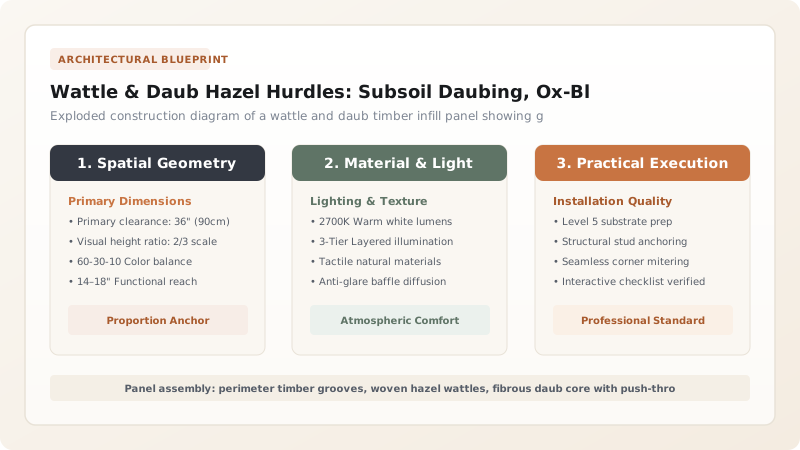
The Wattle Substrate: Coppiced Hazel and Riven Oak Staves
In timber-framed construction, the empty spaces between heavy oak posts and rails—known as bays—require a flexible, lightweight, and mechanically keyed infill panel. Carpenters created the Wattle substrate by coppicing native hazel (Corylus avellana) on a 7- to 10-year rotational cycle in local woodlands.
First, vertical cleft-oak or ash uprights called staves were shaped with chisel-pointed ends. Master builders cut a continuous groove along the top rail and augered a series of holes along the bottom sill; the flexible staves were sprung into the groove and seated into the bottom holes. Flexible, unpeeled hazel rods—often split down the center (riven) to expose the raw fibrous core—were then woven horizontally around the staves in an over-and-under basketweave pattern, creating an ultra-strong, resilient wooden hurdle capable of holding heavy mud plaster.
Soil Science and Formulation: Clay, Sand, Straw, and Manure
Applying daub is an art of soil balance. An effective daub mixture requires four essential components: a binder (clay), an aggregate (sand), a fibrous reinforcement (straw), and an organic plasticizer (cow dung). If the mix has too much clay, it will shrink catastrophically, developing gaping cracks upon drying; if it has too much sand, it will crumble and drop off the hazel sticks.
Traditional builders extracted yellow or red clay subsoil from beneath the agricultural topsoil layer. The clay was mixed with coarse, sharp sand in roughly equal parts, moistened with water, and blended with chopped barley or wheat straw (cut to 5–10 cm lengths). Crucially, builders incorporated 10% to 15% fresh cow manure. The digested grass fibers in dung provide micro-scale tensile reinforcement, while bile enzymes and organic acids act as natural plasticizers that make the mud pliable and buttery under the trowel.
Application Technique: Two-Sided Pressing and Mechanical Keying
Daubing was traditionally performed by two workers working simultaneously on opposite sides of the wall. Grabbing fist-sized mud balls (cats), the plasterers hurled and pressed the wet daub firmly into the hazel hurdle from both sides at the same time.
This synchronized pressing forced the sticky daub through the interstitial gaps between the woven hazel rods, causing the mud from both sides to meet, interlock, and mushroom around the wood, creating thousands of physical keys. Once the hurdle was fully encapsulated to a thickness of roughly 50 to 75 mm, the surface was scratched with hazel twigs to create a textured key and allowed to dry slowly in the shade for several weeks to minimize shrinkage cracking.
Weatherproofing: Slaked Lime Renders and Historic Ox-Blood Washes
Raw daub is water-soluble; exposed to heavy Welsh Marches driving rain, an unprotected panel would dissolve within a single winter. To protect the mud core while maintaining breathability, builders applied two thin coats of non-hydraulic slaked lime render (CL90) mixed with washed river sand and animal hair.
For final aesthetic and weatherproof sealing, panels were coated with multi-layered limewashes. In the Welsh borderland, vernacular barns and farmsteads were frequently finished with Ox-Blood limewash. Fresh bullock blood collected from butchery was mixed directly into hot quicklime; the iron in hemoglobin and the blood serum proteins reacted with the calcium hydroxide to form an insoluble calcium-albuminate film that repelled wind-driven rain and lent buildings an auspicious, deep terracotta-red hue.
Wattle & Daub Formulations Across Vernacular Regions
Use this reference table to calculate exact physical dimensions, ratios, and specifications before purchasing:
| Regional Formulation | Clay Subsoil Source | Fiber Reinforcement | Finish Limewash Treatment | Performance Profile |
|---|---|---|---|---|
| Welsh Marches (Clun Standard) | Red marl alluvial clay subsoil | Chopped wheat straw + fresh cow dung | Ox-blood + slaked lime (terracotta red) | High moisture buffering, resilient against hill rain |
| East Anglian Chalk Mix | Chalky boulder clay (marl) | Crushed hay, horsehair, and chopped reeds | Tallow-limewash (Suffolk Pink ochre) | Smooth, dense surface; excellent thermal mass |
| Cotswold Oolite Mix | Yellow calcareous clay subsoil | Barley straw and shredded sheep fleece | Natural white/cream slaked lime wash | Alkaline matrix; highly resistant to insect attack |
| Wealden Sussex Mix | Heavy Weald iron clay | Coarse meadow grass and flax tow | Boiled linseed oil and lime slip | Dense weather-resistant core for exposed bays |
Practical Constraints
Every successful decoration project must account for physical and environmental constraints:
Slow Drying Times in Damp Autumn and Winter Climates
Applying wet daub in cold, humid weather prevents evaporation; panels remain damp for months and can freeze, destroying structural cohesion. Mitigation: Schedule all wattle and daub fabrication and rendering exclusively between May and August during dry, warm weather.
Rodent and Vermin Burrowing in Straw-Rich Cores
Mice and rats can gnaw through soft daub to nest inside hazel hurdle cavities, weakening panel integrity. Mitigation: Ensure lime renders contain coarse sharp sand and apply a thin copper or brass mesh barrier along ground-level sill transitions.
Differential Movement Between Oak Framing and Infill Panels
Seasonal timber frame expansion creates perimeter hairline gaps between oak studs and daub panels, allowing draft infiltration. Mitigation: Cut perimeter V-grooves into studs to anchor daub, and seal perimeter junction gaps with flexible burnt-sand or lime-hemp mastics.
Execution Blueprint & Craftsmanship Sequence
Execute this professional sequence to achieve flawless results without backtracking:
Coppicing and riving Hazel Rods
Harvest 7-year-old hazel rods in winter. Split the round rods down the middle with a froe to produce flexible half-round riven wattling sticks.
Installing Oak Staves and Weaving the Hurdle
Chisel points onto vertical oak staves, spring them into the top timber frame groove, and seat them into bottom sill holes. Weave hazel rods horizontally around staves.
Treading and Mixing the Raw Daub Mud
Blend subsoil clay, sharp sand, water, chopped straw, and fresh cow dung in a shallow pit. Tread the mixture barefoot or with draft animals until thoroughly cohesive.
Simultaneous Dual-Sided Mud Application
Work in pairs on opposite sides of the wattle screen. Press mud balls into the weave simultaneously so the daub extrudes and locks around the hazel rods.
Drying and Hairline Crack Filling
Allow the daub panel to dry naturally for 3 to 4 weeks. Pack any deep shrinkage fissures with a wetter clay-dung slip rubbed firmly into gaps.
Applying Slaked Lime Render and Ox-Blood Limewash
Trowel on a 5 mm breathable lime render (1:2.5 slaked lime to sand). Once cured, apply three coats of lime wash pigmented with ox blood or red iron oxide.
Common Mistakes & Countermeasures
Avoid these costly errors that compromise aesthetics, ergonomics, and budget:
Applying Modern Polymer Emulsion Paints Over Daub
Omitting Sand Aggregate from the Daub Recipe
Using Rotten or Dry Brittle Hazel for Wattling
Project Execution Checklist
Track your physical progress. Checkboxes persist automatically on this device:
Frequently Asked Questions
Why is cow dung traditionally added to daub recipes?
Cow dung contains micro-fibers of digested vegetation that provide tensile reinforcement, while bile enzymes act as a natural surfactant and plasticizer that makes the clay workable. When dry, dung-clay mixes exhibit superior crack resistance and water repellency.
Does wattle and daub smell bad inside a home?
Not at all. Once the daub has dried and been coated with slaked lime, it is completely odorless, non-toxic, and creates a fresh, clean indoor air environment.
How does wattle and daub compare to modern drywall for insulation?
While lightweight drywall has slightly higher nominal R-values per inch, wattle and daub provides massive thermal inertia (thermal mass). It absorbs daytime heat and radiates it slowly at night, while functioning as a hygroscopic humidity buffer that stabilizes indoor moisture.
Why was ox-blood used on historic Welsh buildings?
Ox-blood provided both an intense reddish-brown earth pigment and an organic protein binder. The serum albumin in blood reacted with the calcium hydroxide in hot quicklime to create an exceptionally durable, water-resistant exterior coating.


