
Full cruck blade hewing is the demanding craft of transforming a single bowed oak tree into a matched pair of load-bearing structural arches. By splitting the trunk down its pith using pit-saws and broadaxes, medieval carpenters produced mirror-symmetrical blades with uninterrupted longitudinal grain. Joined at the apex via halved lap joints, yokes, or saddles and tied with draw-bored collar beams, these full-cruck trusses carried the entire roof structure directly to stone stylobate footings without resting weight on perimeter walls.
At a Glance: Key Takeaways
- Collar Joinery: Halved dovetail lap joint locked with faceted oak trunnels
- Hewing Tools: Heavy side-axe (broadaxe), socketed adze, and drawknife
- Oak Selection: Pedunculate oak (Quercus robur) with a natural 35°–45° elbow curve
- Splitting Method: Pit-sawing or radial riving down the central heartwood pith
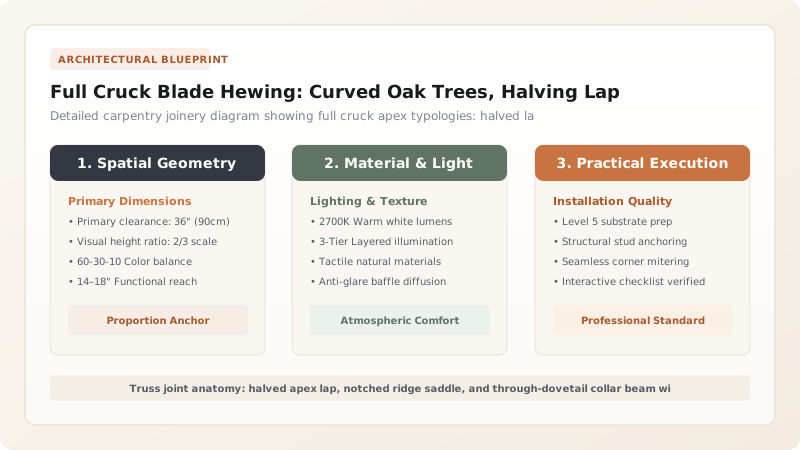
Silvicultural Geometry: Identifying Curved Compass Timber
In medieval forest terminology, naturally curved wood was prized as Compass Timber. Unlike straight ship-mast trees grown in dense competitive stands, compass oaks grew along hedgerows, steep dingle ravines, and wind-scoured ridges of the Welsh border hills. Here, continuous prevailing southwesterly winds and hillside soil creep forced oak saplings to bend outward before reaching for the light, creating a strong, permanent lower trunk bow known as the 'butt-sweep'.
A master carpenter assessed the standing tree for uniform sweep, ensuring the curve was planar rather than corkscrewed. The tree had to be large enough to yield two blades each measuring at least 250 mm by 300 mm in cross-section after squaring, with uninterrupted growth rings following the outer perimeter of the curve.
Conversion: The Two-Man Pit Saw and Broadaxe Hewing
Once felled, the curved log was rolled onto heavy trestles over a saw pit or supported on high sawing dogs. Two sawyers—the 'top-man' standing atop the rolling curved log directing the cut along a chalk line, and the 'pit-man' standing below in a shower of sawdust—operated a long, flexible whip-saw to rip the trunk cleanly down the central pith.
After sawing, each half-log underwent hewing. The carpenter scored deep notches (joggles) along the curved round face with a felling axe at two-foot intervals, split off the waste wood in slabs, and surfaced the timber dead-flat using a single-bevel broadaxe (side-axe). The resulting surface retained subtle scalloped axe marks that modern machine planers can never duplicate.
Truss Topologies: Halved Laps, Yokes, and Saddles
Where the two cruck blades meet at the roof apex, medieval carpenters employed several ingenious joint configurations depending on local workshop traditions. In the Halved Lap Apex, the tops of the blades were thinned to half their thickness and crossed, with a horizontal pin securing the intersection and forming a natural V-crotch to carry the continuous timber ridge-tree.
Alternatively, in the Yoke Apex, the blades terminated just short of meeting and were bridged by a short horizontal timber called a yoke, which carried a miniature king-strut. In high-status Clun barns, carpenters frequently used the Saddle Apex, where the curved tips butted squarely together beneath an inverted V-shaped saddle block that held the square ridge beam set diamond-wise (on edge) to support rafters evenly.
Mechanical Locking: The Physics of Draw-Bored Oak Trunnels
The integrity of a cruck frame relies entirely on Draw-Bored Joinery. When connecting the horizontal collar beam to the curved blades, the carpenter cuts a through-mortise or half-lap dovetail. Using an auger, a hole is bored through the mortise cheek.
Next, the tenon is inserted and marked, then removed. The hole through the tenon is bored 2 to 3 millimeters closer to the tenon shoulder than the mortise mark. When the joint is reassembled and a tapered, octagonal cleft-oak peg (Trunnel) is driven through, the misaligned holes act as an inclined wedge, pulling the collar beam shoulder into the cruck blade with tremendous compressive force. Even as the green oak dries and shrinks over decades, the spring tension of the bent peg keeps the joint permanently locked.
Cruck Apex Typology Engineering & Load-Bearing Characteristics
Use this reference table to calculate exact physical dimensions, ratios, and specifications before purchasing:
| Apex Typology | Joint Geometry | Ridge-Tree Support | Bending Moment Resistance | Regional Distribution |
|---|---|---|---|---|
| Type A: Halved Lap Blades | Blades cross with halved lap joint forming V-fork | Square ridge beam sits in open timber V-fork | High lateral shear resistance against gales | Upper Clun Valley and Radnorshire uplands |
| Type B: Yoke Cross-Timber | Blades terminate 30 cm apart; bridged by yoke | Crown-post or ridge rests on center of yoke | Superior flexibility under roof snow-load deflection | Shropshire plains and Severn Vale farmsteads |
| Type C: Butted with Saddle | Blade tips meet squarely at center line | Carved inverted-V saddle block caps the joint | Maximum vertical compressive load capacity | Montgomeryshire and North Monmouthshire halls |
| Type D: Tied Tie-Yoke Apex | Blades lap with collar tie directly below apex | Direct notch into extended blade tongue | Balanced wind-uplift and racking resistance | Herefordshire Golden Valley barns |
Practical Constraints
Every successful decoration project must account for physical and environmental constraints:
Extreme Weight of Green Oak Timber Elements
Unseasoned green oak weighs approximately 1,000 kg per cubic meter; a single cruck blade can weigh in excess of 800 kg. Mitigation: Design framing yard workflows around heavy timber rollers, lever bars, and overhead gantry hoists to prevent worker strain.
Natural Shrinkage and Surface Checking During Drying
Green oak loses up to 7% tangential volume as it seasons in situ, creating deep surface fissures (checks) along the blades. Mitigation: Ensure joints account for cross-grain shrinkage by utilizing lap dovetails and orienting the heartwood core away from critical joint shoulders.
Tannic Acid Corrosion of Ferrous Metal Fasteners
Oak heartwood contains up to 10% tannic acid; modern steel screws or bolts corrode into black sludge and destroy adjacent wood fibers within years. Mitigation: Use exclusively traditional cleft oak trunnels, or marine-grade bronze / 316 stainless steel fasteners where metallic reinforcement is mandatory.
Execution Blueprint & Craftsmanship Sequence
Execute this professional sequence to achieve flawless results without backtracking:
Mapping the Trunk Curvature with Chalk Lines
Snap plumb and level reference lines along the bark of the fallen curved oak log to establish the central pith cutting plane.
Pit-Sawing the Curved Trunk Down the Pith
Rip the curved log from butt to tip using a two-man pit saw or mechanical horizontal bandsaw, dividing the trunk into two identical half-cylinder blades.
Scoring and Hewing the Mating Faces
Score waste wood down to the chalk line with a felling axe, then slice away excess material with a broadaxe to create clean, flat reference surfaces.
Scribing Halved Collar Mortises on the Framing Yard
Lay the paired blades flat on timber bunks, position the green oak collar beam, and transfer cutting lines directly onto timbers using a race-knife (scribing).
Cutting Dovetail Laps and Draw-Bore Holes
Saw joint shoulders and pare mortise cheeks with heavy framing chisels. Bore 25 mm peg holes, offsetting the tenon hole by 3 mm for draw-boring.
Driving Heartwood Trunnels and Trimming
Assemble the joint, drive dry cleaved-oak trunnels lubricated with tallow until tight, and trim the protruding peg ends flush or leave 25 mm proud.
Common Mistakes & Countermeasures
Avoid these costly errors that compromise aesthetics, ergonomics, and budget:
Sawing Cruck Blades Across the Natural Timber Grain
Using Machine-Turned Round Dowels Instead of Cleft Oak Trunnels
Over-Drilling Draw-Bore Offsets (More Than 4 mm)
Project Execution Checklist
Track your physical progress. Checkboxes persist automatically on this device:
Frequently Asked Questions
Why is green oak used for timber framing instead of seasoned oak?
Green (freshly felled) oak is soft and pliable, allowing carpenters to cut intricate mortises, tenons, and laps with hand tools. As the frame seasons in place over decades, the wood shrinks around the joints, locking the cleft-oak pegs in a permanent, rock-hard grip.
What is the difference between a broadaxe and a felling axe?
A felling axe has a narrow, double-beveled symmetrical blade designed for chopping across grain to cut down trees. A broadaxe has a wide, chisel-ground single-bevel blade (often with an offset handle) designed specifically for slicing flat planes down the length of a log.
How do carpenters ensure a cruck truss is symmetrical?
By splitting one curved tree into two halves, the two resulting blades are identical mirror images. When laid out on the framing ground back-to-back, they naturally form a balanced arch with equal curvature on both sides.
How long can a traditional cruck frame survive?
With a watertight roof and dry stone footings, an English oak cruck frame can easily endure for 600 to 800+ years. Many Welsh cruck barns erected in the 14th century remain structurally sound and in active use today.


