
Finishing authentic Venetian Terrazzo requires a multi-stage historical process. After 30 days of carbonation, the floor is wet-ground using natural stone grinding heads (l'orso) and pumice blocks to expose the marble cross-sections. After filling micro-voids with lime slurry (stuccatura), the floor is saturated with boiled linseed oil, washed with pure Marseille olive-oil soap to create an insoluble saponified seal, and burnished with beeswax.
At a Glance: Key Takeaways
- Curing Prerequisite: Minimum 30 to 40 days damp burlap curing to achieve 80% lime carbonation before grinding.
- Traditional Grinding Tool: L'Orso—curved heavy granite block mounted on a long springy wooden lever pole.
- Abrasive Progression: Coarse Carborundum/granite (60-grit) -> Fine water sandstone (220-grit) -> Lipari pumice (400-grit).
- Pore Slurry Grouting (Stuccatura): Fine lime putty and marble dust slurry rubbed into pores and cured 14 days.
- Chemical Saponification: Reaction between calcium in lime, boiled linseed oil, and potassium/sodium in Marseille soap.
- Periodic Maintenance: Washing exclusively with neutral olive-oil soap and water; strictly zero acid or bleach cleaners.
L'Orso: The Traditional Long-Handled Grinding Tool
In pre-industrial Venice, grinding a massive terrazzo ballroom was an epic manual trial. The primary tool was the orso (the bear)—a massive curved block of dense granite or coarse sandstone weighing 25 to 35 kilograms, attached to the end of a long, flexible chestnut pole.
Standing upright, the craftsman pushed and pulled the orso in sweeping arcs, using abrasive river sand and abundant water as a cutting lubricant. The heavy stone ground through the top millimeter of lime paste and sliced through the embedded marble pebbles, revealing the exquisite interior cross-sections, veins, and colors of the stones.
Stuccatura Grouting and Natural Lipari Pumice Honing
Initial coarse grinding exposes tiny air pinholes and micro-voids where air was trapped beneath pebble edges. To eliminate these voids, the terrazziere executes the stuccatura (grouting).
A creamy slurry of aged slaked lime putty (grassello), fine 200-mesh marble flour, and matching color pigments is squeegeed across the floor, packing every microscopic pore solid. After curing for another 14 days, the floor undergoes fine honing with natural volcanic pumice blocks imported from the island of Lipari, followed by fine Bavarian hone slate, refining the surface to a silken, reflection-ready matte finish.
Chemical Saponification: Olio Cotto and Sapone di Marsiglia
Authentic Venetian Terrazzo is never sealed with modern polyurethane or acrylic lacquers. Synthetic coatings create an impermeable plastic skin that traps tidal moisture rising through lagoon subfloors, causing blistering and milky white delamination.
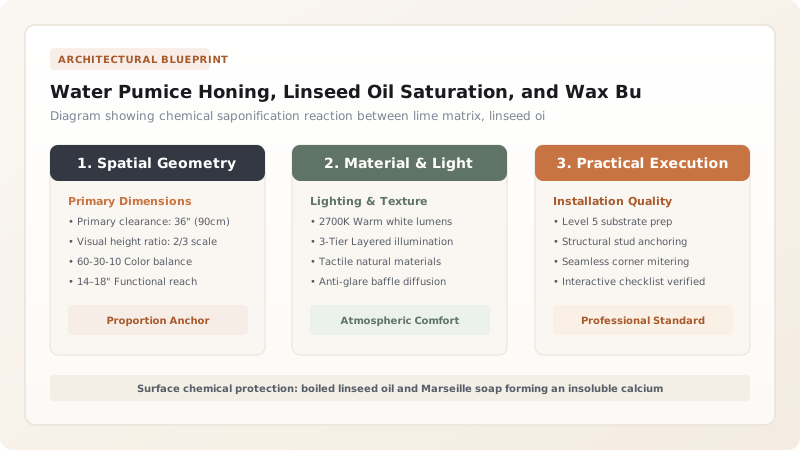
Instead, the dry floor is saturated with warm boiled linseed oil (olio di lino cotto). After 24 hours of capillary absorption, the floor is vigorously scrubbed with hot water and pure Marseille olive-oil soap (sapone di Marsiglia). The free calcium hydroxide in the lime binder reacts chemically with the oleic and palmitic fatty acids in the soap and oil, precipitating an insoluble layer of calcium oleate (saponification). This reaction permanently vitrifies the lime pores, creating a breathable, water-repellent, satin-smooth finish that repels wine and oil stains while developing an intoxicating amber patina over centuries.
Finishing and Sealing Regimes for Historic Venetian Terrazzo
Use this reference table to calculate exact physical dimensions, ratios, and specifications before purchasing:
| Finishing Medium | Chemical Reaction | Vapor Permeability | Resistance to Water / Stains | Historic Authenticity |
|---|---|---|---|---|
| Linseed Oil & Marseille Soap | Calcium oleate saponification | 100% Breathable; releases moisture | Excellent (naturally water-shedding) | 100% Authentic Renaissance protocol |
| Natural Beeswax Paste | Physical microcrystalline wax film | High permeability | High (fingerprint & dust resistant) | Authentic secondary maintenance finish |
| Modern Polyurethane Clear Seal | Synthetic urethane plastic skin | Zero (vapor barrier) | Traps water; blisters & turns milky | STRICTLY PROHIBITED in historic palazzi |
| Silicate Hardener (Lithium) | Inorganic calcium silicate hydrate | High permeability | Moderate stain resistance | Acceptable modern hybrid conservation |
Practical Constraints
Every successful decoration project must account for physical and environmental constraints:
Modern commercial planetary diamond floor grinders moving too fast and gouging soft historic lime matrices
Mitigation: Operate variable-speed planetary grinders at low RPM (under 300 RPM) using resin-bonded diamond pads with abundant water.
Execution Blueprint & Craftsmanship Sequence
Execute this professional sequence to achieve flawless results without backtracking:
Verify 30-Day Curing Period Under Damp Burlap
Keep floor damp under wet burlap sheets for 30 days to ensure hydraulic lime reaches minimum 75% final compressive strength.
Perform Coarse Wet Grinding to Expose Marble Flesh
Grind floor with 60-grit carborundum or granite orso with continuous flowing water until marble cross-sections are flat.
Apply Stuccatura Lime Slurry Pore-Filling Grout
Squeegee tinted lime putty and fine marble dust paste over entire floor, packing all pinholes; allow to cure 14 days.
Execute Fine Honing with Lipari Volcanic Pumice
Hone floor wet with natural pumice blocks (400-grit equivalent), wiping away slurry to inspect surface uniformity.
Saturate Dry Floor with Warm Boiled Linseed Oil
After 14 days dryout, mop heated linseed oil across floor; let soak 2 hours, wiping away all unabsorbed surface excess.
Saponify Surface with Hot Marseille Olive Soap Wash
Scrub floor with hot water and Marseille soap flakes; buff vigorously with wool pads to produce glowing satin patina.
Common Mistakes & Countermeasures
Avoid these costly errors that compromise aesthetics, ergonomics, and budget:
Applying acidic cleaners (vinegar, muriatic acid, or citrus detergents) to clean terrazzo
Sealing a freshly honed terrazzo floor while it still contains construction moisture
Project Execution Checklist
Track your physical progress. Checkboxes persist automatically on this device:
Frequently Asked Questions
How often should a Venetian Terrazzo floor be waxed?
In high-traffic palatial salons, a light coat of natural beeswax is applied once a year and buffed with an electric polisher or wool flannel. Everyday cleaning requires only mopping with lukewarm water and a capful of Marseille liquid olive soap.
Why does historic Venetian Terrazzo feel warm and soft underfoot?
Unlike cold, rigid modern cement or ceramic tiles, hydraulic lime and cocciopesto have lower thermal effusivity and slight elastic compliance, creating a softer, noticeably warmer tactile sensation when walking barefoot.


