
Formulating the authentic Venetian Terrazzo matrix requires balancing natural hydraulic lime (NHL 2 or aged CL90 lime putty) with reactive pozzolanic brick dust (cocciopesto) and graded marble aggregates. By establishing an aggregate packing density where fine marble powders (0–0.2mm) fill the interstitial voids between medium chips (3–8mm), the mortar achieves maximum compressive strength (15–18 MPa) with minimal shrinkage.
At a Glance: Key Takeaways
- Primary Binder: Natural hydraulic lime (NHL 2 or NHL 3.5) or 12-month aged slaked lime putty (grassello).
- Pozzolanic Fortifier: Low-fired terracotta tile dust (cocciopesto) reacting with free lime to form calcium aluminates.
- Aggregate Packing Density: Sieve curve optimized according to Fuller's maximum density formula.
- Binder-to-Aggregate Ratio: 1 part lime binder to 2.5 parts graded marble aggregate by volume.
- Marble Mineralogy: Crystalline calcite (CaCO3) and dolomite (CaMg(CO3)2) with low water absorption (<0.3%).
- Water-to-Binder Ratio: Ultra-low water ratio (0.35 to 0.40) yielding a stiff, packable earth-damp mortar.
Hydraulic Lime Chemistry and the Cocciopesto Pozzolanic Reaction
In Venetian palazzi, ordinary non-hydraulic lime putty (which hardens solely by absorbing carbon dioxide from the air) cures too slowly in thick 50mm slabs and cannot harden in damp sub-canal basements. Master terrazzieri utilized natural hydraulic lime or engineered an artificial hydraulic reaction using cocciopesto.
Cocciopesto consists of finely pulverized, low-fired terracotta roof tiles. When ground to sub-75-micron powder, the amorphous aluminosilicates in the burned clay react chemically with the calcium hydroxide (Ca(OH)2) in slaked lime. This pozzolanic reaction forms insoluble calcium silicate hydrates (CSH) and calcium aluminate hydrates, allowing the thick floor slab to cure hydraulically throughout its entire depth, even under water.
Fuller Curve Mechanics: Maximizing Aggregate Density
The Achilles heel of any lime-based flooring is shrinkage cracking during cure. If a mortar contains excessive water or un-graded sand, water evaporation leaves empty voids that cause the matrix to shrink by 5% to 8%, tearing the floor apart.
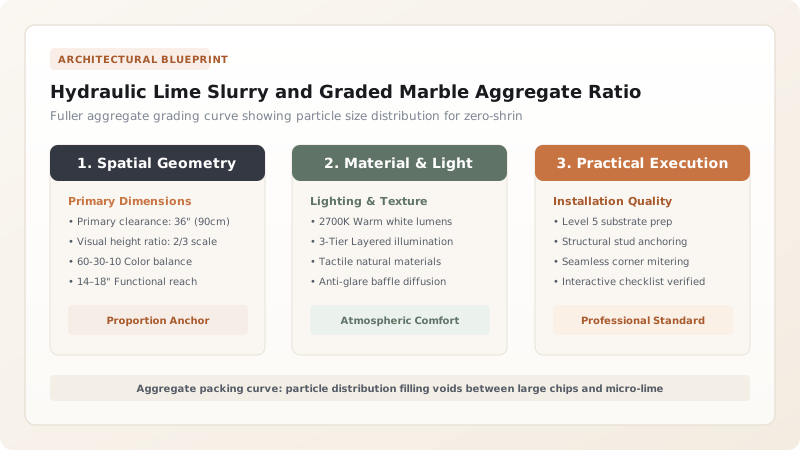
Venetian masters overcame this through strict particle size grading matching the modern Fuller-Thompson parabolic curve. The aggregate blend is formulated with a continuous particle hierarchy: 10% ultra-fine marble flour (0–0.1mm), 25% fine marble sand (0.2–1mm), 35% medium graniglia (2–5mm), and 30% coarse chips (5–10mm). The fine grains physically fit into the empty spaces between the coarse chips, reducing the interstitial void space to under 18%, virtually eliminating drying shrinkage.
The Earth-Damp Consistency and Mixing Discipline
A common modern amateur error is mixing terrazzo mortar to a soupy, self-leveling consistency. In authentic Venetian craft, the mortar is mixed terra umida (earth-damp)—barely moist, resembling damp brown sugar.
When squeezed tightly in the fist, the mortar must hold its shape without slumping and leave zero wet water residue on the palm. This ultra-low water content (water-to-binder ratio below 0.38) guarantees maximum cured compressive strength (exceeding 16 MPa) and prevents the heavy marble aggregate chips from settling to the bottom during installation.
Sieve Grading and Batch Proportions for Venetian Terrazzo Finish Matrix
Use this reference table to calculate exact physical dimensions, ratios, and specifications before purchasing:
| Aggregate Fraction | Grain Size Range | Mass Percentage | Mineral Sourcing | Function in Matrix |
|---|---|---|---|---|
| Micro-Filler | 0.01 mm – 0.1 mm | 10% | Micronized Carrara marble dust | Fills micro-voids; prevents pinholing |
| Fine Sand | 0.2 mm – 1.0 mm | 25% | Washed silica or marble quartz | Provides cohesive tensile mortar body |
| Medium Graniglia | 2.0 mm – 5.0 mm | 35% | Crushed Verona red / Istrian stone | Primary visible background stone matrix |
| Coarse Chip | 5.0 mm – 9.0 mm | 30% | Sieved Botticino / Belgian black | Provides structural mass and wear resistance |
| Pozzolanic Cocciopesto | < 0.075 mm | 15% (of lime mass) | Crushed Roman terracotta tile | Supplies reactive pozzolanic silica |
Practical Constraints
Every successful decoration project must account for physical and environmental constraints:
Modern supply chains delivering marble chips contaminated with chemical quarry crushing oils
Mitigation: Wash all bulk marble aggregates in clean water troughs and dry completely before batching into mortar.
Execution Blueprint & Craftsmanship Sequence
Execute this professional sequence to achieve flawless results without backtracking:
Weigh and Proportion Dry Marble Fractions
Blend marble chips, graniglia, and fine marble dust in mechanical drum mixer according to Fuller density curve.
Add Sifted Natural Hydraulic Lime and Cocciopesto
Incorporate NHL 2 lime powder and 200-mesh brick dust; dry-mix for 3 minutes until uniform pale terracotta color.
Gauge with Minimal Clean Water to Earth-Damp State
Add water gradually until mortar reaches terra umida consistency; avoid liquid slurry formation.
Spread 15mm Matrix Bed over Dampened Sub-Base
Trowel earth-damp mix onto pre-wetted cocciopesto screed, leveling with heavy notched aluminum screed bar.
Tamp Firmly with Flat Wooden Beater (Fratazzo)
Pound the bed with heavy wooden tamper to consolidate aggregate grains prior to marble pebble seeding.
Commence Immediate Hand-Seeding of Large Pebbles
Cast washed decorative marble pebbles across surface while matrix retains moisture to accept embedded stone.
Common Mistakes & Countermeasures
Avoid these costly errors that compromise aesthetics, ergonomics, and budget:
Adding excess water to make the terrazzo mortar easier to spread with a trowel
Using soft, porous limestone aggregates with water absorption > 3%
Project Execution Checklist
Track your physical progress. Checkboxes persist automatically on this device:
Frequently Asked Questions
What is the role of Verona Red marble in classical Venetian Terrazzo?
Verona Red (Rosso Ammonitico) is a dense, nodular limestone containing fossilized ammonites quarried near Verona. Its warm terracotta-salmon hue provided the iconic warm Venetian chromatic signature seen in the Doge's Palace.
Why is cocciopesto terracotta dust red?
Low-fired clay bricks contain iron oxide (hematite, Fe2O3). When pulverized into mortar, it imparts a beautiful warm pinkish-buff undertone to the lime matrix while accelerating hydraulic curing.


