
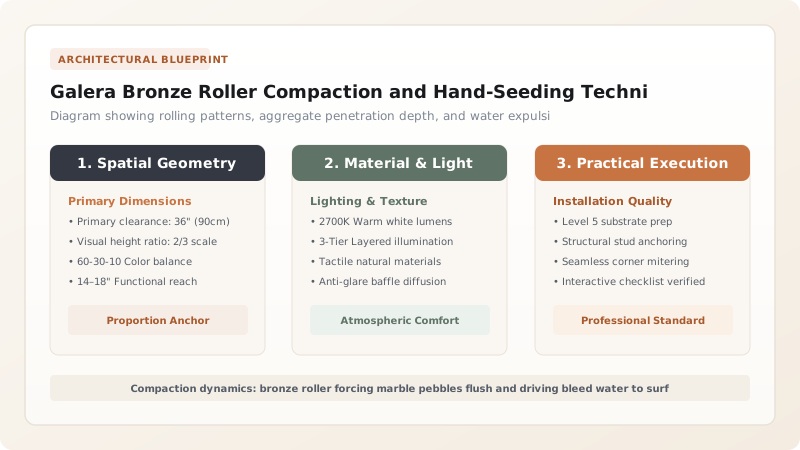
The defining hallmark of authentic Terrazzo alla Veneziana is the semina (hand-seeding) and galera rolling technique. Master artisans hand-scatter large 15mm–25mm irregular marble pebbles onto the fresh lime bed until 80%–85% surface stone density is achieved. A 100kg two-man cylindrical bronze roller (la galera) is then rolled in multi-pass cross patterns, mechanically forcing the stones flat into the bed while purging excess water.
At a Glance: Key Takeaways
- Seeding Technique (Semina): Hand-casting washed marble pebbles from knee-boards with calibrated wrist flick.
- Surface Stone Density: Target of 80% to 85% visible marble stone coverage on finished polished floor.
- The Galera Compactor: Solid cast-bronze or stone cylinder (diameter 250mm, length 600mm, mass 80–120 kg).
- Roller Mechanics: Hand-pulled via a T-shaped wooden frame by two artisans walking in stocking feet.
- Compaction Passes: Minimum 8 to 12 orthogonal cross-passes (north-south then east-west).
- Bleed Water Expulsion: Squeezes out surplus gauging water and consolidates aggregate packing.
The Semina Ritual: Hand-Casting Color and Proportion
In Venetian dialect, seminare means to sow seeds. The master terrazziere kneels upon padded wooden boards placed over the fresh earth-damp lime bed, carrying trays of washed, damp marble pebbles (ciottoli or marmi spaccati) graded from 15mm to 30mm.
With an experienced flick of the wrist, the master casts the pebbles across the bed. Unlike a random scatter, the semina is an artistic performance: the artisan balances dominant Verona red pebbles against crisp Carrara white and contrasting black Nero Marquina accents. The goal is to achieve an astonishing 85% surface stone coverage, leaving barely 15% of the visible surface as lime mortar joints.
La Galera: The Heavy Bronze Compactor and Shear Kinetics
Once seeded, the pebbles sit loosely on top of the lime bed. To bed them solid, the team deploys la galera (the galley roller). Cast from solid bell bronze or turned from hard granite, the roller weighs between 80 and 120 kilograms and features a long forked hardwood handle.
Two artisans pull and push the roller across the floor in slow, deliberate lines. As the heavy cylinder rolls over the pebbles, it exerts intense localized compressive line pressure (exceeding 25 kg per linear centimeter). This force drives the irregular stones down into the earth-damp mortar until their upper facets lie completely coplanar, while internal hydraulic pressure forces excess water and air bubbles to the surface where they are wiped away with sponges.
Orthogonal Cross-Rolling and Perimeter Hand-Beating
Rolling is not done in a single pass. The crew executes a rigorous cross-rolling sequence: first rolling north-to-south, followed immediately by east-to-west, and finally diagonally at 45° across the room. Over 8 to 12 passes, the matrix transforms from loose aggregate into a rock-solid, cohesive pavement.
In perimeter corners and against walls where the wide galera cannot reach, craftsmen use the pestello—a heavy iron hand-tamper with a flat 100mm square base. Any stray pebble that tilts on edge during rolling is tapped flat with a wooden mallet, ensuring zero protruding edges that could catch and tear during subsequent grinding.
Compaction Mechanics: Traditional Galera vs Modern Power Trowels
Use this reference table to calculate exact physical dimensions, ratios, and specifications before purchasing:
| Compaction Method | Applied Compressive Mode | Risk to Marble Pebbles | Density Achievement | Lagoon Heritage Authenticity |
|---|---|---|---|---|
| Traditional Bronze Galera | Heavy linear deadweight roll (100kg) | Zero chipping (smooth cylindrical contact) | Maximum (85% stone density) | 100% Authentic historic Venetian method |
| Mechanical Power Trowel | High-speed rotating steel blades | Shatters and scratches large marble pebbles | Poor on large seeded pebbles | STRICTLY UNACCEPTABLE for historic terrazzo |
| Hand Wooden Tamper (Fratazzo) | Manual percussive impact | Moderate; requires uniform human force | Good for perimeter edges & corners | Essential secondary tool for perimeter borders |
| Pneumatic Plate Compactor | High-frequency vibration | Cracks timber joists; settles stones to bottom | Destroys aggregate surface suspension | PROHIBITED on historic wooden floors |
Practical Constraints
Every successful decoration project must account for physical and environmental constraints:
Physical strain of maneuvering a 100kg bronze roller up narrow spiral palace staircases
Mitigation: Utilize modular segmented bronze rollers that disassemble into three 35kg cylindrical sections for safe transport.
Execution Blueprint & Craftsmanship Sequence
Execute this professional sequence to achieve flawless results without backtracking:
Wash and Dampen Colored Marble Seed Pebbles
Rinse 15mm–25mm marble pebbles in clean water tubs to remove quarry dust, keeping stones damp to promote lime adhesion.
Position Knee-Boards across Fresh Lime Bed
Lay wide plywood knee-boards over fresh earth-damp matrix to distribute artisan body weight without denting the bed.
Cast Marble Pebbles in Calibrated Fan Patterns
Scatter marble pebbles by hand across bed, maintaining balanced color distribution and 85% surface stone density.
Execute Primary North-South Galera Rolling
Pull 100kg bronze galera roller slowly across floor, pressing pebbles down until flush with lime matrix surface.
Execute Secondary East-West Orthogonal Cross-Pass
Roll perpendicular to first pass; wipe away displaced water slurry that bleeds out of the compressed lime bed.
Hand-Tamp Perimeter Edges and Corners with Pestello
Consolidate floor margins against walls with heavy iron hand-tamper, checking for flush coplanar alignment.
Common Mistakes & Countermeasures
Avoid these costly errors that compromise aesthetics, ergonomics, and budget:
Rolling the floor too fast or with sudden jerky direction changes
Walking across the newly rolled floor with hard-soled work boots
Project Execution Checklist
Track your physical progress. Checkboxes persist automatically on this device:
Frequently Asked Questions
Why is bronze used for the galera roller instead of iron or steel?
Cast bronze is extremely dense and heavy, resists rusting in moist lime environments, and does not cause black iron-staining marks on white Carrara marble pebbles during rolling.
How soon after seeding must the galera rolling begin?
Immediately. Rolling must begin while the earth-damp lime matrix retains sufficient moisture to bed the pebbles smoothly (typically within 30 to 45 minutes of spreading).


