
Classical Venetian Terrazzo (terrazzo alla veneziana) is an extraordinary continuous seamless flooring technology perfected in Renaissance Venice to accommodate the shifting wooden joists of lagoon palazzi. Composed of natural hydraulic lime (calce idraulica) blended with graded marble aggregates, hand-strewn with large marble pebbles (semina), compacted with heavy bronze rollers (galera), and polished with natural pumice stones and linseed oil soap, traditional terrazzo forms an elastic, breathable, monolithic floor that resists tidal moisture without cracking.
At a Glance: Key Takeaways
- Lagoon Flexibility: Engineered with flexible hydraulic lime to flex over wooden joists without cracking.
- Aggregate Stratigraphy: Graded crushed marble chips (coccio and graniglia) from Verona red, Carrara white, and Istrian stone.
- The Semina Ritual: Hand-scattering large polished marble pebbles across the wet lime matrix to achieve 85% surface stone density.
- Mechanical Compaction: Multi-pass rolling with heavy two-man bronze rollers (la galera) expelling trapped water.
- Stone Honing Progression: Multi-stage wet polishing using natural volcanic pumice blocks and fine water stones.
- Natural Nourishment: Saturated with boiled linseed oil (olio cotto) and burnished with natural beeswax and Marseille soap.
In-Depth Guides in this Directory
Explore specialized subtopic blueprints, technical dimensions, and execution checklists:
Hydraulic Lime Slurry and Graded Marble Aggregate Ratios
Technical mortar guide to Venetian Terrazzo: natural hydraulic lime (NHL 2/3.5) chemistry, cocciopesto brick dust pozzolans, and aggregate sieve grading.
Galera Bronze Roller Compaction and Hand-Seeding Techniques
Master artisan guide to Venetian Terrazzo execution: semina marble pebble hand-scattering, galera bronze roller compaction, and void elimination.
Water Pumice Honing, Linseed Oil Saturation, and Wax Buffing
Comprehensive finishing and conservation guide for Venetian Terrazzo: orso stone grinding, pumice honing, stuccatura grouting, and linseed soap saponification.
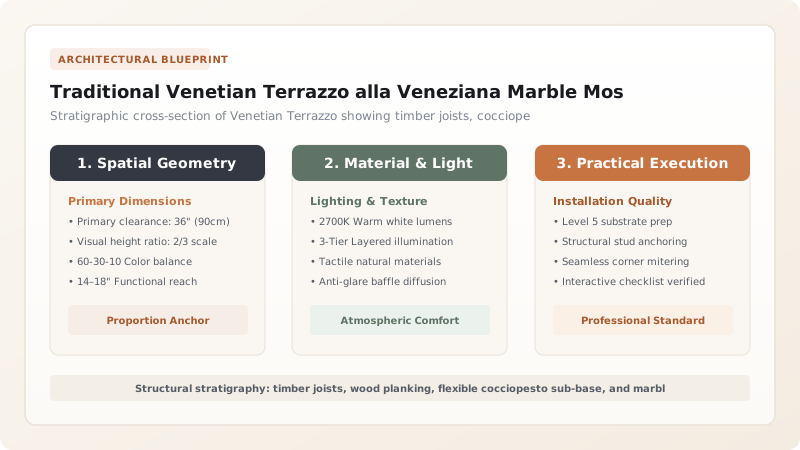
Lagoon Engineering: Surviving on Flexible Wooden Foundations
Venice is an architectural miracle built on thousands of submerged timber piles driven into salt mud. Because palazzo foundations constantly settle and shift with tidal ebbs and canal water currents, rigid concrete or brittle stone flagstone floors crack and heave within decades.
Venetian masters developed terrazzo alla veneziana as a lightweight, flexible continuous membrane. Rather than rigid Portland cement (which was invented centuries later), the binder is non-hydraulic or natural hydraulic lime (calce idraulica) mixed with crushed terracotta brick dust (cocciopesto). This mortar possesses low elastic modulus (stiffness), allowing a 30-meter ballroom floor to flex and undulate with building movements without developing structural cracks.
The Semina Technique and the Galera Bronze Compactor
Unlike modern pre-mixed terrazzo where stone chips are blended into a mixer, traditional Venetian terrazzo is built in distinct physical layers. After the lime leveling bed (sottofondo) is placed, the master artisan (terrazziere) performs the semina (seeding).
Working on knee-boards, the artisan casts hand-selected, irregular marble chunks—measuring 15mm to 30mm—across the wet lime surface by hand, distributing Verona red, Carrara white, and black Belgian marble with compositional balance until 80% to 85% of the surface area is pure stone. Immediately following the semina, two artisans roll the floor with the galera—a massive cylindrical bronze roller weighing 80 to 120 kilograms. The roller forces the marble chunks flat, squeezes out excess gauging water, and eliminates internal air pockets.
Pumice Stone Honing and Linseed-Marseille Saponification
After curing for 4 to 6 weeks under damp burlap, the floor undergoes exhaustive grinding. Historically, workers knelt with the orso—a curved granite grinding stone attached to a long wooden pole, using wet sand and volcanic pumice blocks to cut the marble level with the lime matrix.
Once mirror-flat and thoroughly dry, the floor is treated with warm boiled linseed oil (olio di lino cotto). The oil penetrates deeply into the microscopic pores of the lime binder. The surface is then washed with hot water and pure olive-oil Marseille soap. The alkaline calcium ions in the lime react chemically with the free fatty acids in the oil and soap, forming insoluble calcium oleate (saponification)—an impenetrable, satin-smooth, waterproof seal that resists canal dampness forever.
Classical Venetian Lime Terrazzo vs Modern Epoxy Terrazzo
Use this reference table to calculate exact physical dimensions, ratios, and specifications before purchasing:
| Technical Feature | Classical Terrazzo alla Veneziana | Modern Epoxy Resin Terrazzo | Modern Portland Cement Terrazzo |
|---|---|---|---|
| Binder Chemistry | Natural hydraulic lime (calce) & cocciopesto | Two-part synthetic epoxy polymer resin | Ordinary Portland cement (OPC) |
| Vapor Permeability | High (100% breathable; releases moisture) | Zero (impermeable plastic vapor barrier) | Very Low (traps moisture; effloresces) |
| Flexural Accommodation | High (micro-yields over timber beams) | High tensile flex (cannot breathe) | Extremely Brittle (cracks over wood joists) |
| Aggregates Used | Large hand-strewn marble pebbles (semina) | Fine 3mm–6mm crushed machine chips | Machine crushed aggregate mix |
| Visual Aging Quality | Develops deep luminous amber antique patina | Prone to UV yellowing & plastic scratch hazing | Chalks and turns dull grey with age |
Practical Constraints
Every successful decoration project must account for physical and environmental constraints:
Tidal flooding (Acqua Alta) in Venice submerging ground-floor terrazzo under brackish lagoon water
Mitigation: Traditional saponified lime terrazzo is immune to water; simply rinse seawater off with fresh water and re-wax once dry.
Execution Blueprint & Craftsmanship Sequence
Execute this professional sequence to achieve flawless results without backtracking:
Lay Flexible Cocciopesto Base Screed
Trowel 35mm base layer of hydraulic lime and crushed porous brick (cocciopesto) over timber subfloor planking.
Apply Lime-Marble Matrix Bed (Coperta)
Spread 15mm bed of aged lime putty, fine marble powder, and medium marble grit (graniglia) across the screed.
Execute the Semina Hand-Seeding of Marble Chunks
Scatter large hand-selected marble pebbles (Verona red, Carrara, Istrian) evenly across wet bed to 85% coverage.
Compact Matrix with Heavy Bronze Galera Roller
Roll floor in orthogonal cross-patterns with 100kg bronze roller, driving marble flat and forcing out water.
Wet-Hone Surface with Natural Volcanic Pumice
Grind floor after 30 days curing using progressive water sandstone and Lipari pumice stones until glass-smooth.
Saturate with Boiled Linseed Oil and Marseille Soap
Apply hot linseed oil, allow capillary absorption, and burnish with pure olive soap and flannel buffing pads.
Common Mistakes & Countermeasures
Avoid these costly errors that compromise aesthetics, ergonomics, and budget:
Pouring modern rigid Portland cement terrazzo over historic wooden joist floors
Grinding the lime terrazzo before the binder has achieved full 30-day carbonation
Project Execution Checklist
Track your physical progress. Checkboxes persist automatically on this device:
Frequently Asked Questions
How thick is an authentic classical Venetian Terrazzo floor?
A complete traditional terrazzo floor is 40mm to 50mm thick: a 30mm flexible cocciopesto sub-base (sottofondo) topped by a 15mm to 20mm marble-seeded finish matrix (coperta).
Can cracks in historic Venetian Terrazzo be invisibly repaired?
Yes. Conservators clean the fissure, inject micro-hydraulic lime grout, hand-insert matching antique marble chips matching the original grain and color, and hand-hone the repair flush with pumice.


