
Tibetan carved bracket capitals (known as Chutse or Ba) are the expressive decorative and structural pivots of traditional Himalayan interior carpentry. Mounted atop massive circular tree-trunk columns (ka), these multi-stepped cantilevered wooden brackets serve a vital mechanical role: they effectively reduce the clear bending span of heavy ceiling girders (dung) by up to 35%, while providing rotational flexibility during seismic shaking. Hand-carved from seasoned Himalayan pine, cypress, or cedar, the brackets feature stepped scroll profiles, lotus petal registers, and sacred Buddhist auspicious symbols, brought to life through vibrant natural mineral polychromy using azurite blue, malachite green, orpiment yellow, and cinnabar red.
At a Glance: Key Takeaways
- Structural Role: Cantilevered load distributor reducing girder bending moment by 30–35%.
- Timber Species: Seasoned Himalayan blue pine (tsang-shing), deodar cedar, or sacred juniper.
- Seismic Ductility: Loose-fitted mortise-and-tenon connection that acts as a rotational friction damper.
- Ornamental Anatomy: Stepped console profile, lotus bud pendant (pema), and undulating cloud scrolls.
- Mineral Polychromy: 100% natural earth pigments: cinnabar (red), malachite (green), azurite (blue), orpiment (gold).
- Glue & Sizing Medium: Boiled yak-skin gelatin glue (tso) providing waterproof elasticity across freezing cycles.
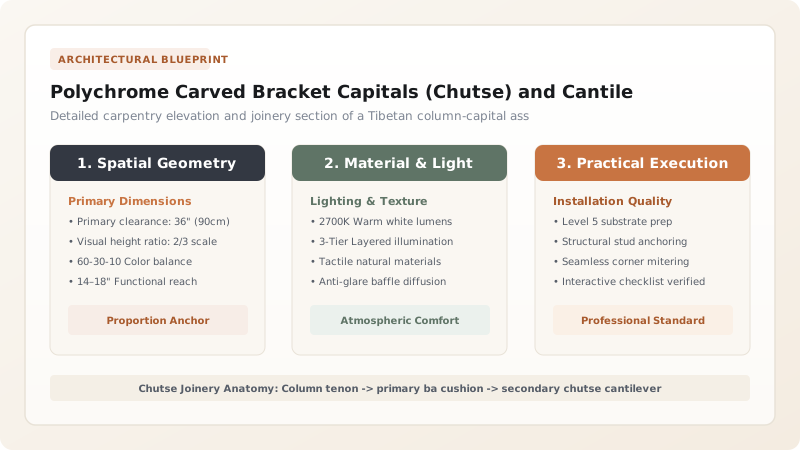
1. Mechanical Function and Rotational Seismic Damping of Chutse Capitals
In traditional Tibetan timber architecture, large ceiling girders (dung) carry massive loads from thick mud-and-stone roofs (arga) that can weigh upwards of 300 kg/m². If supported on simple column posts, point-load compression would crush the transverse grain of the girder, while horizontal earthquake shaking would easily dislodge the beam.
The chutse solves both problems simultaneously. By extending outward 400 to 600mm on either side of the column axis, the bracket acts as a cantilever spring. It spreads the column's vertical reactive force across a 1.2-meter length of the girder, halving shear stress and reducing maximum mid-span deflection. Crucially, the bracket is pinned with a loose wooden dowel rather than glued or nailed, allowing the joint to rotate slightly during earthquakes, dissipating seismic kinetic energy through internal wood friction.
2. Iconographic Profiling: Lotus Registers, Jewel Motifs, and Cloud Scrolls
Master Tibetan woodcarvers (shing-zo) execute the chutse using specialized gouges, drawknives, and beveled chisels. The capital assembly typically consists of three integrated components:
- Ba (Lower Cushion Block): A square or rectangular wooden block resting directly on the column head, carved with inverted lotus petals (pema) symbolizing purity and spiritual elevation.
- Chutse Proper (Bow Bracket): The main elongated cantilever beam, carved with stepped terminal scrolls reminiscent of billowing Himalayan storm clouds or the curved horns of the sacred blue sheep.
- Pendant Boss (Chutse-tong): A carved downward-pointing droplet or jewel boss suspended from the center of the bracket, representing the wish-fulfilling jewel (cintamani).
3. Sacred Mineral Pigments and Yak-Skin Gelatin Binding Chemistry
The painting of architectural woodwork in Tibet is not merely decorative; it is a sacred act of consecration performed according to strict iconometric canons. Modern chemical acrylics fade rapidly under extreme high-altitude ultraviolet radiation, but traditional mineral pigments retain their brilliance for centuries:
Craftsmen prepare pigments by grinding raw stones: Azurite for lapis-blue, Malachite for emerald-green, Cinnabar for vermilion-red, Orpiment for golden-yellow, and crushed chalk for bone-white. These powders are bound with boiled yak-hide gelatin (tso). The yak glue remains elastic in extreme sub-zero cold, expanding and contracting with the timber without flaking or crazing. A final protective coat of purified beeswax or light walnut oil seals the painted carvings against smoke and dust.
Tibetan Chutse Architectural Joinery and Dimensioning Standards
Use this reference table to calculate exact physical dimensions, ratios, and specifications before purchasing:
| Assembly Component | Material Specification | Typical Dimension | Structural Role | Decorative Treatment |
|---|---|---|---|---|
| Column Shaft (Ka) | Himalayan pine / Cypress log | 250–350mm diameter | Primary vertical gravity load | Fluted facets, painted floral bands |
| Column Tenon (Ka-go) | Integral timber tenon | 80 x 80mm, 100mm height | Interlocks column to capital | Concealed structural pin |
| Cushion Block (Ba) | Dense birch or deodar cedar | 400 x 400mm, 120mm height | Distributes load from bracket | Relief-carved inverted lotus petals |
| Main Bracket (Chutse) | Himalayan blue pine / cedar | 900–1400mm length, 150mm depth | Reduces girder bending span by 35% | Curved cloud scrolls, mineral polychromy |
| Ceiling Girder (Dung) | Heavy squared pine timber | 200 x 250mm cross section | Carries floor joists and roof load | Painted geometrical meander borders |
Practical Constraints
Every successful decoration project must account for physical and environmental constraints:
High Cost of Authentic Mineral Pigments
Yak-Glue Temperature Window
Carpentry and Polychrome Decoration Sequence for Chutse Bracket Capitals
Execute this professional sequence to achieve flawless results without backtracking:
Timber Seasoning and Rough Milling
Air-dry blue pine or cedar baulks for 2 years; rough-hew rectangular bracket blanks using traditional Himalayan adzes.
Mortise and Tenon Milling
Chisel square mortise sockets into the underside of the ba cushion block and chutse bracket to receive the column tenon.
Stepped Profile Laying and Adzing
Draw sacred cloud and lotus profiles using bone templates; shape stepped cantilever scrolls with curved gouges and drawknives.
Deep Relief Undercutting
Carve three-dimensional lotus petals and central jewel pendants, undercutting edges by 15mm to create dramatic architectural shadows.
Yak-Glue Gesso Priming
Apply two coats of chalk whiting mixed with warm yak-skin gelatin glue to seal wood grain and create a smooth painting ground.
Mineral Pigment Polychromy
Grind raw malachite, azurite, and cinnabar stones; apply vibrant color fields in accordance with traditional Buddhist architectural color hierarchy.
Gold Leaf Highlight and Oil Burnish
Apply real gold leaf to lotus tips and jewel accents using garlic juice mordant; buff lightly with yak wool and walnut oil.
Common Mistakes & Countermeasures
Avoid these costly errors that compromise aesthetics, ergonomics, and budget:
Gluing or rigidly bolting the chutse bracket to the column shaft
Using commercial synthetic acrylic paints on interior timber carvings
Carving chutse from fast-grown, unseasoned sapwood
Project Execution Checklist
Track your physical progress. Checkboxes persist automatically on this device:
Frequently Asked Questions
How does the chutse bracket help save timber in Tibet?
Large structural timber is extremely scarce on the arid Tibetan Plateau. By cantilevering outward and supporting the girder 500mm away from the post on both sides, the chutse reduces the effective clear span of the ceiling, allowing builders to use smaller, lighter timber girders that would otherwise fail under heavy roof loads.
What is the symbolic meaning of the colors on Tibetan capitals?
The five traditional colors correspond to the Five Buddha Families and elements: White represents water and pure consciousness; Yellow represents earth and stability; Red represents fire and discernment; Green represents wind/air and action; Blue represents space and wisdom.
Why is yak-skin glue used instead of modern wood adhesives?
Yak-skin glue is 100% reversible, non-toxic, and maintains exceptional elasticity in freezing temperatures down to -30°C. Modern PVA or resin glues become glassy and brittle in deep Himalayan sub-zero freezes, causing paint to flake off rapidly.


