
Cope stones and heather caps form the protective crown of a dry-stone dyke. Cope stones are heavy, flat slabs set upright on edge across the width of the wall, leaning against one another and locked under compression with hammer-driven wedge stones. In exposed Highland moors, traditional dykers topped the crest with living heather sods that knit the top stones into an erosion-proof root mat.
At a Glance: Key Takeaways
- Upright Book-Matched Coping: Slabs set vertically on edge spanning the full 400mm top width, leaning at 15° like books on a shelf.
- Compression Arch Wedging: The final stone in a run is a tapered wedge driven with a wooden maul, locking the entire line under tension.
- Weight Standardization: Each cope stone weighs 18 to 30 kg, preventing sheep and Highland cattle from dislodging them.
- Uniform Height Sightline: Upper tips dressed to follow a smooth, continuous skyline that mirrors the landscape contours.
- Heather Sod Root Mat: Living turf caps with dense fibrous heather root networks that bind the crest and shed driving rains.
- Friction Locking Without Mortar: Resists 100 mph Atlantic gales without cement, allowing water to drain without ice cracking.
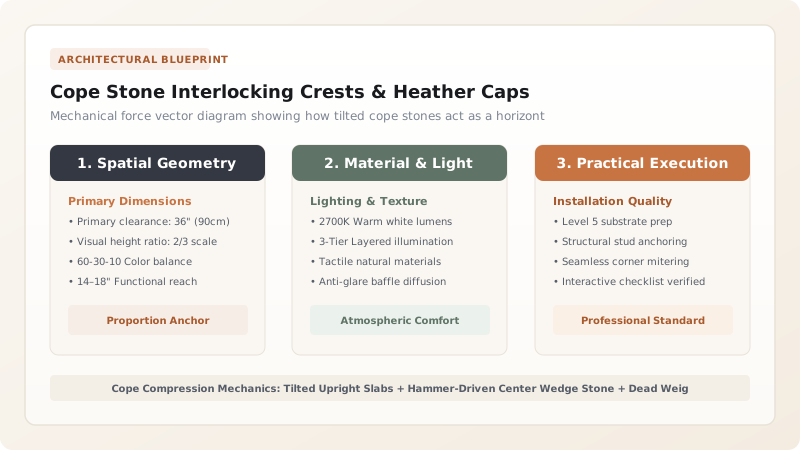
1. Compressive Mechanics: The Horizontal Arch of Cope Stones
The top \(200\text{ to }300\text{ mm}\) of a dry-stone dyke is subject to extreme mechanical disruption: leaping deer, grazing sheep, wind gusts, and human climbers. If stones were simply laid flat, individual stones could be easily dislodged.
Scottish dykers counter this by turning stones on edge: the upright cope (also called buck-and-doe or cock-and-hen). Slabs are set across the full width of the wall, tilted at approximately \(15^\circ\) to \(20^\circ\) from vertical. They lean against one another, creating a continuous horizontal compression arch:
The entire coping run acts as a single, interlocked structural beam that cannot be moved without lifting dozens of stones simultaneously.
2. Wedging Mechanics: The Keystone Strike
The critical climax of building a cope run is wedging the line. As the dyker sets stones from opposite ends of a wall run toward the center, a narrow wedge-shaped aperture remains.
The master dyker carves a hard, tapered stone keystone (the wedge stone). The wedge is dropped into the slot and driven home with heavy blows from a wooden beetle or stone hammer. The lateral wedging force drives both halves of the cope run into high compression against the end scuncheons, locking the entire 20-meter run so tightly that it rings like iron when struck.
3. The Traditional Highland Heather Cap
In the windswept heaths of Sutherland, Argyll, and the Hebrides, stone was often small and irregular. Highland dykers completed walls with a heather cap (turf crest).
Strips of tough, mature heather sod (Calluna vulgaris) were cut from the moor with peat spades and laid root-to-root across the flat top stones. The dense, wiry roots grow down into the hearting voids, creating an indestructible biological mesh. The living thatch sheds torrential rains outward beyond the wall faces while providing green camouflage that blends seamlessly into the Highland landscape.
Dyke Capping Systems Comparison
Use this reference table to calculate exact physical dimensions, ratios, and specifications before purchasing:
| Capping Method | Regional Style / Stone Type | Average Stone Weight | Livestock / Wind Performance |
|---|---|---|---|
| Upright Book-Matched Copes | Galloway & Southern Uplands (Sandstone/Granite) | 20 to 30 kg per slab | Supreme; withstands heavy livestock and 100mph gales |
| Cock-and-Hen (Alternating) | Highland & Border Country (Schist/Slate) | 15 to 25 kg alternating heights | Excellent; jagged teeth deter sheep from jumping |
| Flat Dressed Capstones | Formal Scottish Estate Walls (Freestone) | 35 to 60 kg continuous slabs | High visual elegance; prevents water pooling |
| Living Heather Turf Cap | Northern Highlands & Hebrides (Rubble stone) | Turf sods with 150mm root depth | Natural erosion shield; binds small loose stones into a mat |
Crest Execution Constraints
Every successful decoration project must account for physical and environmental constraints:
Span Matching
Every cope stone must span the full width of the wall top (minimum 350–400mm); using short copes that rest on only one face will cause the top course to peel apart.
End Pillar Anchoring
Upright copes exert powerful horizontal wedging thrust; wall termination pillars (scuncheons) must be massive and solid to prevent being pushed over.
Turf Cap Desiccation
Heather turf caps installed during hot dry summers will dry out and blow away before roots take hold; turfing must be executed in damp autumn months.
Cope Setting & Wedging Sequence
Execute this professional sequence to achieve flawless results without backtracking:
Top Cover Band Leveling
Lay small, flat cover stones across the upper wall course to create a level, stable shelf for the cope stones.
Cope Stone Sizing & Selection
Select uniform flat slabs measuring 400mm wide by 250mm tall, checking that all stones span the full top thickness.
End Scuncheon Anchor Setting
Set the heavy anchor cope at the wall end upright against the gateway pillar, propping it with a wedged brace.
Upright Book-Matched Laying
Set adjacent copes on edge leaning at 15 degrees against the anchor stone, keeping top peaks aligned to a tight string line.
Center Keystone Wedging
Drive a tapered stone wedge into the central meeting point with a wooden mallet, locking the entire run under horizontal compression.
Heather Cap Turf Placement (Optional)
Lay 100mm-thick heather sods across the crest, tamping roots into crevices and watering thoroughly.
Common Mistakes & Countermeasures
Avoid these costly errors that compromise aesthetics, ergonomics, and budget:
Using cope stones that are narrower than the top of the wall
Leaving upright copes loosely set without driving a final center wedge stone
Mortaring cope stones with Portland cement in cold climates
Project Execution Checklist
Track your physical progress. Checkboxes persist automatically on this device:
Frequently Asked Questions
Why do some Scottish dykes have alternating high and low cope stones ('cock-and-hen')?
The alternating tall and short jagged silhouette was intentionally designed to deter Highland sheep and hill goats from attempting to jump the wall, as animals cannot gauge a stable landing surface on jagged stone teeth.
How long does a properly coped dry-stone dyke last without maintenance?
When built with durable metamorphic stone (granite, schist) and properly wedged copes, dry-stone dykes regularly endure for 150 to 300+ years in the harsh Scottish climate with only minor occasional maintenance.
Can you walk on top of a dry-stone dyke?
While a properly wedged cope run can support human weight without shifting, walking on dykes is strongly discouraged in the countryside because repeated dynamic foot impacts can loosen locking wedge stones over time.


