Traditional hearth bedding and linseed oil conditioning are the time-honored techniques used to install and finish Caithness flagstone in Scottish domestic architecture. Large-format flags are bedded over breathable hydraulic lime mortar or sand-and-ash screeds around traditional peat hearths (the neuk). The natural cleft stone is conditioned with multiple coats of hot boiled linseed oil and pure beeswax, which penetrates the micro-porous Devonian siltstone to polymerize into an inky black-blue, soot-resistant, and velvet-sheen protective patina.
At a Glance: Key Takeaways
- Substrate Bedding: Breathable Natural Hydraulic Lime (NHL 2) mortar or tamped sand-ash screed
- Thermal Environment: Direct contact with open peat fire hearths (neuk) and wood-burning stoves
- Conditioning Medium: Hot raw or boiled linseed oil (Linum usitatissimum) blended with pure beeswax
- Optical Transformation: Pale chalky blue-grey shifts into a deep, lustrous inky black-blue velvet patina
- Chemical Resistance: Impermeable to grease, soot, hot ash, spilled tea, and wine
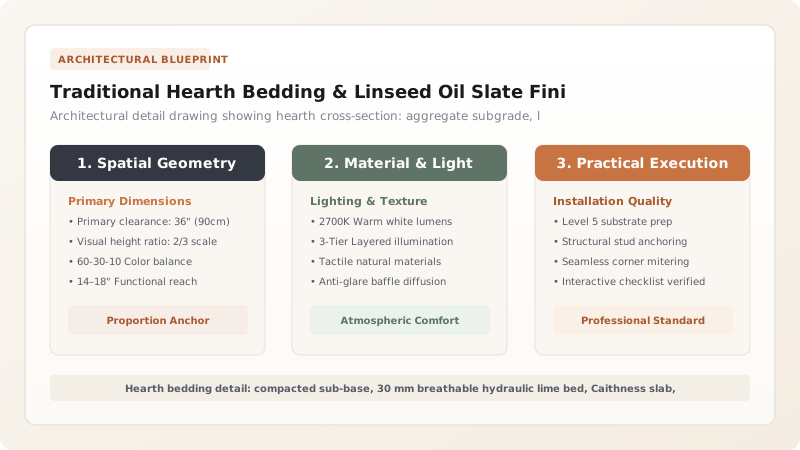
The Thermal Dynamics of the Croft Peat Hearth (The Neuk)
In the traditional Scottish croft cottage, domestic life revolved around a single burning nexus: the open peat fire, known in vernacular Scots as the hearth or neuk. In a landscape without coal or firewood, dried peat turf cut from the moorlands was burned continuously through winter. The thermal demands placed on the surrounding floor were severe: glowing embers reached temperatures exceeding 600°C, subjecting adjacent masonry to intense cyclical thermal shock.
Devonian Caithness flagstone was the only material capable of enduring these conditions without cracking, spalling, or shattering. Unlike sedimentary sandstones that contain moisture pockets that explode when heated, or limestones that calcine into quicklime under high heat, Caithness stone’s dense, microcrystalline silt-and-dolomite matrix possesses remarkable thermal stability. Formed under geological pressure, a single massive hearthstone (often measuring 1.5 meters square and 75 mm thick) anchored the fire, absorbing radiant heat all day and gently warming the stone floor through the night.
Breathable Hydraulic Lime Bedding Mechanics
Installing massive flagstone floors in damp, rain-swept Scotland requires careful moisture management. Modern contractors frequently make the catastrophic mistake of bedding flags in dense Portland cement mortar over damp concrete slabs. Cement is completely non-breathable and rigid. It blocks the natural upward evaporation of ground moisture, forcing water sideways into adjacent timber baseboards and plaster walls, causing fungal dry rot and severe salt efflorescence.
Authentic installation requires Natural Hydraulic Lime mortar (NHL 2 or NHL 3.5). The mortar is blended using one part hydraulic lime to two-and-a-half parts sharp, well-graded washed pit sand. This lime bed provides an elastic, flexible cushion that accommodates minor subgrade settlements without cracking the stone flags. Most importantly, hydraulic lime is vapor-permeable; it allows subgrade moisture to breathe harmlessly through the stone and joints, maintaining a dry, healthy indoor microclimate throughout damp Scottish winters.
The Polymer Chemistry of Boiled Linseed Oil Conditioning
When freshly quarried and cleft, Caithness flagstone presents a dry, pale, slate-grey or blue-grey appearance. Left unconditioned, the microporous surface can absorb grease splatters, spilled tea, and wet soot, leaving dull matte stains. The vernacular remedy is linseed oil conditioning.
Linseed oil, cold-pressed from the seeds of the flax plant (Linum usitatissimum), is a drying oil rich in polyunsaturated fatty acids, particularly alpha-linolenic acid. When warmed and buffed into the clean, bone-dry stone, the low-viscosity oil penetrates 1.0 to 2.5 mm deep into the microscopic capillary pores between the quartz silt grains. Exposed to ambient atmospheric oxygen, the oil undergoes oxidative polymerization—the carbon double bonds cross-link into a solid, resilient, rubbery polymer network that fills the pores, permanently locking out liquid moisture, soot, and culinary grease.
Optical Depth, Beeswax Buffing & The Velvet Patina
The visual transformation wrought by linseed oil on Caithness stone is breathtaking. Because the refractive index of polymerized linseed oil (roughly 1.48) closely matches the refractive index of quartz crystals and organic bitumen in the stone, light is no longer scattered diffusely at the surface. Instead, light penetrates deeply into the stone matrix before reflecting, shifting the chalky grey stone into an astonishingly deep, inky midnight-blue or charcoal velvet.
To seal and protect the oil finish, master stone conservators apply a final buffing paste of melted pure Scottish beeswax dissolved in gum turpentine. Buffed vigorously with coarse woolen blankets, the beeswax fills microscopic surface ripples, creating a soft, tactile, low-sheen satin luster that feels warm and silky beneath stockinged feet. With minimal maintenance—simply sweeping soot away and periodic damp mopping with natural vegetable soap—this traditional finish matures over generations, developing a deep, historic patina that grows more beautiful with every decade of domestic life.
Finishing Regimes for Interior Caithness Flagstone
Use this reference table to calculate exact physical dimensions, ratios, and specifications before purchasing:
| Finishing Treatment | Application Chemical | Surface Appearance | Maintenance Requirement | Suitability Profile |
|---|---|---|---|---|
| Traditional Boiled Linseed & Beeswax | Boiled linseed oil + 10% melted beeswax | Deep inky black-blue; rich satin sheen | Buff annually with wax; re-oil every 3–5 years | Historical crofts, traditional hearths, kitchen floors |
| Natural Cleft (Raw / Untreated) | None (raw stone) | Pale chalky slate grey; completely matte | Periodic scrubbing with clean water | Rustic entryways, mudrooms, exterior transitions |
| Breathable Mineral Silicate Staining | Potassium silicate + iron oxide pigments | Uniform dark charcoal; zero film | Zero ongoing maintenance for 15+ years | High-traffic modern civic buildings, museum galleries |
| Synthetic Acrylic 'Wet-Look' Sealer | Solvent-based acrylic polymer | Glossy plastic shine; artificial sheen | Requires chemical stripping every 3 years | Unsuitable; traps moisture and turns cloudy white |
| Black Soap (Savon Noir) Wash | Linseed oil-derived potassium soap | Soft glowing patina; water repellent | Wash weekly with black soap in mop water | High-end contemporary residential living rooms |
Practical Constraints
Every successful decoration project must account for physical and environmental constraints:
Combustion spontaneous heating risk of linseed-oil-soaked application rags
Rags piled in garbage bins can spontaneously combust and ignite a devastating house fire Mitigation: Immediately submerge all oil-soaked rags in a bucket of water or lay flat outdoors to dry fully
Extreme thermal shock around open peat hearths causing stone expansion fissures
Direct flame impingement on cold Caithness flags can induce laminar spalling Mitigation: Install a sacrificial cast-iron fireback or bed the central hearthstone on a 50 mm crushed lime-ash cushion
Execution Blueprint & Craftsmanship Sequence
Execute this professional sequence to achieve flawless results without backtracking:
Subfloor Excavation & Moisture Barrier
Excavate floor to 150 mm depth, compacting clean crushed stone aggregate to provide a solid, non-capillary base.
Hydraulic Lime Screed Mixing
Blend one part Natural Hydraulic Lime (NHL 2 or 3.5) with two-and-a-half parts well-graded coarse pit sand.
Hearth Centerline Setting
Lay the central monumental hearthstone (the neuk flag) first, aligning it perfectly with the chimney flue above.
Back-Butter & Flag Placement
Coat the back of each Caithness flag with liquid lime slip, setting it into the 30 mm mortar bed with mallet taps.
Tight Joint Tooling
Fill narrow 3 mm perimeter joints with fine sand-and-lime grout, striking flush with the natural cleft surface.
Two-Week Curing & Desiccation
Allow the floor to cure for 14 days under damp burlap, followed by complete air-drying before oil application.
Hot Boiled Linseed Oil Application
Warm pure boiled linseed oil to 40°C, wiping it across the clean stone with cotton cloths in thin, circular motions.
Excess Removal & Beeswax Buffing
Wipe away all unabsorbed surface oil after 20 minutes; apply a thin paste of beeswax and buff to a deep velvet sheen.
Common Mistakes & Countermeasures
Avoid these costly errors that compromise aesthetics, ergonomics, and budget:
Applying thick, puddling coats of cold raw linseed oil directly onto unheated stone
Bedding hearth flags in modern Portland cement mortar directly around high-heat fireboxes
Using chemical acid brick washes to clean new Caithness flagstone floors
Project Execution Checklist
Track your physical progress. Checkboxes persist automatically on this device:
Frequently Asked Questions
Why does linseed oil turn pale grey Caithness stone dark inky black?
Devonian Caithness flagstone contains significant quantities of natural organic bitumen and dark carbonaceous clay between its quartz silt grains. In raw, dry stone, light refracts off porous air voids, making it appear pale slate-grey. Linseed oil fills these micro-pores; because the oil's refractive index matches the quartz and bitumen, light penetrates deeply, revealing the rich, natural inky-black depth of the stone.
Is boiled linseed oil better than raw linseed oil for stone floors?
Yes. Raw linseed oil takes weeks to dry and can remain sticky on non-absorbent stone. Boiled linseed oil has been pre-heated with natural metallic driers (such as manganese), causing it to polymerize and cure into a tough, dry, water-resistant solid within 24 to 48 hours.
How do you clean an oiled Caithness stone hearth without stripping the oil?
Never use harsh chemical detergents, bleach, or degreasers. Sweep away cold peat or wood ash with a soft broom whisk, and mop the floor with warm water mixed with a capful of natural linseed oil soap (black soap). The soap gently cleans while depositing a micro-layer of fresh vegetable lipids to maintain the patina.