Traditional Scottish Caithness stone flagging and drystone cleits represent the zenith of North Atlantic vernacular masonry. Mined from the Devonian Old Red Sandstone strata of northern Scotland, Caithness flagstone naturally splits along bituminous bedding planes into dense, frost-proof, high-flexural slabs historically used for civic pavements, croft hearths, and field dykes. In the wind-scoured outer archipelagos, drystone corbelled cells known as cleits harness gale winds blowing through mortarless wall gaps to cure meat, seabirds, and peat turf without artificial heat.
At a Glance: Key Takeaways
- Geological Formation: Middle Devonian Old Red Sandstone lakebed sediment (Lake Orcadie, ~380 Ma)
- Regional Epicenter: Caithness (Spittal, Castletown, Thurso) & Outer Hebrides (St Kilda)
- Stone Physical Properties: Fine-grained bituminous siltstone, water absorption <0.5%, high flexural strength
- Iconic Drystone Typology: St Kilda corbelled cleit (cleitean) with wind-permeable drystone & turf cap
- Traditional Finish: Raw hand-split natural cleft or rubbed with boiled linseed oil and beeswax
In-Depth Guides in this Directory
Explore specialized subtopic blueprints, technical dimensions, and execution checklists:
Devonian Flagstone Quarry Splitting & Square Dressing in Caithness Stone
Master the geological extraction, hand-splitting, and square edge-dressing of Scottish Devonian Caithness flagstone.
Wind-Permeable Drystone Cleit Corbelling & Turf Caps in Hebridean Architecture
Explore the aerodynamic corbelled drystone masonry and wind-permeable engineering of St Kilda cleits in the Scottish Hebrides.
Traditional Hearth Bedding & Linseed Oil Slate Finishes for Caithness Flags
Learn traditional hearth bedding techniques and hot boiled linseed oil conditioning for Scottish Caithness stone flag floors.
The Devonian Petrology of Lake Orcadie Flagstone
In the windswept far north of the Scottish mainland, the county of Caithness presents a treeless, undulating landscape of peat bogs and dramatic coastal cliffs. Beneath this brooding moorland lies one of the most extraordinary geological deposits on Earth: the Caithness Flagstone Formation of the Middle Old Red Sandstone, laid down approximately 380 million years ago during the Devonian Period.
At that time, northern Scotland lay south of the equator, covered by a vast, rhythmic inland freshwater lake known to geologists as Lake Orcadie. Over millions of years, climatic Milankovitch cycles caused the lake to expand and contract. During deep, stagnant lake phases, dead algal blooms and fine quartz silt settled onto the anoxic lake floor, forming paper-thin laminations enriched with bitumen, dolomite, and silica. Compressed by kilometers of overlying rock, these sedimentary beds transformed into an ultra-dense, microcrystalline siltstone that naturally splits into massive, perfectly planar slabs with extraordinary flexural strength and virtually zero water absorption (<0.5%).
Vernacular Quarrying, Splitting & Croft Architecture
Because Caithness lacked native structural timber, the local population adapted the stone to solve every domestic and agrarian challenge. In the 18th and 19th centuries, an industrial empire emerged around quarries in Spittal, Castletown, and Thurso under innovators like Sheriff James Traill. Quarriers utilized natural joint sets (backs and cutters), using iron bars and split-iron feathers to pry massive sheets measuring up to three by four meters from the bedrock.
In local crofting communities, flagstone was ubiquitous. Upright flags bedded in slot trenches formed livestock fences (flagstone dykes) that required no mortar and stood impervious to salt-laden Atlantic gales. Inside the traditional longhouse croft, large-format cleft flags paved the damp byre and kitchen floors, lined the open central hearth (the neuk), framed water cisterns, and formed massive lintels across low door openings, creating a fireproof, hygienic, and nearly indestructible domestic architecture.
The Aerodynamic Engineering of the St Kilda Cleit (Cleitean)
Nowhere did North Atlantic drystone engineering reach greater audacity than in the isolated archipelago of St Kilda, forty miles west of the Outer Hebrides. Exposed to the uninterrupted fury of the open Atlantic Ocean, where trees cannot survive and salt spray drenches the land, the St Kildans built over 1,200 unique drystone structures known as cleits (Scottish Gaelic: cleitean).
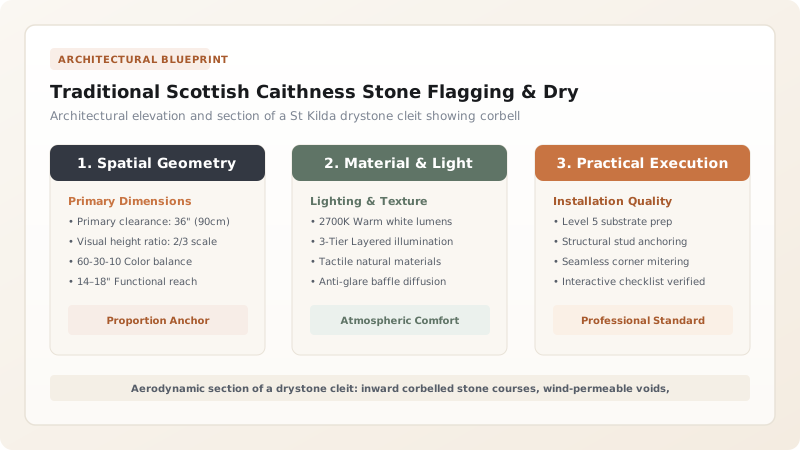
A cleit is an elongated, boat-shaped or oval stone vault constructed entirely without mortar. The walls are built of double-wythe unworked gneiss and basalt boulders, cantilevering inward course by course in a corbelled false arch. Crucially, the vertical joints between stones are left wide open. The structure is capped with massive flat stone lintel slabs and blanketed with living sods of coastal fescue grass and peat (divots). The genius of the cleit lies in its thermodynamic permeability: howling gale winds pass continuously through the stone walls, creating a high-velocity convective draft that dehydrates and cures stored fulmars, puffins, gannets, and mutton without smoke or precious fuel, while the inverted turf cap sheds heavy rains down the outer stone batters.
Conservation, Hearth Chemistry & Contemporary Flooring Legacy
Today, historic Caithness flagstone and drystone cleits are fiercely protected heritage treasures under Historic Environment Scotland and the National Trust for Scotland. The physical properties that made Caithness stone famous during the Industrial Revolution—when it was shipped across the British Empire to pave the streets of London, Sydney, and Buenos Aires—make it one of the most sought-after luxury architectural surfaces in modern sustainable design.
Unlike soft, porous limestones or artificial porcelain tiles, authentic Caithness flagstone possesses deep thermal inertia and natural slip resistance. In contemporary residential projects, interior flags are laid over lime-sand screeds integrated with radiant floor heating. When seasoned with traditional hot boiled linseed oil and pure Scottish beeswax, the dark grey stone absorbs the organic lipids, deepening into a lustrous, velvety inky-blue satin patina that repels wine, oil, and moisture spills while highlighting 380-million-year-old fossilized Devonian fish scales and ripple marks embedded within the ancient stone.
Caithness Stone Applications & Drystone Vernacular Typologies
Use this reference table to calculate exact physical dimensions, ratios, and specifications before purchasing:
| Architectural Typology | Stone Thickness | Bedding Substrate | Structural Mechanism | Environmental Performance |
|---|---|---|---|---|
| Interior Croft Hearth & Floor | 25–35 mm cleft | Hydraulic lime-sand screed (1:3) | Level paving with staggered tight joints | High thermal mass for radiant peat stove warmth |
| Civic Pavement Flagging | 50–65 mm heavy | Compacted crushed granite sub-base | Interlocking square-dressed slabs | Extreme wear resistance; zero frost spalling |
| St Kilda Cleit (Storage Vault) | 75–150 mm rubble slabs | Mortarless drystone ground footing | Corbelled stone vault with turf cap | Wind-permeable desiccator drying meat without smoke |
| Field Dyke / Flagstone Fence | 30–50 mm upright | Direct vertical slot trench in subsoil | Upright flags tied with iron cramps | Impenetrable windbreak with zero timber requirement |
| Harbor Quay & Sea Wall | 100–250 mm massive | Interlocking drystone / hydraulic pozzolan | Gravity revetment absorbing wave shocks | Impervious to saltwater marine boreholes |
Practical Constraints
Every successful decoration project must account for physical and environmental constraints:
Colossal weight and freight logistics of dense Devonian flagstone
Transportation costs escalate rapidly when shipping thick Caithness flags beyond northern Scotland Mitigation: Specify precision-sawn 25 mm thin-bed flagstones for interior domestic installations to minimize dead load
Violent North Atlantic gales lifting turf caps from drystone cleits
Exposed ridge turf rolls peel off during 100 mph Atlantic hurricane-force winter storms Mitigation: Peg living coastal fescue turf rolls with hazel pegs and weight eaves with heavy rounded river stones
Execution Blueprint & Craftsmanship Sequence
Execute this professional sequence to achieve flawless results without backtracking:
Geological Quarry Extraction
Expose natural sedimentary beds in the quarry, inserting wedges (plugs and feathers) to separate continuous flagstone sheets.
Splitting Along Bituminous Laminae
Drive wide splitting chisels along horizontal bed lines, parting flags to uniform 25 mm or 35 mm natural cleft thicknesses.
Square Edge Dressing (Bolstering)
Trim irregular slab edges with stone-dressing hammers and broad cold chisels, creating straight, slightly under-cut edges.
Sub-Base Compaction & Grading
Excavate floor area to 150 mm depth, compacting a 100 mm bed of crushed stone aggregate topped with breathable sand.
Hydraulic Lime Bedding & Setting
Lay flags into a 25 mm bed of soft hydraulic lime mortar (NHL 2), tapping home with heavy rubber mallets to ensure solid bearing.
Narrow Joint Grouting
Fill tight 3 to 5 mm joints with fine silica sand and lime slurry, striking joints flush with the natural cleft surface.
Cleit Drystone Corbel Erection (If Exterior)
Stack un-mortared stone slabs in an oval plan, cantilevering each course inward 30 mm until spanned by top capstones.
Linseed Oil & Beeswax Conditioning
For interior hearths, wipe clean dry flags with hot boiled linseed oil and melted beeswax, buffing into an inky satin sheen.
Common Mistakes & Countermeasures
Avoid these costly errors that compromise aesthetics, ergonomics, and budget:
Bedding interior Caithness flags in rigid, impermeable Portland cement over damp subgrades
Pointing or mortaring the gaps in traditional drystone cleit storage walls
Applying synthetic topical acrylic wet-look sealers over Caithness stone
Project Execution Checklist
Track your physical progress. Checkboxes persist automatically on this device:
Frequently Asked Questions
What makes Caithness flagstone geographically unique?
Caithness flagstone was deposited roughly 380 million years ago at the bottom of Lake Orcadie, a vast prehistoric tropical lake. Periodic seasonal flooding deposited alternating layers of microscopic quartz silt, calcium carbonate, and organic algae. Under immense pressure, this transformed into a microcrystalline stone with exceptionally low porosity, remarkable flexural strength, and natural splitting properties.
What was the purpose of a drystone cleit on St Kilda?
A cleit (plural: cleitean) was an un-mortared drystone storage structure unique to the remote Scottish archipelago of St Kilda. With over 1,200 cleits built across the islands, they functioned as wind-powered food dehydrators. Howling Atlantic winds blew continuously through gaps between the dry stones, drying seabirds (fulmars, puffins), salted mutton, and damp peat fuel without fire in a damp sub-polar climate.
Does Caithness flagstone become slippery when wet?
No. The natural cleft surface of cleaved Caithness stone possesses microscopic undulating quartz ridges that provide natural skid resistance even during heavy rainfall. For this reason, it was chosen in the 19th century to pave urban sidewalks across London, Edinburgh, and harbors worldwide.
Can Caithness stone be used with modern underfloor radiant heating?
Yes. Caithness stone is an extraordinary conductor of thermal energy. Its high geological density allows it to absorb heat rapidly from underfloor hydronic coils and radiate steady, gentle warmth into the room for hours after the heating system shuts down.