Devonian Caithness flagstone extraction is an ancient Scottish stonework craft governed by rhythmic geological bedding planes. Mined from the historic Spittal and Castletown quarries, large sedimentary rock sheets are separated using steel wedges (plugs and feathers) along horizontal bituminous laminae. Stonemasons then split the slabs into uniform thicknesses using wide-bladed splitting chisels and dress the perimeter edges square with bolster chisels and dressing scutches, preserving the natural cleft texture while providing tight, uniform joints.
At a Glance: Key Takeaways
- Geological Epoch: Middle Devonian Old Red Sandstone (Lake Orcadie basin, ~380 Ma)
- Primary Mineralogy: Microcrystalline quartz silt, dolomite, illite clay, and organic bitumen
- Splitting Mechanism: Plugs and feathers along natural horizontal bituminous cleavage planes
- Edge Dressing Tool: Tungsten-tipped masonry bolster and broad-faced scutching hammer
- Surface Texture: Natural cleft (undulating matte texture with micro-quartz ridges)
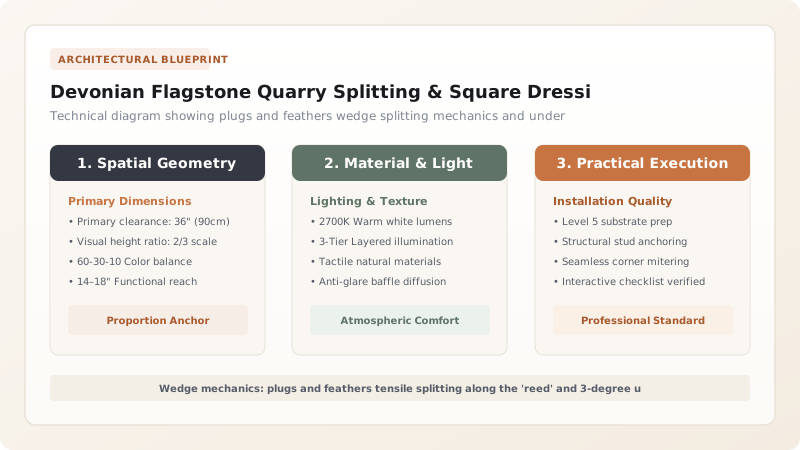
The Bedding Architecture of the Caithness Flagstone Strata
In stone quarrying, the geological genesis of a rock formation dictates the methods of its extraction. Caithness flagstone is unique among British building stones because of its remarkable laminated structure. Deposited over hundreds of thousands of years on the floor of the ancient Lake Orcadie, the stone is built of countless alternating microlayers (laminae) of quartz-rich silt and dark, organic bituminous mud.
These micro-laminations create natural, continuous planar weakness zones known to Scottish quarrymen as the reed or the 'bed'. Unlike igneous granites that must be blasted or massive sandstones that must be sawn in all three dimensions, Caithness stone wants to split horizontally. A skilled quarryman reading the exposed rock face can identify the natural bedding horizons and separate slabs the size of a billiard table with minimal mechanical energy, preserving the undulating, non-slip natural cleft texture formed by Devonian water currents.
The Plugs & Feathers Splitting Technique
The extraction of massive flagstone sheets begins with the ancient masonry technique of plugs and feathers. Once the horizontal bedding joint is exposed, the stonemason marks a straight splitting line across the rock bench. Using a pneumatic or rotary drill, a series of shallow holes—roughly 20 mm in diameter and 100 to 150 mm deep—are drilled along the line at intervals of approximately 150 to 200 mm.
Into each hole, the mason places two half-round steel shims with flared tops, known as 'feathers'. A tapered steel wedge, the 'plug', is inserted between them. The mason then walks down the line with a heavy club hammer, striking each plug in sequence with measured, rhythmic blows. This action translates downward hammer force into immense lateral tensile stress perpendicular to the hole. Because sedimentary rock is weak in tension, a straight fracture propagates cleanly between the holes, parting a multi-ton slab from the quarry face with razor-like precision.
Horizontal Cleaving & Layer Separation
Once the large rectangular slab is detached from the rock face, the next challenge is horizontal cleavage—splitting a 150 mm thick block into thinner, usable 25 mm or 35 mm flooring flags. This operation demands exceptional tactile sensitivity. The stone is stood on edge, and the mason inspects the edge profile to locate the natural bituminous bedding lines.
Using wide-bladed, thin steel splitting chisels (spalt-irons), the mason drives the tool into the edge seam at regular intervals. As the wedges penetrate, hydraulic air pressure inside the micro-fissure assists the parting. The stone yields with a dull, hollow thud, splitting open like the pages of an ancient book. The exposed interior faces reveal pristine, unweathered natural cleft surfaces, displaying delicate sedimentary structures, prehistoric mud cracks, and occasional fossil impressions of armored Devonian fishes (such as Dipterus and Osteolepis) preserved for 380 million years.
Square Edge Dressing: Bolstering & Undercut Geometry
A split flagstone has irregular, ragged edges that cannot be laid into neat flooring courses without dressing. The mason lays the cleft slab across low wooden trestles, snapping straight lines with powdered chalk. Using a broad, tungsten-tipped bolster chisel struck with a heavy steel mash hammer, the mason cuts along the line, pitching off the waste stone in sharp, decisive flakes.
A critical technical rule in traditional Caithness stone dressing is the undercut. The mason tilts the bolster chisel inward at an angle of roughly 2 to 3 degrees relative to the face. Consequently, the top edge of the flagstone represents its widest point, while the hidden lower edge recedes slightly. When adjacent flags are laid side-by-side on the mortar bed, their top surfaces butt together in an impeccably tight, uniform joint line, while the triangular void beneath provides space for bedding mortar to key between the stones, ensuring permanent interlocking stability under heavy loads.
Caithness Flagstone Sizing & Edge-Dressing Standards
Use this reference table to calculate exact physical dimensions, ratios, and specifications before purchasing:
| Application Specification | Nominal Thickness | Edge Dressing Method | Joint Gap Width | Flexural Bending Strength |
|---|---|---|---|---|
| Interior Domestic Flooring | 22–28 mm (calibrated) | Hand-dressed / sawn and pitched | 3 to 5 mm | 28 to 35 MPa |
| Exterior Civic Pavements | 45–55 mm | Hammer-bolstered square edge | 6 to 8 mm | 35 to 45 MPa |
| Heavy Vehicular Driveways | 65–75 mm heavy block | Rough-dressed squared margin | 8 to 10 mm | 45+ MPa |
| Hearthstones & Steps | 75–100 mm solid slab | Hand-tooled margin with bullnosed edge | Tight hairline fit | Exceptional point-load bearing |
| Vertical Dyke / Boundary Flag | 35–50 mm upright | Natural split quarry edge | Slot-trenched in subsoil | High lateral wind resistance |
Practical Constraints
Every successful decoration project must account for physical and environmental constraints:
Variable natural bedding thickness requiring manual hand sorting and grading
Unsorted slabs cause severe height step-ups and trip hazards on finished floors Mitigation: Sort quarry flags into precise thickness batches before delivery and bed in variable mortar depths
Presence of pyrite nodules causing potential localized rust oxidation spots
Small golden-brown iron rust stains appear on interior stone faces under damp conditions Mitigation: Inspect flag surfaces at the quarry and reject slabs containing visible brassy iron pyrite crystals
Execution Blueprint & Craftsmanship Sequence
Execute this professional sequence to achieve flawless results without backtracking:
Quarry Face Stripping & Bed Inspection
Remove overburden peat and glacial till to expose clean horizontal Devonian siltstone beds in the quarry bench.
Pinhole Line Drilling
Drill a straight line of 20 mm holes spaced at 150 mm intervals along the natural joint fissure using a rotary hammer.
Plugs & Feathers Wedge Insertion
Insert two tapered steel feather shims into each hole, driving a central steel plug wedge between them with rhythmic strikes.
Bed Parting & Slab Prying
Listen for the resonant crack indicating the bed has parted; lever the multi-ton flagstone sheet out with long quarry bars.
Horizontal Cleavage Splitting
Drive wide, flat steel splitting chisels along the edge of the slab, separating it into uniform 25 mm natural cleft layers.
Chalkline Squaring & Marking
Lay out square rectangular dimensions on the cleft face using a mason's framing square and snapped powdered chalk lines.
Edge Pitching & Bolstering
Hold a broad tungsten bolster chisel against the line and strike with a heavy club hammer to shear off waste stone cleanly.
Undercutting & Quality Inspection
Scutch the rear underside edge at a slight 3-degree inward angle to ensure tight top-surface butt joints on the job site.
Common Mistakes & Countermeasures
Avoid these costly errors that compromise aesthetics, ergonomics, and budget:
Using explosive blasting charges to break flagstone beds in the quarry
Dressing the stone edges with an outward bevel instead of an undercut bevel
Attempting to split stone across the natural grain orientation (the 'reed')
Project Execution Checklist
Track your physical progress. Checkboxes persist automatically on this device:
Frequently Asked Questions
What tools are used to split Caithness flagstones by hand?
Traditional quarriers use steel 'plugs and feathers' (a pair of curved steel shims with a central wedge) driven into drilled holes to split massive blocks, followed by wide-bladed splitting irons (also called flagger's chisels) and heavy sledgehammers to split slabs horizontally along their natural bedding planes.
What is an 'undercut' edge in stone dressing and why is it important?
An undercut edge (or pitched edge) is carved so that the top face of the stone is slightly wider than the bottom face. When two dressed stones are pushed together, their top edges meet in an exquisitely tight, narrow joint, while the wider gap below allows bedding mortar to lock the stones firmly in place.
How can you tell hand-dressed Caithness stone from diamond-sawn stone?
Hand-dressed stone displays subtle chisel marks, slightly varied texture, and a soft, pitched border margin along its perimeter edges. Diamond-sawn stone has perfectly sharp, uniform 90-degree edges with microscopic parallel saw blade striations that lack historic vernacular character.