
Dragon head gable carvings (dragehoder) and multi-layered fish-scale pine shingles (spon) define the external envelope of Scandinavian stave churches. Protected by the regular application of kiln-distilled, boiled Scots pine tar (tretjære), the wood absorbs natural terpenes and resin acids that penetrate deep into the timber's cellular structure, polymerizing under solar UV light into a breathable, pitch-black water barrier that prevents fungal decay for centuries.
At a Glance: Key Takeaways
- Viking Dragon Head Iconography: Open-mouthed serpent carvings derived from Viking dragon ships (drakkars), warding off evil while shedding roof water.
- Cleft Fish-Scale Shingles (Spon): Hand-split radially from pine logs with froes, preserving unbroken longitudinal wood medullary rays.
- Traditional Tar Kiln Distillation: Slow oxygen-deprived pyrolysis (tjæremile) of resin-rich pine stumps yielding high-purity boiled pine tar.
- Natural Antifungal Chemistry: High concentrations of pinosylvin, abietic acid, and aromatic terpenes providing permanent immunity to rot fungi.
- Triennial Re-Tarring Cycle: Heated to 50-60°C and applied with coarse natural bristle brushes during warm, dry summer days for optimal penetration.
1. Viking Dragehoder: Iconography & High-Relief Woodcarving
Projecting from the highest ridge gables of churches like Borgund and Lom, Dragon Heads (Dragehoder) represent the triumphant survival of pre-Christian Viking mythology into medieval Christian architecture:
- The Apotropaic Tradition: Derived from the dragon figureheads of Viking war galleys, these serpent heads were believed to terrify malevolent land spirits (landvetter) and protect the sacred interior from demonic storm winds.
- Woodcarving Technique: Carved from solid, slow-grown malmfuru pine logs measuring 1.5 to 2.5 meters in length, the dragon's neck emerges directly from the ridge verge boards (vindskier). Carvers used curved gouges and V-parting chisels to sculpt gaping jaws, bifurcated tongues, flared nostrils, and interlacing Urnes-style zoomorphic ribbon scrolls along the crest.
- Functional Gargoyle Detailing: Beyond their symbolic role, dragon heads act as Architectural Water Spouts. The open jaws project 1.0 to 1.5 meters beyond the fragile wooden shingle gables, throwing cascading roof runoff clear of the building's lower timber walls. Review overall structural framework in our stave church hub.

2. Fish-Scale Shingle Craft (Spon): Cleaving & Overlapping
A typical high-medieval stave church roof is clad in over 20,000 individual wooden shingles (tak-spon):
- Radial Hand Cleaving: Shingles must never be sawn. Sawn wood severs capillary vessels, creating a sponge-like surface that absorbs water. Shingles are split radially from split log rounds using a riving froe (klove-kniv) and wooden club. This ensures the shingle surface follows the natural, unbroken medullary rays of the wood.
- Fish-Scale Patterning: Shingles measure 300mm to 400mm long, 100mm to 150mm wide, and 15mm thick at the butt, tapering to 5mm at the tip. The exposed lower edge is hand-tooled into a pointed, semicircular, or fish-scale profile that channels rainwater toward the center of each shingle rather than into side joints.
- Triple-Lap Exposure: Shingles are laid with a one-third exposure (triple-lap coverage). Rainwater must penetrate three distinct layers of dense, tarred pine heartwood before it can reach the roof rafters below. Learn sill and column joinery in massive pine ground sills.
3. Pine Tar Biochemistry: Distillation, Application & Curing
The dark obsidian color and incredible durability of stave church exteriors are the result of centuries of Tjærebredning (Tarring):
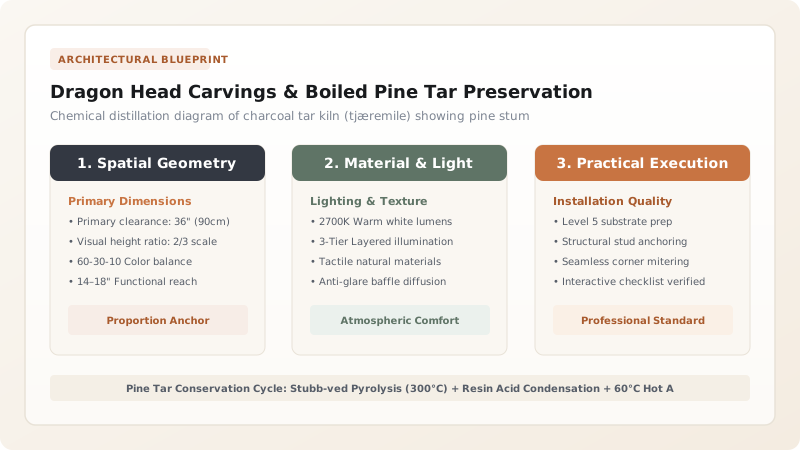
- The Charcoal Tar Kiln (Tjæremile): Pine tar is manufactured through the destructive dry distillation of resin-rich pine stumps (tyri). Ancient stumps are stacked in a funnel-shaped earth-covered pit. When fired under oxygen-deprived conditions at 250°C to 350°C, natural resins boil out of the wood cells, condensing into a thick, golden-brown to dark amber viscous tar that flows out through a lower wooden pipe.
- Chemical Protective Mechanism:
$$\text{Biocidal Index: } C_{\text{resin acids}} \ge 65\% \implies \text{Fungal Inoculation } = 0$$Rich in abietic acid, pimaric acid, and volatile terpenes, pine tar does not form a brittle surface film like synthetic varnish. It penetrates into the empty cell lumens of the wood. When exposed to solar ultraviolet radiation, it cross-links and polymerizes into a natural, breathable, water-repellent resin shield.
- Application Temperature: Pure pine tar is thick and sticky at room temperature. It must be gently warmed in an iron cauldron to 50°C to 60°C to lower its viscosity, allowing it to penetrate up to 3mm into the wood fibers. Conservators apply tar exclusively on warm, sunny summer days when the wood is dry and warm. Review truss engineering in scissor-beam roof framing.
Pine Tar Grades & Exterior Shingle Treatment Matrix
Use this reference table to calculate exact physical dimensions, ratios, and specifications before purchasing:
| Tar Grade | Distillation Method | Viscosity / Consistency | Penetration Depth | Application Frequency | Recommended Structural Zone |
|---|---|---|---|---|---|
| First-Run Golden Tar (Lys Tjære) | Low-temp initial kiln draw | Thin, golden amber liquid | 3 - 5 mm (Deep) | Annual for new wood | Carved dragon heads & portals |
| Heavy Boiled Black Tar (Militjære) | Full-cycle kiln distillation | Thick, viscous dark pitch | 1.5 - 3 mm (Dense) | Every 3 to 5 years | Exterior fish-scale roof shingles |
| Linseed Oil / Tar Blend (50/50) | Blended with cold-pressed oil | Medium fluid brushable | 4 - 6 mm (Maximum) | Every 4 to 6 years | Vertical wall planks & bell towers |
| Modern Coal-Tar / Creosote | Fossil fuel byproduct | Thin toxic liquid | Surface only | STRICTLY FORBIDDEN | PROHIBITED on historic stave churches |
Carving & Pine Tar Application Constraints
Every successful decoration project must account for physical and environmental constraints:
Extreme Fire Flammability
Freshly applied pine tar is flammable until the light terpenes evaporate over 4 to 6 weeks; all open flames, lightning risks, and welding must be forbidden on site.
Sunlight & Temperature Windows
Cold pine tar (< 15°C) coagulates on the surface like glue without penetrating; application can only be conducted during warm summer spells (ambient temp > 20°C).
Shingle Cleaving Skill Scarcity
Splitting 20,000 curved fish-scale shingles with a froe along radial medullary rays requires hundreds of hours of specialized craft labor.
Staining Runoff on Foundations
Fresh pine tar can drip onto dry-stone granite foundation footings during summer heat waves, creating dark resin stains.
Dragon Head Carving & Hot Pine Tar Application Sequence
Execute this professional sequence to achieve flawless results without backtracking:
Malmfuru Log Selection
Select a slow-grown, resinous Scots pine trunk free of heart checks, sizing to 2.5 meters length and 450mm diameter.
Layout & Rough Hewing
Draw the zoomorphic dragon profile on the wood blank; rough out the jaw, neck crest, and mounting mortise with a felling axe.
Detailed Relief Carving
Carve ribbon scrolls, open teeth, and eyes using curved gouges and V-tools, maintaining deep 40mm relief for dynamic shadows.
Ridge Mounting
Slot the carved dragon head over the ridge purlin and verge boards, securing with 30mm cleft juniper dowels driven through the neck base.
Shingle Radial Cleaving
Split pine heartwood bolts radially with a froe and club; shape the lower butt into fish-scale points using a drawknife on a shaving horse.
Heating the Pine Tar
Heat pure kiln-distilled Scots pine tar in a double-walled iron kettle over a safe, remote burner to 55°C (130°F).
Hot Brush Application
Apply the hot tar liberally across dragon heads and shingles using natural hog-bristle brushes, working the hot liquid deep into end-grain and overlap joints.
Common Mistakes & Countermeasures
Avoid these costly errors that compromise aesthetics, ergonomics, and budget:
Applying cold pine tar directly from the drum on a cold, overcast day
Using modern toxic coal-tar creosote or petroleum asphalt coatings
Sawing shingles on a modern high-speed circular sawmill
Project Execution Checklist
Track your physical progress. Checkboxes persist automatically on this device:
Frequently Asked Questions
Why does pine tar turn stave churches jet black over time?
While freshly distilled pine tar is a warm golden-amber or reddish-brown hue, it contains microscopic charcoal particles from the kiln. When exposed to solar ultraviolet radiation over decades and centuries, the resin acids oxidize and polymerize, transforming into a deep, lustrous obsidian black.
How often must a stave church be treated with pine tar?
In medieval times, churches were tarred every three years (tjærebredning). Modern Norwegian conservation authorities re-tar roofs every 5 to 8 years depending on micro-climate exposure, focusing on south- and west-facing roofs exposed to driving weather.
What is the aroma of an authentic stave church?
A stave church possesses a deeply unforgettable, evocative aroma: an intense, smoky, balsamic blend of sweet pine resin, wood smoke, and old-growth timber that fills the interior air, remaining potent even after 800 years.


