
In traditional Russian log izba construction, thermal insulation between logs was achieved using living Sphagnum bog moss (*Kukushkin lyon*). Tucked into continuous curved longitudinal grooves (*paz*) gouged along log undersides, sphagnum expands to seal joints airtight while releasing natural antimicrobial phenolics (*sphagnol*) that prevent wood-rot fungi and insect infestation for centuries.
At a Glance: Key Takeaways
- Chinking Material: Red and common Sphagnum bog moss (Sphagnum palustre / Sphagnum magellanicum)
- Russian Name: Kukushkin lyon (Cuckoo's flax) / Torfyanoi mokh
- Antimicrobial Agent: Sphagnol (phenolic compound that halts bacterial and fungal growth)
- Water Absorption: Absorbs up to 20 times dry weight without decomposing
- Joint Geometry: Semicircular moon groove (*paz*) carved with curved adze along entire log
- Thermal Conductivity: λ ≈ 0.04 W/mK (matching modern fiberglass insulation)
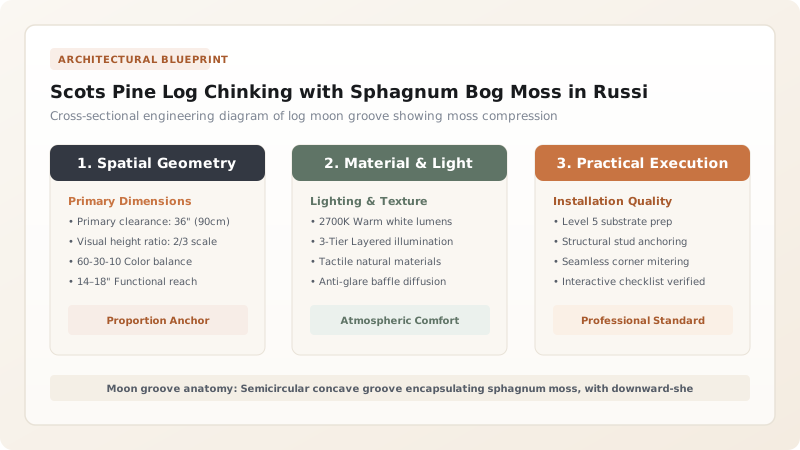
Sphagnum Biochemistry and the Miracle of Sphagnol
While builders in other cultures used hemp tow, straw, or mud chinking that rotted and attracted vermin, Russian northern carpenters relied exclusively on bog moss. Sphagnum moss contains unique biochemical defenses developed over millions of years to prevent decay in waterlogged peat bogs:
- Sphagnol Phenolics: Sphagnum cell walls are infused with sphagnol, a complex phenolic compound that inhibits the growth of cellulolytic fungi and putrefying bacteria. When packed against Scots pine logs, it actively preserves the wood grain from dry rot.
- Hygroscopic Breathing: Sphagnum moss consists of living photosynthetic cells surrounded by large, empty dead cells (hyaline cells) with capillary pores. These cells absorb ambient moisture when humidity rises and release it when the air dries, preventing condensation from pooling on log surfaces.
- Perpetual Elasticity: Unlike cementitious chinking that cracks when logs shrink and settle, compressed sphagnum fibers maintain elastic spring pressure, continuously sealing joint gaps over decades of building settlement.
Carving the Moon Groove (Paz) and Caulking Mechanics
Moss chinking cannot simply be stuffed into exposed cracks between round logs; it must be completely protected inside a purpose-carved architectural cavity. Carpenters use a specialized tool called a chertilo (an iron scriber with two adjustable points):
- The upper log is set dry atop the lower log. The scriber is run along the joint, transferring the irregular profile of the lower log to the underside of the upper log.
- The log is rolled over. The carpenter uses a curved gouge axe or adze (teslo) to hollow out a semicircular concave groove (paz) 100 to 150 mm wide.
- The outer edges of the groove are carved slightly deeper than the center (the 'cup shape'). When moss is laid and the upper log is dropped into place, the sharp outer lips bite tightly into the lower log, while the hollow center provides a generous pocket for uncrushed moss fibers.
Scots Pine Log Chinking with Sphagnum Bog Moss in Russian Izba Homes Architectural Decision Matrix
Use this reference table to calculate exact physical dimensions, ratios, and specifications before purchasing:
| Chinking Material | Biological Longevity | Antimicrobial Action | Elasticity under Settling | Thermal Performance |
|---|---|---|---|---|
| Sphagnum Bog Moss | Indefinite (Centuries) | High (Natural sphagnol) | Superior (Springy fiber rebound) | Excellent (λ: 0.04) |
| Flax / Hemp Tow (Paklya) | 20–40 Years (Can rot) | None (Can attract moths/beetles) | Moderate | Good |
| Clay & Straw Daub | 10–20 Years (Cracks off) | None | Zero (Brittle cracking) | Moderate |
| Modern Synthetic Foam | 10–15 Years (Degrades) | None (Traps hidden rot) | Good initially, tears later | Good |
Practical Constraints
Every successful decoration project must account for physical and environmental constraints:
Labor-Intensive Harvesting Volume
Bird Nesting Depredation
Harvesting and Packing Sphagnum Moss in Log Walls
Execute this professional sequence to achieve flawless results without backtracking:
Autumn Bog Harvesting
Harvest long-strand sphagnum moss from clean peat bogs in late autumn; avoid root muck and muddy water.
Controlled Shade Drying
Spread moss on raised wooden racks under shade; dry until pliable and slightly damp (never bake bone-dry, which makes fibers brittle).
Groove Laying
Lay continuous thick mats of moss strands across the top crown of the lower log, hanging 50mm over both inner and outer edges.
Log Seating
Lower the upper log with its carved moon groove directly onto the moss; strike log heads with heavy wooden rammers to seat the wood.
Joint Caulking (Konopatka)
Tuck protruding moss strands into the joint seam using a wide wooden caulking blade (konopatka) and mallet until rock-hard.
Secondary Re-Caulking
Inspect joints after one full winter of building settlement; drive additional moss into loosened crevices.
Common Mistakes & Countermeasures
Avoid these costly errors that compromise aesthetics, ergonomics, and budget:
Using dried green forest moss (pleurozium) instead of sphagnum
Carving the moon groove on the top face of the log
Packing moss bone-dry without slight residual moisture
Project Execution Checklist
Track your physical progress. Checkboxes persist automatically on this device:
Frequently Asked Questions
Why did Russian builders never use cement mortar between logs?
Wood constantly expands and contracts with seasonal temperature and humidity swings. Rigid cement mortar cannot flex; it breaks away from the logs, creates gaps that allow freezing wind to penetrate, and traps rainwater against the wood grain, accelerating fungal decay.
How long does sphagnum moss remain active inside a log wall?
When dismantled during historic restorations of 300-year-old Karelian churches, the internal sphagnum moss is frequently found in pristine, flexible condition, still smelling fresh of the peat bog and still protecting the surrounding pine wood.


