
Lemekh (лемех) are hand-carved wooden tiles used exclusively to cloak the complex compound curves of Russian onion domes and tent roofs. Carved from European trembling aspen (*Populus tremula*), each shingle features a curved concave body with stepped or serrated diamond silhouettes. Under rain, snow, and ultraviolet radiation, the surface lignin degrades, leaving pure cellulose micro-fibers that gleam with a metallic silver-mirror patina.
At a Glance: Key Takeaways
- Wood Species: European Trembling Aspen (Populus tremula / Osina)
- Carving Tool: Small curved carpenter's adze (*teslice*) and drawknife (*strug*)
- Shingle Typologies: Zubchatyi (crenelated/serrated), Gorodchatyi (stepped/castellated), Gladkiy (smooth)
- Curvature: Double-curved (concave longitudinal scoop matching sphere radius)
- Patination Time: Turns pale gold in 1 year, transition to shimmering mirror-silver in 3–5 years
- Fasteners: Hand-forged wrought-iron or copper square-shank nails
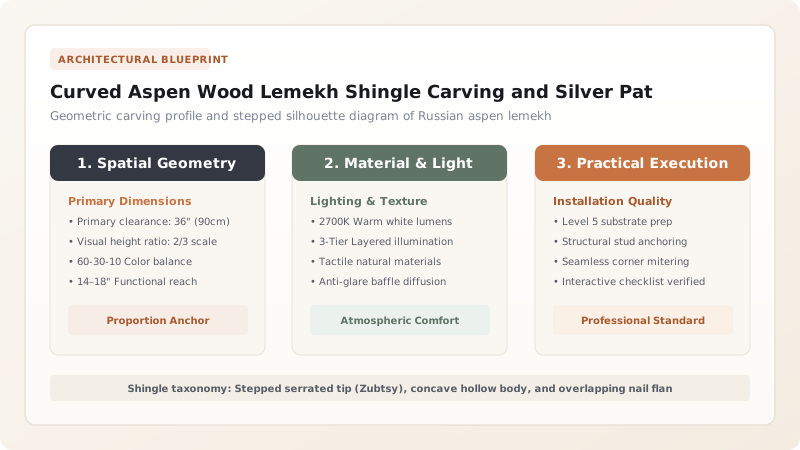
Aspen Wood Anatomy and Compound 3D Plasticity
In Russian folklore, the trembling aspen (osina) had a dual reputation: it was the tree of Judas, but to northern carpenters, it was an irreplaceable architectural treasure. Pine, spruce, and larch are resinous softwoods with prominent growth rings that split when carved across grain. Aspen, a diffuse-porous hardwood, possesses unique mechanical properties:
- Homogeneous Fiber Structure: Aspen has no distinct resin canals and virtually uniform density across spring and summer growth. It cuts like cold cheese in any direction with a sharp gouge without splintering or tearing.
- Moisture Expansion Sealing: When wetted by rain, aspen fibers swell significantly, closing the microscopic gaps between overlapping shingles into a waterproof wooden skin.
- Weight and Flexibility: Lightweight yet remarkably tough, freshly felled aspen can be bent and carved to conform to tight spherical curvatures without steam bending.
The Chemistry of Photolytic Silvering and Specular Reflection
Visitors to Kizhi Pogost are astonished to discover that the shimmering, metallic domes of the Church of the Transfiguration are not coated in silver leaf or tin plate, but are raw, unpainted wood. This phenomenon is governed by atmospheric photochemistry:
Wood consists of cellulose, hemicellulose, and lignin. Lignin is the brown 'glue' that binds wood cells together. Under the high ultraviolet radiation of northern latitudes, combined with moisture from rain and dew, photolytic oxidation breaks down the lignin. Rainwater washes the degraded lignin away, leaving behind a dense surface mat of un-bonded, pure white crystalline cellulose micro-fibrils.
These microscopic cellulose tubes reflect sunlight across multiple scattering angles. In overcast weather, the domes appear soft velvet-grey; in direct sunlight, they gleam with radiant, burnished silver brilliance, and at sunset, they reflect the fiery pinks and golds of the northern sky.
Curved Aspen Wood Lemekh Shingle Carving and Silver Patina in Russia Architectural Decision Matrix
Use this reference table to calculate exact physical dimensions, ratios, and specifications before purchasing:
| Shingle Profile | Russian Name | Edge Geometry | Visual Shadow Effect | Typical Dome Location |
|---|---|---|---|---|
| Stepped / Castellated | Gorodchatyi | Multi-tiered rectangular steps | Deep geometric shadow relief | Main onion dome belly (Puzo) |
| Serrated / Tooth | Zubchatyi | Triangular saw-tooth tips | Fine glittering texture | Upper dome shoulder and neck (Sheya) |
| Smooth / Rounded | Gladkiy / Kruglyi | Clean semicircular arc | Sleek water-shedding | Barrel-vaulted Bochtas & kokoshniks |
| Needle Tip | Ostrorylyi | Single sharp triangular point | High wind penetration | Conical spire tops and tent roofs |
Practical Constraints
Every successful decoration project must account for physical and environmental constraints:
Massive Quantity Scale
Life Expectancy and Cyclic Replacement
Carving and Installing Aspen Lemekh Shingles
Execute this professional sequence to achieve flawless results without backtracking:
Spring Aspen Felling
Fell mature aspen trees (30–40cm diameter) in May during peak sap flow; cut into 400mm bolts and split into wedge-shaped radial billets with a froe.
Rough Axe Shaping
Chop the billet into a rough rectangular blank (350mm long, 120mm wide, 25mm thick) using a broadaxe.
Concave Body Scooping
Gouge out the center of the bottom face with a curved adze (teslice), matching the radius of the dome framework.
Stepped Tip Carving
Carve stepped decorative crenellations (gorodki) on the bottom exposed tail using a sharp carving knife.
Progressive Overlap Nailing
Nail shingles to radial timber dome ribs in overlapping horizontal tiers, staggering vertical joints like fish scales.
Apex Collar Flashing
Cinch the topmost course under a hand-forged copper collar at the base of the iron or wooden summit cross.
Common Mistakes & Countermeasures
Avoid these costly errors that compromise aesthetics, ergonomics, and budget:
Applying protective clear varnishes or linseed oil
Carving shingles flat without concave hollows
Using aspen trees felled in dead of winter
Project Execution Checklist
Track your physical progress. Checkboxes persist automatically on this device:
Frequently Asked Questions
Why didn't builders use larch, which is far more durable than aspen?
Siberian larch contains heavy resins that make it exceptionally tough, but it is heavy, difficult to carve into delicate 3D curves, splits under small nails, and weathers to a dark, gloomy brownish-grey. Aspen is light, carves effortlessly, swells tightly when wet, and creates the incomparable celestial silver reflection.
How many shingles does a single Kizhi onion dome require?
A standard medium-sized dome on the Church of the Transfiguration requires between 1,200 and 1,800 individual lemekh shingles, each individually tailored to fit the changing diameter as the dome expands and tapers.


