
Provençal Ceiling Floral Rosettes and Reed Lath Diaphragms embody the artistic embellishment and structural substrate of historic southern French interiors. Suspended from robust chestnut joists by hand-tied iron wire, woven Arundo donax reed laths (cannissettes) form an elastic ceiling diaphragm capable of flexing without cracking. At the center of these vaulted expanses sit monumental hand-cast plaster rosettes (rosaces de plafond) sculpted with regional Mediterranean flora—acanthus rinceaux, olive branches, and cicadas—anchoring chandelier drops and diffusing acoustic energy.
At a Glance: Key Takeaways
- Arundo Donax Reed Diaphragms: Elastic woven mats of split river reeds providing continuous crack-free deflection resistance.
- Acanthus & Olive Leaf Iconography: Classical Mediterranean flora intertwined with Provençal motifs like sheaves of wheat.
- Gelatin & Wax Mould Casting: Flexible historical glue moulds (moules en gélatine) allowing deep undercut relief without seams.
- Chandelier Anchor Reinforcement: Structural wrought-iron eyelet bolts anchored directly into solid ceiling joists.
- Acoustic Flutter Attenuation: High-relief floral petals scattering overhead acoustic echoes across high-ceilinged salons.
- Reversible Structural Restoration: Securing sagging historic reed ceilings using stainless steel wire and lime-gypsum injections.
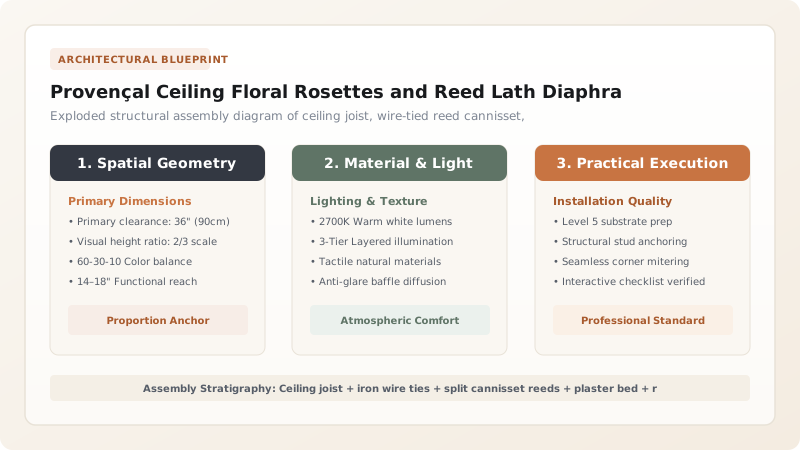
1. The Mechanics of the Arundo Donax Ceiling Diaphragm
Unlike rigid modern drywall that cracks when heavy furniture moves across the floorboards above, a Provençal cannissette ceiling is an elastic composite diaphragm. Bundles of split Arundo donax reeds are bound with annealed iron wire and secured across ceiling joists every 120mm.
When coarse gypsum plaster is pressed upward against the reeds, it mushrooms out through the narrow slits, wrapping completely around each reed stem. Once set, thousands of these cured gypsum 'keys' act like rivets, suspending the ceiling in an elastic, shock-absorbing hammock that tolerates floor joist deflections of up to 1/240th of the span without hairline cracking.
2. Casting Floral Rosettes in Flexible Gelatin Moulds
The central focal ornament of a Provençal ceiling is the rosace de plafond. In the 18th and 19th centuries, complex rosettes featuring deeply undercut acanthus leaves, grapes, and olive sprigs could not be pulled from rigid plaster piece-molds.
Artisans invented moules en gélatine (animal gelatin moulds). High-strength animal bone glue and glycerin were boiled into a thick liquid and poured over a sculpted clay original. Once cooled into rubbery, flexible molds, plâtriers poured fine Luberon gypsum into the cavity. The flexible gelatin peeled away effortlessly around deep, 45° undercut leaf edges without snapping delicate petals.
3. Structural Anchorage and Heritage Ceiling Conservation
Never mount a heavy wrought-iron or crystal chandelier directly to a plaster rosette. In authentic Provençal construction, a wrought-iron eyelet bolt (cheville à œil) is bolted directly through the center of the heavy timber joist above.
The decorative plaster rosette is cast with a central hole that slips over the iron hook, bedded in fresh plaster paste and pinned to the reed laths with copper wire ties. During historic restoration, sagging ceilings where the reed lath has pulled away from rotten joists are consolidated by injecting fluid hydraulic lime-gypsum slurries from above, clamping the ceiling back into contact with padded plywood shoring until cured.
Provençal Ceiling Rosette Sizing & Proportion Guide
Use this reference table to calculate exact physical dimensions, ratios, and specifications before purchasing:
| Room Area (m²) | Ceiling Height (m) | Rosette Diameter (mm) | Relief Depth (mm) | Chandelier Weight Limit |
|---|---|---|---|---|
| 12m² - 18m² (Bedrooms) | 2.8m - 3.2m Height | 450mm - 600mm Dia | 25mm - 35mm Relief | Up to 15 kg (with joist tie) |
| 18m² - 30m² (Dining Rooms) | 3.2m - 3.8m Height | 650mm - 850mm Dia | 35mm - 50mm Relief | Up to 30 kg (with through-bolt) |
| 30m² - 50m² (Grand Salons) | 3.8m - 4.8m Height | 900mm - 1,250mm Dia | 50mm - 85mm Undercut | Up to 60 kg (with timber trimmer) |
| 50m²+ (Palace Ballrooms) | 4.8m - 6.0m Height | 1,300mm - 1,800mm Dia | 80mm - 120mm Deep High Relief | Up to 120 kg (with steel bracket) |
Weight & Installation Constraints
Every successful decoration project must account for physical and environmental constraints:
Overhead Lifting Ergonomics
Supporting an 800mm diameter wet plaster rosette (weighing 15-20 kg) overhead while wiring requires specialized dead-man prop stands.
Gelatin Thermal Sensitivity
Animal gelatin moulds melt if plaster boils during hydration; mix water must be kept cool to regulate reaction temperatures.
Protocol for Casting, Anchoring, and Mitring a Ceiling Rosette
Execute this professional sequence to achieve flawless results without backtracking:
Structural Joist Trimmer Installation
Install solid timber bridging trimmer between floor joists above room center; bolt wrought-iron chandelier hook through trimmer.
Gelatin Mold Preparation & Oiling
Clean flexible animal gelatin mold; brush cavity lightly with sweet almond oil or liquid lard release agent.
High-Strength Gypsum Slurry Pouring
Mix fine Luberon casting plaster (plâtre à modeler); pour into mold; embed coarse burlap scrim cloth for tensile shatter resistance.
Demolding & Undercut Cleaning
Allow plaster to undergo exothermic heat set (approx. 25 minutes); flex rubbery gelatin mold away cleanly; carve away minor flashings.
Ceiling Bedding & Copper Tie Wiring
Score ceiling plaster with comb; apply buttering bed of fresh gypsum paste; hoist rosette; thread copper tie wires through reeds and twist tight.
Perimeter Margin Blending & Glazing
Blend outer rosette rim into flat ceiling plaster using fine leaf spatulas; allow to cure; finish with warm beeswax buffing.
Common Mistakes & Countermeasures
Avoid these costly errors that compromise aesthetics, ergonomics, and budget:
Hanging a heavy chandelier from the decorative plaster rosette instead of the timber joist
Using modern silicone caulks to seal the rim around historic plaster rosettes
Project Execution Checklist
Track your physical progress. Checkboxes persist automatically on this device:
Frequently Asked Questions
Why are cicadas (cigales) commonly sculpted on Provençal ceiling rosettes?
The cicada is the sacred cultural emblem of Provence, celebrated by the Félibrige literary movement (led by Frédéric Mistral) as a symbol of southern sunshine, joyful resilience, and the eternal spirit of the Mediterranean landscape.
How do you clean centuries of candle soot off a historic plaster rosette?
Conservators apply poultices of cellulose pulp soaked in warm water and triammonium citrate (pH 7.5). The poultice draws soot, nicotine, and grease out of the porous gypsum via capillary suction without eroding delicate carved leaf details.


