
Cladding a three-dimensional Persian Muqarnas vault in glazed ceramic tiles is one of the most demanding disciplines in architectural decoration. Utilizing either Kashi Haft-Rangi (seven-color overglaze tiles fired at 950°C) or Kashi-ye Mo'arraq (intricate mosaic faience hand-cut from monochrome tiles), master tilewrights (Kashi-kar) trace every curved, triangular, and rhombic facet of the stalactite canopy. Using hand-chipping hammers (Teesheh), tiles are cut with reverse-beveled edges and bedded onto the plaster vault, transforming raw gypsum into an iridescent, shimmering sapphire and turquoise sky.
At a Glance: Key Takeaways
- Bedding Matrix: Low-hydraulic slaked lime + fine quartz sand + animal protein glue
- Chipping Tool: Teesheh (double-beveled steel tile-chipping hammer with willow handle)
- Glaze Chemistry: Alkaline tin-lead glazes pigmented with cobalt, copper, iron, and antimony
- Tile Techniques: Kashi Haft-Rangi (7-color polychrome) & Kashi Mo'arraq (cut-tile mosaic)
Ceramic Typologies: Mo'arraq Cut-Mosaic vs. Haft-Rangi Seven-Color Tiles
In Persian architecture, two distinct ceramic technologies were deployed to clad Muqarnas vaults. The earlier and more labor-intensive technique is Kashi-ye Mo'arraq (mosaic faience), perfected in the 14th and 15th centuries. In this method, monochrome tiles of individual solid colors (cobalt blue, turquoise, saffron yellow, emerald green, aubergine, white, and black) are cut by hand into thousands of miniature puzzle pieces that are assembled face-down and cast in mortar.
During the Safavid Golden Age under Shah Abbas I (1587–1629), the monumental scale of urban construction in Isfahan demanded a faster, more cost-effective technique: Kashi Haft-Rangi (seven-color tiles). In this technique, square earthenware biscuits were painted with complex floral designs using metal oxide pigments separated by a greasy manganese resist line, then fired in a single glost firing at 950°C. While less sharp than Mo'arraq mosaic, Haft-Rangi allowed vast, swirling narrative arabesques to sweep continuously across complex Muqarnas stalactites.
Artisanal Technique: Teesheh Chipping and Compound Bevels
Mounting flat tiles onto compound-curved three-dimensional Muqarnas cells requires incredible tactile skill. The artisan's primary tool is the Teesheh—a specialized forged-steel hammer with two sharp, chisel-shaped striking ends mounted on a flexible willow wood handle.
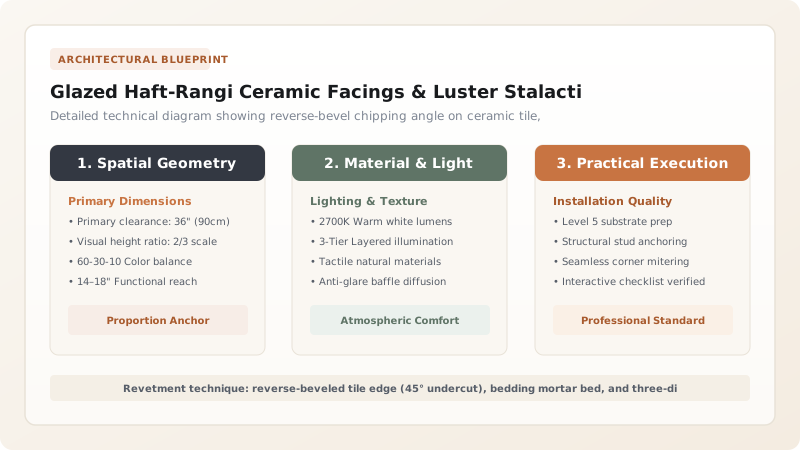
The artisan traces the exact outline of a Muqarnas cell (such as a curved Tās ceiling or triangular Pā foot) onto the glazed face of the tile using paper templates. Resting the tile on a rounded stone anvil (Kharak), the tile-cutter strikes the edge with rapid, glancing blows of the Teesheh. Crucially, the cut is made with an undercut reverse-bevel of roughly 45 degrees: the glazed face remains knife-sharp, while the clay body behind it is beveled away. This allows adjacent tiles to butt tightly together on the curved 3D surface with virtually zero exposed mortar joints.
Glaze Chemistry: Copper Luster and Optical Chiaroscuro
In palace pavilions and holy shrines (such as the Imam Reza Shrine in Mashhad), master ceramists deployed Luster Glazes (Zarrin-fam). First perfected by Ilkhanid potters in Kashan, lusterware was created by painting silver and copper oxides onto already-fired tin glazes, followed by a second low-temperature firing in an oxygen-deprived (reducing) kiln.
This reduction firing deposited a microscopic metallic film—only nanometers thick—onto the glaze. When installed on the recessed facets of a Muqarnas vault, this metallic film created an extraordinary optical phenomenon: as sunlight or candlelight shifted throughout the day, the stalactite facets reflected iridescent flashes of ruby-red, burnished gold, and violet. The stalactite geometry dissolved physical mass, transforming the heavy stone ceiling into a shimmering, weightless illusion of celestial light.
Installation Mechanics: Reverse Casting, Lime Mastics, and Thermal Cycling
For Mo'arraq mosaic Muqarnas, installation was often performed using reverse casting. Artisans laid out the entire pattern of pre-cut tile pieces face-down on a flat floor over a full-scale cartoon. Paper was glued to the glazed front face with flour paste. Liquid gypsum mortar was then poured over the rough backs of the tiles, creating rigid, curved mosaic shells corresponding to individual Muqarnas tiers.
These pre-formed tile shells were hoisted into the vault and anchored to the ceiling structure. Conserving historic Muqarnas tiles requires vigilance against salt delamination. When moisture wicks through plaster vaults, expanding sodium sulfate salts break the bond between the clay biscuit and the plaster bed. Conservators employ warm-water desalination compresses and re-adhere loose tile facets using reversible acrylic resins (Paraloid B-72) blended with micro-fine volcanic pozzolans.
Persian Architectural Tile Systems for Muqarnas Revetment
Use this reference table to calculate exact physical dimensions, ratios, and specifications before purchasing:
| Tile Typology | Manufacturing Method | Color Palette | Joint Precision | Architectural Application |
|---|---|---|---|---|
| Kashi-ye Mo'arraq (Mosaic) | Monochrome tiles cut into pieces with Teesheh | Pure saturated colors; 7 to 9 distinct glazes | Hairline joints (< 0.5 mm); flush jigsaw fit | High-status royal portals, mihrab niches, dome apexes |
| Kashi Haft-Rangi (7-Color) | Polychrome painted overglaze on square tiles | Turquoise, cobalt, yellow, green, fawn, black, white | Standard grid joints (2–3 mm) conforming to tiles | Large-scale entrance Iwans, exterior facades, courtyards |
| Zarrin-fam (Luster Tile) | Reduction-fired copper/silver metallic film | Iridescent ruby, gold, amber, and olive reflections | Precision relief-molded facets | Palace reception halls, imperial mausoleums, shrines |
| Ayna-kari (Cut-Mirror) | Silvered glass sheets hand-cut into geometric facets | Monochromatic diamond mirror reflections | Fine gypsum bevels with embedded mirror facets | Safavid/Qajar interior throne rooms and holy shrines |
Practical Constraints
Every successful decoration project must account for physical and environmental constraints:
Intense Solar Ultraviolet Radiation and Glaze Crazing
Exterior South-facing mosque portals experience extreme summer temperatures exceeding 50°C, causing fine glaze network crazing over centuries. Mitigation: Ensure tile clay bodies contain balanced calcareous marl that matches the thermal expansion coefficient of the overlying alkaline glaze.
Extreme Labor Expenditure of Mo'arraq Cut Mosaic
A single monumental Muqarnas portal can contain over 100,000 individually chipped ceramic pieces, requiring years of manual labor. Mitigation: Utilize modern waterjet cutting technology for roughing out geometric blanks in reproduction projects, finishing critical edge bevels with hand hammers.
Vibration-Induced Detachment of Heavy Ceramic Facets
Seismic ground tremors cause heavy ceramic tiles to pop off the underside of cantilevered stalactite vaults, posing severe safety hazards below. Mitigation: Incorporate mechanical copper wire anchors tied through the backs of large tile panels directly into the structural vault frame.
Execution Blueprint & Craftsmanship Sequence
Execute this professional sequence to achieve flawless results without backtracking:
Taking Accurate Paper Templates of 3D Muqarnas Facets
Press heavy tracing paper into every individual cell of the completed gypsum Muqarnas vault, rubbing margins to create exact cutting patterns.
Transferring Patterns to Glazed Ceramic Tiles
Trace the template shapes onto the glazed faces of selected turquoise, cobalt, or yellow tiles using fine ink pens or carbon pouncing.
Reverse-Bevel Chipping with the Teesheh Hammer
Rest tiles on the stone anvil and chip edges with rapid Teesheh blows, undercutting the rear clay body at 45° while keeping the glazed face intact.
Face-Down Assembly on the Master Floor Cartoon
Lay out the cut tile pieces face-down over the full-scale drawing, checking that all arabesque lines align continuously with zero gaps.
Backing with Gypsum Mortar and Fabricating Vault Shells
Glue paper over the front faces to hold pieces. Pour a 20 mm layer of fiber-reinforced gypsum mortar over the back to create rigid curved panels.
Hoisting, Bedding, and Washing Glazed Tile Panels
Mount the tiled shells onto the Muqarnas vault, bedding in lime-gypsum mortar. Wash off face paper with warm water and polish glazed tiles with soft flannel.
Common Mistakes & Countermeasures
Avoid these costly errors that compromise aesthetics, ergonomics, and budget:
Cutting Tiles Square Without Reverse Undercutting
Using Synthetic Epoxy Adhesives for Historic Tile Re-Setting
Washing Glazed Tiles with Acidic Cleaning Solutions
Project Execution Checklist
Track your physical progress. Checkboxes persist automatically on this device:
Frequently Asked Questions
What is the difference between Mo'arraq and Haft-Rangi tiles?
Mo'arraq (mosaic faience) is made by cutting individual shapes out of solid-color glazed tiles and assembling them like a puzzle with hairline joints. Haft-Rangi (seven-color) tiles are pre-made square tiles painted with multi-colored patterns using overglaze pigments and fired in a single kiln run.
Why is turquoise such a dominant color in Persian Muqarnas vaults?
Turquoise (Firoozeh) is deeply symbolic in Persian culture, representing divine heaven, spiritual transcendence, and protection from the evil eye. Geochemically, copper oxide glazes formulated with desert silica produced brilliant, durable turquoise shades that glowed against the dusty arid landscape.
What tool is used to cut ceramic tiles for Muqarnas vaults?
Artisans use the Teesheh—a double-headed forged steel hammer with sharp chisel edges. Working over a rounded stone anvil, the craftsman taps the tile edge with rapid, rhythmic blows to chip away waste clay at an exact 45-degree angle.
How do tiles stay attached to the underside of hanging stalactites?
Tiles are bedded in high-tack gypsum-lime mortar that expands slightly upon setting, creating an airtight bond. For large suspended stalactite drops, copper wires or linen ties are embedded into the back of the tile mortar and secured directly to internal timber ribs.


