
Nov Corner Notching and Scandinavian Scribe Fitting are the mathematical and artisanal keystones of lafteverk log carpentry. The corner notch (nov or lafteknute) interlocks perpendicular logs through complex subtractive geometry: a curved bottom saddle (kinning), a narrowed central neck (hals), and an internal locking tongue (tann). Using the specialized meddrag scriber to transfer micro-contours between logs, the notch is carved with inward-sloping bevels that ensure the joint locks tighter as timber shrinks.
At a Glance: Key Takeaways
- Kinning & Halsing Geometry: Tapered lateral cheeks and narrowed log throat forming a self-wedging saddle.
- Internal Locking Tongue (Tann): Concealed vertical key preventing wind penetration and lateral log twisting.
- Meddrag Scribe Calibration: Dual-axis iron scriber maintaining precise plumb alignment during contour transfer.
- Shrinkage Wedge Mechanics: Inward 5° bevel angles converting vertical log settlement into lateral joint compression.
- Axe-Hewn Tooling: Hand-adzed and broadaxe-hewn contact faces creating crisp knife-tight joint seams.
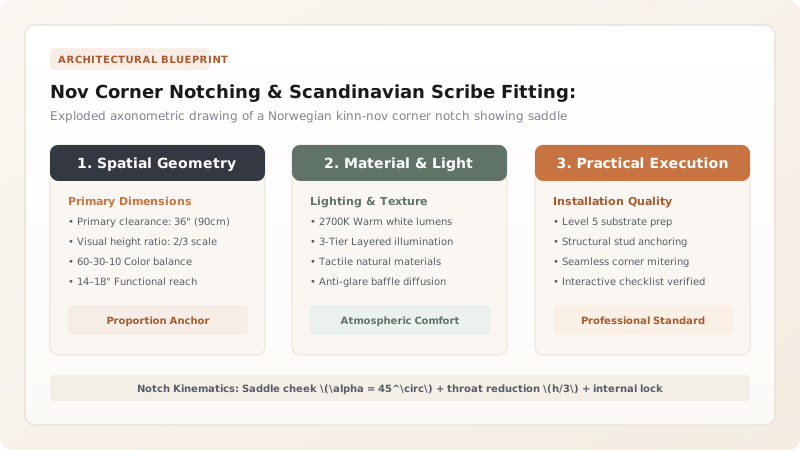
1. Anatomy of the Chinned Saddle Notch (Kinn-Nov)
The most advanced and durable iteration of the Scandinavian corner joint is the kinn-nov (chinned notch), developed in Telemark and Numedal. A complete notch consists of three distinct anatomical zones:
- The Cheek (Kinning): Angled, planar facets cut into the sides of the lower log at a 45° to 50° slope, creating a tapered saddle.
- The Throat (Hals): The narrowed central core of the log, reduced to roughly one-third of the total log diameter to allow the upper log to seat deeply without weakening structural bending strength.
- The Tongue (Tann): A raised triangular or trapezoidal key carved inside the bottom socket of the upper log that interlocks with a corresponding mortise in the lower throat, blocking lateral slippage during seismic or wind vibrations.
2. Scribing Dynamics with the Meddrag Compass
No two tree trunks are identical; every log has natural taper, curves, and surface swellings. The carpenter cannot cut standard repeating shapes. The entire joint is custom-scribed using the meddrag.
With the upper log secured on temporary spacing blocks above the wall, the carpenter sets the compass points to the maximum gap distance. Holding the scriber strictly plumb using an integrated spirit level or plumb bob, the tool is drawn along the intersection of the two logs. The lower point follows the natural bark irregularities of the lower log, while the upper iron stylus scratches an exact mirror contour into the wet timber of the upper log.
3. The Shrinkage Wedge Principle
Wood shrinks approximately 0.2% longitudinally, but between 5% and 8% tangentially across the grain as it dries from green to seasoned states. In a poorly designed joint, this shrinkage opens wide gaps that let in arctic winds.
In the kinn-nov, master carpenters angled the mating cheeks inward by 3° to 5°. As the log diameter decreases over the first three years of building life, the upper log slides downward like a wedge along the sloped cheeks of the lower log. The joint actively tightens itself under gravity, maintaining an airtight friction seal across decades of seasonal humidity cycling.
Norwegian Log Notch Sizing & Proportioning Rules
Use this reference table to calculate exact physical dimensions, ratios, and specifications before purchasing:
| Log Diameter (D) | Throat Sizing (Hals) | Cheek Angle (Kinning) | Tongue Height (Tann) |
|---|---|---|---|
| 250mm - 280mm | 85mm - 95mm (D/3) | 45° Symmetrical | 25mm Internal Key |
| 280mm - 340mm | 95mm - 115mm (D/3) | 48° Steep Wedge | 35mm Internal Key |
| 340mm - 420mm | 115mm - 140mm (D/3) | 50° Heavy Load | 45mm Stepped Key |
| Monumental Church (> 420mm) | 140mm - 170mm (D/2.5) | 52° Double-Chinned | 60mm Multi-Tier Key |
Craft & Anatomical Constraints
Every successful decoration project must account for physical and environmental constraints:
Spiral Grain Checking
Logs with spiraling wood grain will twist as they dry, wrenching the corner notches open; carvers reject twisted trees in the forest.
Tungsten Tool Maintenance
Hand-adzing hard seasoned pine knots requires honing carving axes every 30 minutes on fine oilstones.
Protocol for Cutting a Kinn-Nov Corner Notch by Hand
Execute this professional sequence to achieve flawless results without backtracking:
Log Positioning & Indexing
Dog upper log atop corner junction on 50mm spacing blocks; align wall centerlines with plumb bob.
Plumb Scribing with Meddrag
Scribe corner notch cheeks on both sides of log using calibrated meddrag scriber held strictly vertical.
Relief Kerf Sawing
Saw vertical relief cuts down to scribed depth line inside the notch throat using a coarse crosscut saw.
Adze & Chisel Waste Removal
Chop out waste wood with a heavy framing gouge and wooden club; smooth cheek facets with a broadaxe.
Internal Tongue Carving
Carve 30mm raised central tongue on lower log throat; carve matching mortise pocket on underside of upper log.
Test Drop & Chalk Marking
Drop log into place; check contact fit with powdered chalk; pare high spots until joint closes with hairline tightness.
Common Mistakes & Countermeasures
Avoid these costly errors that compromise aesthetics, ergonomics, and budget:
Holding the meddrag scriber at an angle rather than strictly plumb during scribing
Cutting the throat deeper than one-third of the log thickness
Project Execution Checklist
Track your physical progress. Checkboxes persist automatically on this device:
Frequently Asked Questions
What is the purpose of the protruding log ends (laftehoder) at building corners?
The protruding log ends (typically 200mm to 350mm long) protect the end-grain of the notched throat from direct rain, add critical counterweight mass to keep the corner joints clamped under gravity, and prevent cross-grain cleavage under heavy roof loads.
How are historic rotted corner notches repaired without taking the whole building down?
Conservators erect heavy screw-jack shoring towers to lift the upper logs by 10mm, saw out the rotten notch section, and insert an exact 'prosthetic' replacement notch carved from seasoned Scots pine, joined with stepped scarf joints and secured with oak dowels.


