
Sphagnum Moss Chinking and Drag Channel Insulation represent the pinnacle of boreal building biology. In traditional Norwegian lafteverk construction, the continuous longitudinal hollow groove (meddrag) along the bottom of every log is packed with living wetland peat moss (Sphagnum / torvmose). Uniquely containing the polysaccharide sphagnan, Sphagnum moss acts as an antiseptic, antimicrobial thermal barrier that absorbs moisture vapor without rotting, buffering indoor humidity while preventing draft infiltration in sub-zero arctic winters.
At a Glance: Key Takeaways
- Antimicrobial Sphagnan Chemistry: Pectin-like polysaccharide creating an acidic environment (pH 3.5–4.5) inhibiting rot fungi.
- Hygroscopic Vapor Buffering: Capable of absorbing up to 20 times its dry weight in water without losing insulating value.
- Elastic Cellular Compression: Large dead hyaline cells acting as spring-loaded micro-cushions that maintain compression seals.
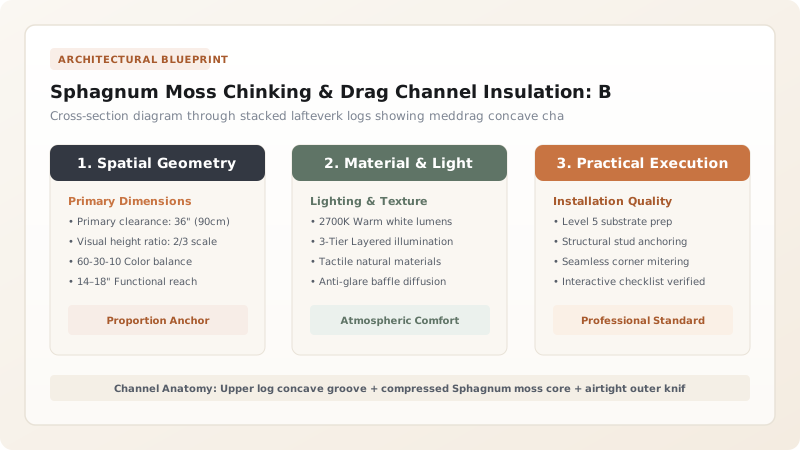
- Continuous Meddrag Channel: Precision U-shaped concave groove holding a continuous 50mm moss insulating core.
- Zero Chemical Off-Gassing: 100% natural, renewable biological insulation with zero VOCs and complete biodegradability.
1. Botanical Biology & Cellular Anatomy of Sphagnum Moss
Not all mosses can be used in timber building. Scandinavian carpenters harvested specifically bog peat mosses (Sphagnum palustre, Sphagnum magellanicum, and Sphagnum fuscum) from mountain wetlands.
Under microscopic analysis, Sphagnum leaves consist of two distinct cell types: small living photosynthetic chlorophyllose cells and massive dead hyaline cells (leucocytes). These hyaline cells have spiral reinforcing fibrils and large open pores, allowing them to suck up liquid water through capillary action, absorbing up to 16 to 25 times their dry weight while retaining structural elasticity.
2. Natural Antiseptic Chemistry: The Sphagnan Defense
Modern fiberglass or cellulose insulation rots when exposed to chronic condensation. Sphagnum moss has survived 500 years inside historic Norwegian log walls without decomposing due to its unique chemical composition.
The cell walls of Sphagnum contain sphagnan, a complex, pectin-like polyuronic acid polymer. Sphagnan actively binds free metal ions (calcium, magnesium, and iron) via cation exchange, releasing hydrogen ions that drop the localized microclimate pH down to 3.5 to 4.5. This acidic, metal-depleted environment completely suppresses the growth of wood-decay basidiomycetes, dry-rot fungi, and putrefactive bacteria, effectively preserving both the moss and the surrounding pine timber.
3. The Meddrag Channel: Engineering the Compression Pocket
The moss is not simply stuffed into cracks from the outside; it is encapsulated inside an engineered timber chamber termed the drag. The carpenter carves a concave groove 40mm to 75mm wide and 15mm deep along the center of the log's underside, leaving two sharp lateral lips (dragskiver).
The moss is laid into the channel while slightly damp. When the upper log is rolled into place, its full dead weight (typically 200 to 400 kg per log) compresses the moss into a dense, felt-like core. The outer wood-on-wood lips touch with knife-edge tightness, blocking rain and wind, while the compressed moss core seals against air filtration and thermal heat loss (thermal conductivity \(\lambda \approx 0.040\text{ W/m}\cdot\text{K}\)).
Log Chinking Insulation Material Comparison
Use this reference table to calculate exact physical dimensions, ratios, and specifications before purchasing:
| Insulation Material | Thermal Conductivity (W/mK) | Moisture Buffering Capacity | Fungal / Rot Resistance | Compression Longevity |
|---|---|---|---|---|
| Sphagnum Wetland Moss | 0.038 - 0.042 | Exceptional (2,000% dry weight) | Natural antiseptic (pH 4.0 sphagnan) | Resilient across 300+ years |
| Raw Sheep's Wool (Ull) | 0.038 - 0.044 | High (35% dry weight) | Natural lanolin wax barrier | High (Maintains spring loft) |
| Fiberglass Batt Insulation | 0.035 - 0.040 | Zero (Water pools between fibers) | Harbors black mold and wood rot | Collapses and sags when wet |
| Polyurethane Foam Spray | 0.024 - 0.028 | Zero (Impermeable barrier) | Traps condensation against logs | Cracks and pulls away as logs shrink |
Ecological & Sourcing Constraints
Every successful decoration project must account for physical and environmental constraints:
Wetland Conservation Laws
Harvesting moss in designated nature reserves is strictly prohibited; harvesting must occur on private managed bog concessions.
Compression Settling Tolerances
Over-packing the groove with too much moss prevents the outer wood lips from touching, creating unsightly wide seams.
Protocol for Harvesting, Preparing, and Installing Sphagnum Moss
Execute this professional sequence to achieve flawless results without backtracking:
Wetland Bog Harvesting
Harvest Sphagnum moss in late summer from unpolluted mountain wetlands; pull clean top moss mats free from dark sub-soil peat.
Air-Drying & Cleaning
Spread moss on wire mesh racks under covered drying sheds for 7 days; remove twigs, pine needles, and dirt clumps.
Moisture Re-Conditioning
Lightly mist dry moss with clean water 2 hours before installation; moss must be pliable and damp, but not dripping wet.
Meddrag Channel Bedding
Lay continuous rolls of moss into the concave log groove, ensuring uniform 30mm uncompressed thickness without thin spots.
Log Lowering & Compression
Lower the upper log into place using timber levers; strike top face with heavy wooden beetle to seat the outer drag lips tightly.
Trimming Protruding Whiskers
Trim any moss fibers protruding beyond the exterior wood joint using a sharp drawknife, leaving a clean, invisible seam.
Common Mistakes & Countermeasures
Avoid these costly errors that compromise aesthetics, ergonomics, and budget:
Installing soaking wet Sphagnum moss freshly pulled from a bog into the log wall
Using woodland feather moss (Hylocomium splendens) instead of true wetland Sphagnum moss
Project Execution Checklist
Track your physical progress. Checkboxes persist automatically on this device:
Frequently Asked Questions
Can historic dried Sphagnum moss inside a 200-year-old wall be reused during restoration?
Yes! Historic Sphagnum moss extracted during building dismantling is frequently in near-perfect condition. Conservators gently shake out old dust, mist the moss with water to restore its natural springiness, and reinstall it into the reassembled log channels.
How does Sphagnum moss improve indoor air quality in log homes?
Sphagnum moss acts as a natural hygroscopic lung. When indoor humidity rises, the moss absorbs water vapor through open timber seams; when winter heating dries the indoor air, the moss releases moisture back into the living space, naturally stabilizing indoor relative humidity around a comfortable 40% to 50% without mechanical humidifiers.


