
Stave Post Substructures and Pine-Tar Impregnation represent the primary environmental defense systems of Norwegian timber architecture. Elevating vulnerable horizontal log walls above damp ground and heavy winter snowpacks, master builders erected structures on dry-laid granite boulder piers (stabbesteiner) and carved vertical corner pillars (stolper). The entire exterior envelope was protected using pure, kiln-extracted Scots pine root tar (tre-tjære), which penetrates deep into wood cell lumens to provide a breathable, hydrophobic, UV-resistant shield that endures for centuries.
At a Glance: Key Takeaways
- Stabbestein Dry-Laid Plinths: Undressed glacial granite boulders isolating timber structures from ground damp.
- Stabbur Corner Pillars: Turned mushroom-cap or flared timber posts providing mouse-proof (museklosser) cantilever supports.
- Kiln-Extracted Wood Tar (Tjære): High-temperature pyrolysis of resinous pine stumps yielding pure antiseptic wood tar.
- Birch-Bark (Never) Damp-Proofing: Multi-layer birch-bark sheets laid between stone foundation piers and timber sills.
- Breathable Hydrophobic Micro-Coat: Tar permits water vapor to escape while shedding bulk rain and snow melt.
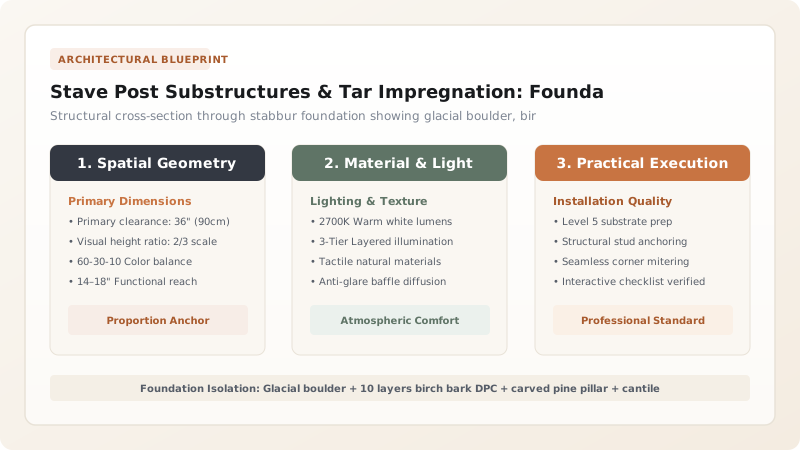
1. Foundation Isolation: Stabbesteiner & Birch-Bark DPC
The cardinal rule of Scandinavian timber survival is: never let wood touch the ground. Glacial erratic boulders (stabbesteiner) were gathered from fields and dry-laid without mortar to form corner foundation piers.
Between the cold stone pier and the timber sill beam (svill), builders installed a traditional damp-proof course (DPC) composed of six to ten layers of peeled birch bark (never). Birch bark is saturated with betulin—a naturally waterproof, rot-proof triterpenoid resin. Laid with the white outer bark facing outward, the birch bark prevents capillary groundwater from wicking into the bottom timber sill, lasting hundreds of years without degradation.
2. The Stabbur Storehouse Pillar & Vermin Defense
The iconic Norwegian elevated storehouse (the stabbur or loft) was engineered to protect precious grain, cured meats, and textiles from moisture and rodents.
The building is elevated 0.8m to 1.5m above ground on carved timber pillars (stolper). At the top of each pillar, carpenters mounted a large circular slate slab or turned concave wooden mushroom cap termed a musekloss (mouse-block). Mice and rats climbing the vertical post cannot negotiate the downward 90° lip of the overhang, creating an impregnable vermin barrier for communal food stores.
3. The Science of Kiln-Extracted Pine Tar (Tjære)
Exterior timber envelopes survive severe freeze-thaw and ultraviolet scour through periodic applications of pure pine root tar (tre-tjære or milebrent tjære). Extracted by slow anaerobic pyrolysis of resin-rich Scots pine stumps inside earthen charcoal kilns (tjæremiler), the tar contains over 200 organic compounds, including abietic acid, phenolics, and guaiacols.
Applied hot (heated to 50°C–60°C and thinned with natural gum turpentine), the tar penetrates deep into the tracheid cell lumens. Unlike modern synthetic paints that form brittle surface skins, pine tar cross-links within the wood cell matrix, creating a micro-porous, hydrophobic, antiseptic coating that allows the timber to breathe while turning weathered facades an iconic golden-brown to deep lustrous black.
Wood-Tar Grades & Protective Performance Metrics
Use this reference table to calculate exact physical dimensions, ratios, and specifications before purchasing:
| Tar Formulation | Production Method | Penetration Depth (mm) | Color / Sheen | Re-Application Cycle |
|---|---|---|---|---|
| Milebrent Tjære (Kiln Tar) | Earthen charcoal mound pyrolysis | 4mm - 8mm Deep Cell Penetration | Golden amber to deep translucent brown | Every 6 - 10 Years |
| Stump Tar + Boiled Linseed | 50% Pine tar + 50% Linseed oil | 6mm - 10mm (High lubricity) | Warm satin chestnut sheen | Every 5 - 8 Years |
| Black Rosin Tar (Svarttjære) | Pine tar + Lampblack carbon | 3mm - 5mm UV-shielding barrier | Matte opaque charcoal black | Every 8 - 12 Years |
| Modern Bitumen / Creosote (Prohibited) | Coal tar / Petroleum distillate | Surface skin (Toxic off-gassing) | Dead black; traps moisture | Unacceptable for heritage |
Safety & Environmental Constraints
Every successful decoration project must account for physical and environmental constraints:
Combustion Hazards
Heating pine tar requires water-jacketed heaters away from open flames; volatile turpentine vapors are flammable.
Traditional Kiln Scarcity
Traditional earthen tar kilns (tjæremiler) are operated only once every few years by heritage guilds; authentic kiln tar commands premium prices.
Protocol for Preparing and Applying Hot Pine Tar to Historic Log Facades
Execute this professional sequence to achieve flawless results without backtracking:
Surface De-Moss & Washing
Brush away loose lichens, dirt, and dried moss using stiff natural fiber brushes; wash with clean warm water and dry for 5 sunny days.
Tar & Oil Heating
Heat pure kiln-extracted pine tar to 55°C in a water-jacketed heating kettle; blend with 20% boiled linseed oil and 10% gum turpentine.
Hot Sun Application Window
Apply tar during warm, sunny summer days when timber pores are open; work on sun-warmed wall elevations for maximum penetration.
End-Grain Saturation
Saturate projecting log heads (laftehoder) with multiple wet-on-wet applications until end-grain pores reach total refusal.
Longitudinal Stroke Brushing
Brush tar along horizontal log grain using wide boar-bristle roofing brushes, maintaining a thin, even coat without sags.
Curing & Oxidative Drying
Allow 14 to 21 days for natural oxidative cross-linking under sunlight; surface will transition from tacky to a durable satin sheen.
Common Mistakes & Countermeasures
Avoid these costly errors that compromise aesthetics, ergonomics, and budget:
Applying cold pine tar directly to cold, damp timber in autumn or winter
Using modern asphalt-based bitumen roofing paint to simulate historic pine tar
Project Execution Checklist
Track your physical progress. Checkboxes persist automatically on this device:
Frequently Asked Questions
How did Norwegian Stave Churches survive 800 years without rotting?
Stave churches survived because of three factors: they were built from resin-saturated ancient Scots pine heartwood (malmfuru), elevated above ground on stone sills to eliminate soil moisture contact, and periodically recoated with pure kiln-extracted pine tar every decade since the 12th century.
Why is birch bark used for damp-proofing instead of modern plastic membranes?
Birch bark contains high concentrations of natural betulin resin, which is completely impervious to water, fungal decay, and rot. Unlike modern plastic damp-proof membranes that become brittle and crack after 30 years, birch bark remains flexible and effective for well over 300 years.


