
Tin-opacified majolica glazes are delicate, low-fire vitreous enamels susceptible to thermal crazing and acidic degradation. When installed outdoors in cold climates, water penetrates the porous earthenware bisque (10-15% water absorption) and expands by 9% upon freezing, generating hydraulic pressures exceeding 200 MPa that cause catastrophic glaze spalling. Long-term durability requires breathable silane-siloxane impregnating sealers, non-acidic pH-neutral cleaners, and strict avoidance of frost zones.
At a Glance: Key Takeaways
- Micro-Crazing Mechanics: Mismatched coefficients of thermal expansion between glaze (\(\alpha_g\)) and clay bisque (\(\alpha_b\)) create stable hairline crazing.
- Freeze-Thaw Spalling Threshold: Water expanding into ice exerts severe hydraulic pressure, popping glazes off tiles in climates with > 5 freeze-thaw cycles annually.
- Breathable Impregnating Sealers: Fluoropolymer and silane/siloxane sealers that repel liquid water while allowing water vapor transmission (\(S_d < 0.1\text{ m}\)).
- Acid & Alkali Vulnerability: Traditional leaded and mineral frits degrade when exposed to acidic cleaners (vinegar, muriatic acid), turning dull and chalky.
- Interior & Loggia Optimization: Best suited for shaded courtyard niches, covered loggias, fountain splash zones in USDA zones 9-11, and climate-controlled interiors.
1. Majolica Glaze Physics: Tin Opacification & Crazing Dynamics
Authentic Puebla Talavera owes its optical depth to Tin-Opacified Enamels developed during the Italian and Spanish Renaissance:
Where \(\epsilon\) is residual strain, \(\alpha_b\) is the thermal expansion coefficient of the earthenware bisque (\(\approx 7.5 \times 10^{-6}/^\circ\text{C}\)), and \(\alpha_g\) is the expansion coefficient of the glaze (\(\approx 6.2 \times 10^{-6}/^\circ\text{C}\)):
- Intentional Crazing: Because the glaze contracts faster than the clay body during cooling, the glaze remains in slight tension. This produces a network of microscopic hairline fractures known as crazing (craquelé). In traditional ceramic art, this is not a defect; it is the hallmark of authentic hand-fired majolica.
- The Optical White Canvas: Tin oxide (\(\text{SnO}_2\)) does not dissolve in the molten silica frit at 950°C. Instead, it remains as suspended colloidal crystals (0.1 to 1.0 micron size), scattering incident light across all wavelengths to produce an intense, milky white surface with unmatched depth.
- Pigment Relief: Mineral oxides like cobalt aluminate are applied thick. When fired, the cobalt partially sinks into the white enamel while maintaining a raised, tactile relief perceptible to the fingertips. Learn tile laying techniques in clay bisque tolerances.
2. Freeze-Thaw Degradation: The 9% Ice Expansion Spalling Trap
The primary enemy of exterior Talavera in temperate or continental climates is the Liquid-to-Solid Phase Transition of Water:
- Capillary Infiltration: Rainwater enters the tile body via microscopic glaze crazing cracks or through the unglazed grout joint perimeter. The porous clay body absorbs up to 15% of its dry weight in water.
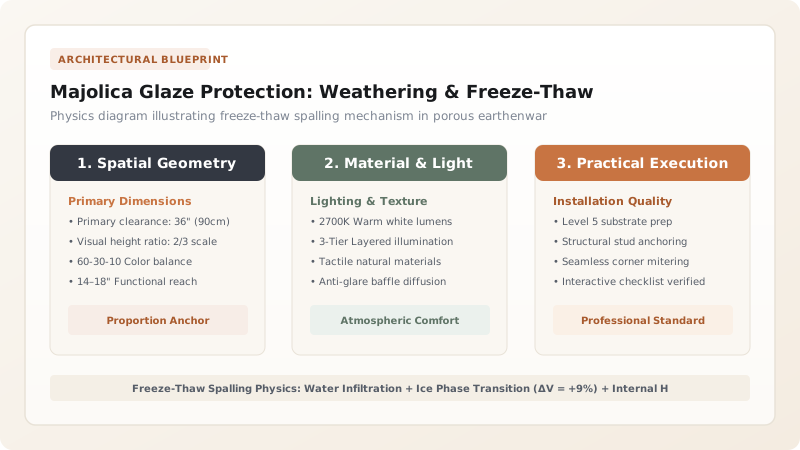
- Phase Transition Expansion: When ambient temperatures drop below 0°C (32°F), water converts to hexagonal ice crystals, expanding volumetrically by 9%:
$$\Delta V = +9.05\% \implies P_{\text{hydrostatic}} > 200\text{ MPa}$$Because the vitrified surface glaze is brittle and rigid, this tremendous hydrostatic pressure shears the bond between the glaze and the underlying clay, popping the glaze off in large flakes (spalling).
- Climate Suitability Limits: Authentic Talavera should never be installed on exposed exterior horizontal surfaces or exterior water features in regions subject to freezing temperatures (USDA Plant Hardiness Zones 1 through 8). In cold climates, installation must be restricted to indoor heated rooms or seasonal summer panels stored indoors for winter.
3. Breathable Protective Sealers & pH-Neutral Maintenance
Protecting Talavera requires treatments that do not trap moisture behind the tile:
- Vapor-Permeable Impregnators: Never apply film-forming topical acrylic, urethane, or epoxy sealers. Topical coatings yellow in UV light and trap moisture, accelerating sub-surface decay. Instead, apply a Sub-Surface Micro-Molecule Silane/Siloxane or Fluoropolymer Impregnator. This coats capillary pore walls without blocking vapor diffusion (\(S_d < 0.05\text{ m}\)), repelling liquid droplets while allowing the tile to breathe.
- Cleaning Protocols: Never clean Talavera with acid-based cleaners (muriatic acid, sulfamic acid, vinegar) or caustic bleaches. Strong acids etch the tin-lead glaze, stripping its glass luster and turning cobalt blue to dull grey. Clean exclusively with neutral-pH stone and tile soaps (pH 7.0 - 8.0) and soft microfiber cloths. Explore architectural installations in our Talavera hub.
Talavera Chemical Resistance & Environmental Suitability
Use this reference table to calculate exact physical dimensions, ratios, and specifications before purchasing:
| Exposure Condition | Impact on Glaze | Impact on Clay Bisque | Permissibility | Required Protection Strategy |
|---|---|---|---|---|
| Exterior Sub-Zero Winter | Catastrophic Spalling / Flaking | Frost Shattering & Cracking | PROHIBITED Outdoors | Relocate to heated interior or seasonal storage |
| Covered Exterior Loggia (Warm) | Stable; Minor Crazing | Moisture Balanced | EXCELLENT | Silane/Siloxane breathable impregnating sealer |
| Fountain Splash Line (Frost-Free) | Limescale Deposition | Saturated Bisque | GOOD (Zoned 9-11) | Epoxy grout + semi-annual scale descaling |
| Kitchen Backsplash Behind Range | Grease Film Accumulation | Stable | EXCELLENT | Pre-grout sealer + neutral degreasing soap |
| Acidic Grout Cleanup (Muriatic) | Irreversible Glaze Etching | Erosion of Clay Fines | STRICTLY FORBIDDEN | Use sulfamic-free neutral grout haze removers |
Glaze Protection & Weathering Constraints
Every successful decoration project must account for physical and environmental constraints:
Topical Coating Blistering
Applying clear acrylic or polyurethane over damp Talavera traps moisture; sun exposure converts water to steam, blistering the clear coat into cloudy, peeling blisters.
Hard Water Mineral Staining
Fountains operating with hard water deposit calcium carbonate scale over the glaze; removing scale requires gentle enzymatic cleaners, as scrapers scratch majolica.
Lead Leaching Regulations
Historic Talavera formulations contained lead silicate frits; while modern Puebla workshops comply with FDA and NOM lead-release standards for dinnerware, architectural tiles should not be used as direct food prep surfaces.
Direct Sun Thermal Shock
Dark cobalt blue tiles in direct full desert sun reach surface temperatures > 65°C; cold sprinkler water hitting hot tiles can exacerbate glaze micro-fractures.
Protective Sealing & Conservation Application Protocol
Execute this professional sequence to achieve flawless results without backtracking:
Thorough Drying Phase
Following tile setting and grouting, allow the entire installation to dry undisturbed for a minimum of 14 days to ensure all moisture evaporates from the clay bisques.
Surface Decontamination
Wipe tile faces and grout joints with a lint-free cloth dampened with demineralized water and pH-neutral cleaner. Let dry completely for 24 hours.
Impregnator Selection
Select an advanced water-based fluoropolymer or oligomeric siloxane impregnating sealer specifically rated for high-porosity earthenware.
First Sealer Coat
Apply sealer liberally across tile faces and sanded grout joints using a natural bristle brush or low-pressure sprayer, keeping the surface wet for 10-15 minutes.
Excess Wipe-Down
Before the sealer dries on the surface, thoroughly buff off all excess liquid with clean, dry cotton terry cloths to prevent sticky residue.
Second Breathable Coat
Apply a second light coat 2 to 4 hours later, repeating the buffing process to ensure complete capillary absorption.
Hydrophobic Performance Check
After 48 hours of curing, drop droplets of clean water onto the tile face; water should bead with a contact angle > 90 degrees.
Common Mistakes & Countermeasures
Avoid these costly errors that compromise aesthetics, ergonomics, and budget:
Applying high-gloss clear topical lacquer or spar varnish over Talavera
Washing new tile work with muriatic or phosphoric acid to remove grout haze
Installing exterior Talavera water features in northern freeze zones
Project Execution Checklist
Track your physical progress. Checkboxes persist automatically on this device:
Frequently Asked Questions
Is all crazing on Mexican Talavera a sign of product defect?
No. Crazing is an inherent, universally recognized characteristic of low-fired majolica ceramics. It results from normal thermal expansion mismatches between the clay body and enamel during kiln cooling and adds to the historic visual charm.
Can I use bleach to clean mildew off outdoor Talavera tiles?
Dilute oxygen-based bleach (sodium percarbonate) is acceptable, but chlorine bleach should be avoided. Strong chlorine can penetrate micro-crazing and react with trace metal oxides in the clay, generating sub-surface salt crystals that cause localized flaking.
How often should outdoor Talavera tile and grout be resealed?
In covered exterior courtyards or loggias, a quality penetrating silane-siloxane sealer lasts 3 to 5 years. In fountain splash zones or areas exposed to driving rain, reapplication every 18 to 24 months is recommended.


