
Installing Talavera tile on stair risers and fountain copings requires rigorous architectural detailing: stair risers require a 25mm to 30mm protective tread overhang (bullnose terracotta or carved cantera stone) with an undercut drip groove to shield fragile majolica from shoe strikes and dripping rainwater. Fountain installations demand dual-layer ANSI A118.10 liquid waterproofing membranes, ANSI A118.15 flexible thinset, and chemical-resistant epoxy grout to withstand submerged immersion.
At a Glance: Key Takeaways
- Protective Tread Overhang: 25-30mm nose projection on treads preventing direct shoe heel impact against glazed riser faces.
- Undercut Drip Grooves: 6mm half-round drip relief cut on the underside of stone/terracotta treads to shed rainwater clear of tile risers.
- Submerged Waterproof Tanking: Dual-coat elastomeric waterproofing (ANSI A118.10) terminated 50mm above highest fountain water level.
- Epoxy Grout for Fountain Copings: 100% solids epoxy grout (ANSI A118.3) providing zero water absorption and complete resistance to pool chemicals.
- Perimeter Movement Joints: ASTM C920 silicone sealant at tread-to-riser and fountain-to-deck junctions to absorb thermal deflection.
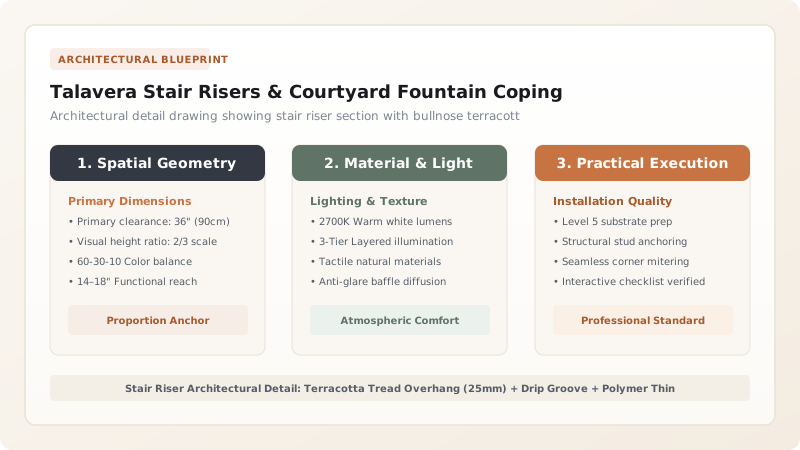
1. Stair Riser Engineering: Protecting Majolica from Foot Impact
Because Mexican Talavera is a soft-fired earthenware tile (MOHS hardness 3.5 to 4.5), it must never be installed on horizontal stair treads where foot friction will quickly ruin the hand-painted enamel.
On vertical risers, however, Talavera creates a spectacular visual tapestry when viewed from the bottom of the flight, provided Precise Impact Protection Geometry is maintained:
- The 25mm Tread Nosing Projection: The horizontal tread—whether natural saltillo terracotta, quarry tile, or hand-carved Cantera limestone—must project 25mm to 30mm beyond the finished tile riser face. This physical projection prevents pedestrian shoe toes from kicking the tile face when ascending the flight.
- Capillary Drip Relief: For outdoor courtyard stairs, the underside of the projecting nosing must feature a continuous 6mm wide x 4mm deep drip kerf (regana) located 12mm back from the front edge. This breaks water surface tension, preventing rainwater from running down the face of the Talavera riser.
- Bottom Soft Joint: Never grout the junction between the bottom of the Talavera riser and the horizontal tread below with rigid cement grout. Install a 6mm flexible movement joint filled with color-matched ASTM C920 Class 25 neutral-cure silicone. Step deflections under human footfall will shear rigid grout. Master overall tile specifications in our Talavera guide.

2. Courtyard Fountain Coping & Waterline Tanking Protocols
Submerged and waterline Talavera installations in architectural courtyards require comprehensive hydraulic protection:
- Hydrostatic Concrete Substrate: Cast concrete fountain basins must be engineered with waterproof concrete (water-cement ratio \(w/c < 0.45\)) cured for at least 28 days and tested by 72-hour hydrostatic flood test before tile installation.
- Dual-Coat Waterproof Membrane: Apply two continuous, pinhole-free coats of ANSI A118.10 liquid elastomeric waterproofing membrane. Reinforce all internal 90-degree corners with polyester fabric mesh embedded in the wet membrane.
- Bonding Mortar: Install tiles using an ANSI A118.15 or ISO 13007 C2TE S2 high-polymer thinset. Mortar coverage must be 100% solid with zero trowel voids behind tiles. Any air pocket behind a submerged tile will collect stagnant water, promoting efflorescence and freeze-thaw failure. Study clay dimensional behavior in clay bisque tolerances.
- 100% Solids Epoxy Grout: Grout all fountain tiles with ANSI A118.3 epoxy grout. Unlike porous cement grouts, epoxy creates an impermeable barrier against chlorinated or mineralized pool water, protecting the tile edges.
3. Pattern Sequencing, Alternation & Loggia Wainscots
Maximizing the architectural rhythm of Talavera across multi-tier stairs and courtyard perimeter walls involves classical compositional rules:
- Riser Pattern Rhythm: The most celebrated colonial aesthetic utilizes Alternating Riser Designs. Flight risers alternate between a solid cobalt blue field (or diagonal checkerboard) on step one, followed by an intricate polychrome botanical medallion (e.g., Flor de Liz or Pajarito) on step two.
- Courtyard Loggia Wainscoting (Zócalo): On covered porch and corridor walls, Talavera is laid to a height of 900mm to 1,200mm (the traditional zócalo). It is capped with a carved Cantera stone molding or glazed quarter-round bullnose trim, anchoring the plaster walls above and protecting against garden splashback. Learn glaze conservation in majolica glaze protection.
Talavera Architectural Detailing & Detailing Spec Matrix
Use this reference table to calculate exact physical dimensions, ratios, and specifications before purchasing:
| Detail Application | Substrate Type | Waterproofing Spec | Adhesive Class | Grout Selection | Critical Geometric Detail |
|---|---|---|---|---|---|
| Courtyard Stair Riser | Poured Concrete / CMU | Elastomeric Crack Isolation | ANSI A118.15 Flexible Thinset | Sanded Polymer Grout (6mm) | 25mm Tread Bullnose Overhang + Drip Kerf |
| Fountain Basin Waterline | Hydrostatic Poured Concrete | Dual-Coat ANSI A118.10 Membrane | ANSI A118.15 S2 Ultra-Flex | 100% Solids Epoxy Grout (6mm) | 100% Solid Mortar Coverage (Zero Voids) |
| Fountain Top Coping Edge | Reinforced Masonry Ring | Elastomeric Sheet Membrane | C2TE S1 Polymer Mortar | Epoxy Grout + Silicone Joints | Outward Slope 2% for Water Shedding |
| Colonial Loggia Wainscot | Plastered Masonry Wall | Vapor-Barrier Primer | ANSI A118.4 Standard Modified | Sanded Cement Grout (5-6mm) | Cantera Stone / Glazed Bullnose Cap Trim |
Stair Riser & Fountain Detailing Constraints
Every successful decoration project must account for physical and environmental constraints:
Stair Tread Deflection
Wood-framed stair carriages flex under foot traffic; Talavera can only be installed on rigid concrete or steel-pan stair structures with deflection ratings < L/720.
Salt Efflorescence Leaching
Fountains built with unsealed brick masonry will leach soluble alkali salts through tile joints; waterproof membranes must encapsulate the entire inner vessel.
Chemical Biocide Sensitivity
High concentrations of copper algaecides or chlorine in fountain water can react with unglazed clay edges; water treatment must rely on ozone, UV, or low-bromine systems.
Cantilevered Coping Overhangs
Fountain coping tiles extending more than 20mm past the basin edge risk snapping when stepped on or leaned against by maintenance workers.
Step-by-Step Stair Riser & Fountain Installation Sequence
Execute this professional sequence to achieve flawless results without backtracking:
Structural Substrate Preparation
Verify concrete stair risers are plumb and fountain basin is watertight via a 72-hour hydrostatic standing flood test.
Waterproofing Application
Apply two coats of elastomeric liquid waterproofing membrane over fountain walls or stair carriage, reinforcing internal angles with fabric tape.
Setting Tread Overhangs First
On stairs, set horizontal stone or terracotta treads first, ensuring a consistent 25mm projection and verifying the undercut drip groove is clean.
Dry Fitting Riser Patterns
Dry-fit Talavera tiles on vertical risers. Scribe and cut end tiles on an electric diamond wet saw to maintain balanced symmetry from staircase center.
Back-Buttered Riser Installation
Apply ANSI A118.15 thinset to the vertical riser face and 100% back-butter each Talavera tile, pressing into place with 6mm joint spacers.
Perimeter Movement Joint Caulking
Mask and fill the horizontal junction between the bottom of the riser tile and the tread below with color-matched 100% silicone sealant.
Grouting & Hydrophobic Treatment
In fountains, pack joints with 100% solids epoxy grout; on stairs, use sanded polymer grout. Apply breathable penetrating sealer after 14 days.
Common Mistakes & Countermeasures
Avoid these costly errors that compromise aesthetics, ergonomics, and budget:
Installing Talavera flush with the front edge of the stair tread (no overhang)
Grouting the bottom riser-to-tread joint with rigid cement mortar
Using cementitious grout instead of epoxy grout inside fountain waterlines
Project Execution Checklist
Track your physical progress. Checkboxes persist automatically on this device:
Frequently Asked Questions
Can Talavera tiles be used on pool coping where people sit and walk barefoot?
Authentic Talavera is suitable for decorative pool waterlines and vertical raised bond beams, but should not be used on the horizontal pool coping where foot traffic occurs. The glazed surface becomes slippery when wet and can wear under abrasive pool deck foot traffic.
How do you align Talavera patterns across stairs of varying riser heights?
Building codes mandate uniform riser heights within 3/8" (9.5mm). Align the bottom row of tiles with the tread, and cut top tiles beneath the nosing shadowline where cuts are visually obscured by the tread overhang.
What is the recommended method for cleaning fountain algae off Talavera tiles?
Use soft nylon bristle brushes and a neutral-pH tile soap or dilute enzymatic pool cleaner. Never use wire brushes, muriatic acid, or abrasive scouring powders, which scratch the delicate tin enamel.


