
Deffun is an ancient Maltese hydraulic roof-waterproofing and flooring technology developed from Phoenician and Roman opus signinum traditions. Formulated from high-calcium slaked lime blended with finely crushed terracotta pottery grog (Taqqief), Deffun is laid across flat Globigerina limestone ceiling slabs (Xorok) and rhythmically compacted for days using heavy wooden beaters (Mazzpesta). The reactive pozzolans in the baked clay chemically bond with calcium hydroxide to form an impervious, glass-hard hydraulic terrazzo that withstands torrential winter rains while channeling pure, non-toxic drinking water into subterranean bedrock cisterns.
At a Glance: Key Takeaways
- Compaction Tool: Wooden floor-beating tampers (Mazzpesta) operated by hand
- Harvesting Role: Paved catchment feeding subterranean domestic bedrock cisterns (Giebja)
- Lime Binder: Pure non-hydraulic or low-hydraulic slaked lime putty (CL90)
- Pozzolanic Aggregate: Crushed earthenware pottery shards and roof tile grog (Taqqief)
Chemical Pozzolanic Mechanics: The Science of Taqqief and Lime
In island environments lacking natural volcanic ash (like Roman pozzolana), ancient builders discovered that manufactured ceramics undergo the same geochemical reaction. In Malta, broken terracotta roof tiles, amphorae, and ceramic vessels were pulverized into fine grog called Taqqief.
When clay is fired in a pottery kiln between 600°C and 850°C, its crystalline aluminosilicates decompose into an amorphous, highly reactive pozzolanic state. When this pulverized pottery is mixed with water and slaked lime (calcium hydroxide), the amorphous silica and alumina react with the lime at ambient temperatures. This reaction synthesizes insoluble Calcium Silicate Hydrates (C-S-H) and Calcium Aluminate Hydrates—the identical chemical binders found in modern Portland cement—producing a stone-like matrix that cures even under standing water.
Roof Stratigraphy: Xorok Stone Slabs and the Torba Cushion Bed
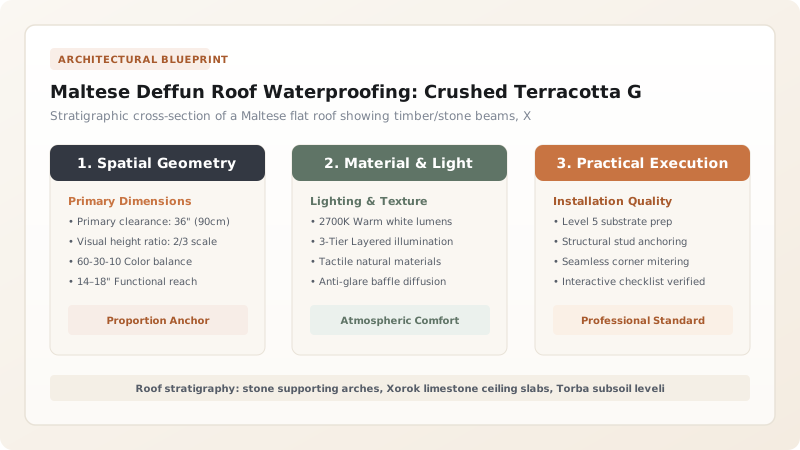
A Maltese flat roof terrace (Bejt) is an ingenious multi-layered sandwich engineered to handle thermal shock and heavy dead-loads. Spanning between massive masonry arches or timber beams are horizontal limestone ceiling slabs called Xorok (singular: Xriek), measuring roughly 1.8 meters long, 30 cm wide, and 8 cm thick.
Because Globigerina stone slabs crack if exposed to direct thermal expansion, builders spread a 10 to 15 cm leveling cushion called Torba. Formulated from crushed limestone quarry scrap, calcareous marl, and sand, the Torba bed acts as a structural thermal buffer and absorbs minor building settlement. The Torba is tamped with heavy pestles and pitched at a continuous 1.5% to 2% slope toward exterior stone drainage downspouts (Mwiezeb).
Mechanical Compaction: The Mazzpesta Beating Process
Over the graded Torba bed, plasterers spread a 40 to 60 mm thick layer of wet Deffun mortar (typically formulated at 1 part slaked lime putty to 2.5 parts graded terracotta grog and river sand). The magic of Deffun lies not merely in its recipe, but in its rigorous mechanical compaction.
Teams of masons wielding heavy wooden mallets called Mazzpesta beat the wet mortar rhythmically for three to five consecutive days. As the water begins to evaporate, this relentless beating drives out entrained air bubbles, collapses microscopic capillary pores, and forces the angular terracotta granules into intimate interlocking contact. The process draws a fine calcium-aluminate slurry to the surface, which is smoothed and burnished with steel trowels into an impervious, seamless, terracotta-colored terrazzo floor.
Hydraulic Performance: Domestic Cistern Integration and Modern Care
Under the historic Code of the Knights, every Maltese house was legally required to possess a subterranean rainwater cistern (Giebja) excavated deep into the underlying rock. The Deffun roof was the gathering apron for this survival infrastructure. Unlike asphalt, coal-tar, or modern synthetic sealants, cured Deffun is completely non-toxic and mineral-based, imparting zero volatile organic compounds, heavy metals, or bitter tastes into harvested drinking water.
Today, historic Deffun roofs are often catastrophically damaged by well-meaning contractors applying impermeable bitumen coatings or cement screeds. Bitumen blisters under scorching 40°C Maltese summer heat, trapping moisture that rots the Xorok slabs below. Traditional conservators restore failing roofs by chipping away failed cement, replenishing the pozzolanic terracotta-lime matrix, and re-beating the Deffun following centuries-old artisanal protocols.
Maltese Roof Waterproofing Materials & Hydraulic Performance
Use this reference table to calculate exact physical dimensions, ratios, and specifications before purchasing:
| Roofing System | Primary Composition | Potable Rain Harvesting | Thermal Flexibility | Expected Service Life |
|---|---|---|---|---|
| Traditional Beaten Deffun | Slaked lime + crushed terracotta grog (Taqqief) | 100% safe, non-toxic potable drinking water | High elasticity; moves with lime-stone slabs | 40 to 60 years (with annual lime washes) |
| Torba Base Layer (Uncoated) | Calcareous limestone dust, loam, and gravel | Porous; absorbs moisture and leaks without Deffun | High thermal buffering capacity | Structural base layer only; cannot weather alone |
| Modern Portland Cement Screed | Portland cement + sand + polymer plasticizers | Alkaline leaching alters water pH; prone to cracks | Rigid; cracks under Mediterranean thermal swings | 10 to 15 years (triggers sub-surface stone spalling) |
| Bituminous Torch-On Felt | Petroleum asphalt + polyester carrier | Toxic leaching; water unsafe for human consumption | Softens and blisters at 45°C summer roof temps | 10 to 12 years (requires total stripping upon failure) |
Practical Constraints
Every successful decoration project must account for physical and environmental constraints:
Scarcity of Artisans Skilled in Traditional Roof Beating
The intense physical labor and specialized cadence of Mazzpesta beating have declined as modern builders turned to quick asphalt coatings. Mitigation: Partner with heritage vocational restoration schools (such as Heritage Malta's Bighi institute) to train young masons in traditional Deffun crafts.
Extreme Winter Downpours and Catchment Scouring
Maltese winter thunderstorms can drop 100 mm of rain in hours, exerting severe hydraulic shear across roof drainage slopes. Mitigation: Form smooth radiused coves at all parapet wall transitions and install carved stone gargoyles (Mwiezeb) with generous overflow capacity.
Contamination of Cistern Water by Urban Air Pollutants
Vehicle exhaust soot deposited on flat roofs washes directly into subterranean drinking cisterns during the first autumn rain. Mitigation: Incorporate traditional 'first-flush' diversion pipes that discard the first 15 minutes of roof runoff before directing clean water into the Giebja.
Execution Blueprint & Craftsmanship Sequence
Execute this professional sequence to achieve flawless results without backtracking:
Inspecting and Shoring Xorok Limestone Ceiling Slabs
Inspect the structural underside of Globigerina Xorok slabs. Replace cracked stone slabs and ensure tight, flush joints between adjacent units.
Spreading and Grading the Torba Earth Cushion
Spread a 10 cm layer of crushed limestone aggregate and marl (Torba). Tamp thoroughly and grade a uniform 1.5% fall toward drainage gargoyle spouts (Mwiezeb).
Crushing and Sieving Terracotta Pottery Grog (Taqqief)
Crush clean earthenware pottery and terracotta tiles using mechanical crushers or hand mauls, sieving to achieve graded particle sizes from 0.5 mm to 4.0 mm.
Mixing Slaked Lime and Pottery Mortar
Blend mature slaked lime putty (aged minimum 6 months) with Taqqief and sharp sand in a 1:2:1 volume ratio, adding minimal water to produce a stiff mortar.
Applying and Rhythmically Beating the Deffun Layer
Spread mortar 50 mm thick over the damp Torba bed. Beat continuously for 3 days using heavy wooden Mazzpesta mallets until the surface consolidates and rings.
Trowel Burnishing and Curing Under Damp Hessian
Burnish the expelled surface slurry with steel trowels to create a smooth, glossy skin. Keep moist under damp burlap bags for 14 days to complete pozzolanic hydration.
Common Mistakes & Countermeasures
Avoid these costly errors that compromise aesthetics, ergonomics, and budget:
Using Unglazed Floor Tiles or Vitrified Porcelain for Grog
Allowing Deffun to Dry Rapidly in Direct Summer Sun
Neglecting the Multi-Day Mazzpesta Beating Process
Project Execution Checklist
Track your physical progress. Checkboxes persist automatically on this device:
Frequently Asked Questions
What is 'Taqqief' and why is it used in Maltese roofs?
Taqqief is finely crushed earthenware pottery or broken terracotta roof tiles. When mixed with slaked lime, the amorphous aluminosilicates in the fired clay react chemically with calcium hydroxide to create an insoluble, waterproof hydraulic binder similar to Roman concrete.
Why do traditional Maltese roofs have to be beaten with wooden mallets?
Beating with heavy wooden mallets (Mazzpesta) collapses all internal air voids and capillary pores, brings excess water and reactive lime slurry to the surface, and compacts the angular pottery granules into an impenetrable, watertight terrazzo plane.
Is rainwater collected from a Deffun roof safe to drink?
Yes. Unlike modern bituminous felt, tar, or synthetic polymer membranes that leach harmful petrochemicals, Deffun is made entirely of natural mineral lime and baked earth, making it completely non-toxic and ideal for drinking water catchment.
What is a 'Giebja' in a Maltese home?
A Giebja is a large subterranean water cistern excavated into the bedrock beneath the courtyard or ground floor of a Maltese house. All rainwater gathered by the flat Deffun roof is funneled directly into this private reservoir to sustain the family through hot, dry summers.


