
Globigerina limestone (specifically the Lower Globigerina member, known as Il-Franka) is the foundational geological material of the Maltese islands. Formed from microscopic foraminiferal plankton shells in ancient Miocene seas, Franka is celebrated for its warm golden honey hue, fine texture, and exceptional freestone workability. When quarried, it can be effortlessly carved with hand chisels; upon atmospheric exposure, it forms a tough calcium carbonate case-hardened crust that supports monumental Baroque cantilevers (Saljaturi) extending nearly a meter from multi-story townhouses.
At a Glance: Key Takeaways
- Calcium Purity: Over 92% Calcium Carbonate (CaCO3) with minor quartz silt
- Carving Tooling: Traditional Maltese masonry pick (Baqqun), flat chisels, and toothed drags
- Geological Bed: Lower Globigerina Formation (Il-Franka), Miocene epoch (c. 20 Ma)
- Structural Role: Cantilever corbel brackets (Saljaturi) bearing full balcony surcharge
Geological Formation: The Science of Lower Globigerina (Il-Franka)
The Maltese sedimentary sequence contains five geological strata, but the second oldest—the Lower Globigerina Limestone—is the bedrock of the nation's architectural heritage. Deposited 15 to 20 million years ago in warm pelagic waters, the stone consists almost entirely of compacted shells of Globigerina bulloides and other planktonic foraminifera.
Masons distinguish sharply between two quarry seams: Il-Franka (good stone) and Il-Soll (bad stone). Franka is a true 'freestone'—it has no distinct bedding planes, possesses uniform microscopic pore distribution, and can be cut or carved in any direction without splitting. Soll, by contrast, contains expansive smectite clay veins that absorb humidity and cause premature weathering.
Extraction and Curing: Atmospheric Case-Hardening (Qoxra)
In historic quarries around Qrendi, Mqabba, and Sigġiewi, blocks were extracted using iron picks (Baqqun) and wooden swelling wedges. When newly extracted from the ground, Globigerina limestone holds significant internal moisture known as quarry sap. While saturated with sap, the stone is buttery soft and can be planed with wooden smoothing tools or sliced with common hand saws.
As the quarried blocks dry in the Mediterranean sunshine, capillary action draws water containing dissolved calcium bicarbonate to the surface. As the water evaporates, calcium carbonate crystallizes in the outer pores, forming an ultra-hard, impermeable exterior patina called the Qoxra (crust). This natural protective shield turns the pale yellow stone into a rich, golden-amber armor that resists wind erosion for centuries.
Structural Physics: The 2:1 Embedment Ratio of the Saljaturi
The technical marvel of Maltese street architecture is the Saljatur—the projecting corbel bracket that carries the timber gallarija. Supporting an enclosed timber room filled with people over a public street without steel beams demands rigorous cantilever physics.
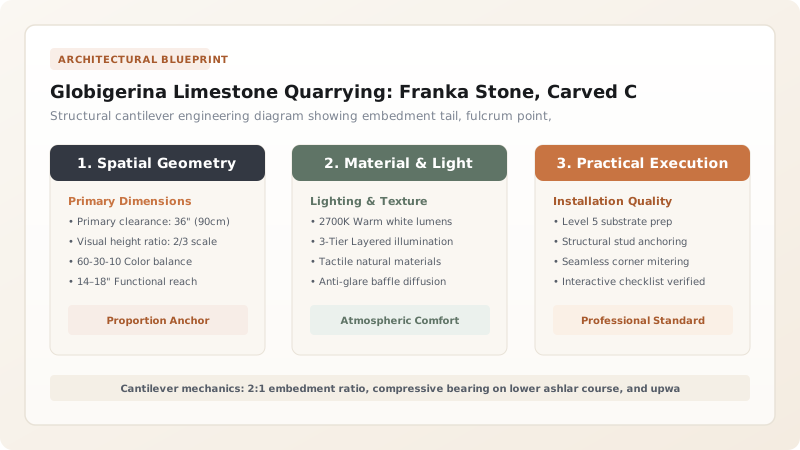
Master builders enforced a strict rule of thumb: the 2:1 embedment ratio. For every 30 centimeters of external projection into the street canyon, at least 60 centimeters of the corbel's solid tail had to be mortised deep into the thickness of the double-leaf masonry wall. The immense downward compressive weight of the upper wall courses acted as a permanent surcharge counterweight, preventing the cantilever from tipping forward under heavy balcony live-loads.
Pathology and Conservation: Haloclasty and Silicate Consolidation
Because Malta is a small island exposed to maritime winds, Globigerina stone suffers primarily from haloclasty (salt-crystallization damage). Marine aerosols deposit sodium chloride and magnesium sulfate onto the stone. During humid nights, the salts dissolve and migrate into the stone's 30% to 40% open porosity; when hot midday sun dries the surface, salts crystallize within the pores (sub-florescence), generating crystallization pressures up to 100 MPa that shatter the stone from the inside out.
Restoring historic corbels requires sacrificial desalination: conservators apply paper-pulp or sepiolite clay poultices saturated with deionized water to draw out deep-seated salts. Friable limestone is then consolidated using tetraethyl orthosilicate (TEOS), which deposits amorphous silica into microscopic voids, strengthening decayed calcite bonds without sealing off vapor breathability.
Maltese Limestone Building Beds: Mechanical & Physical Properties
Use this reference table to calculate exact physical dimensions, ratios, and specifications before purchasing:
| Geological Seam | Common Maltese Name | Porosity (%) | Compressive Strength (MPa) | Recommended Architectural Use |
|---|---|---|---|---|
| Lower Globigerina (Top Grade) | Il-Franka Safra (Yellow Franka) | 32% to 38% | 25 to 35 MPa | Sculpted corbels (Saljaturi), ashlar facades, moldings |
| Lower Globigerina (White Seam) | Il-Franka Bajda (White Franka) | 35% to 42% | 18 to 24 MPa | Internal dividing walls, ceiling slab support arches |
| Middle Globigerina Clay Band | Il-Soll (Impure argillaceous stone) | 40% to 48% | 8 to 12 MPa | Never used structurally; discarded as quarry waste |
| Upper Coralline Limestone | Il-Qawwi (Hard crystalline stone) | 8% to 15% | 60 to 90 MPa | Sea wall bastions, foundation footings, street pavers |
Practical Constraints
Every successful decoration project must account for physical and environmental constraints:
Rapid Salt-Induced Decay in Coastal Exposure Zones
Townhouses directly fronting the Grand Harbour or Marsamxett experience aggressive salt-spalling that destroys historic carvings within decades. Mitigation: Install drip grooves (Gotteri) beneath corbel crowns to shed salt-water wash and apply sacrificial lime-water coatings annually.
Quarry Exhaustion of Premium Franka Beds
Centuries of intense extraction have depleted many historic Lower Globigerina quarries, making high-grade replacement stone scarce. Mitigation: Partner with licensed restoration quarries in Mqabba that conduct geotechnical petrographic testing to certify stone quality before extraction.
Vibration Damage from Heavy Modern Traffic
Ground vibrations from heavy urban buses rattling through narrow historic streets loosen corbel mortar joints and crack fragile stone tails. Mitigation: Enforce pedestrianized zones and strict vehicle weight limits in historic urban cores, and install discreet stainless-steel tie-back anchors.
Execution Blueprint & Craftsmanship Sequence
Execute this professional sequence to achieve flawless results without backtracking:
Quarry Seam Survey and Core Sampling
Examine the quarry face for homogeneous Lower Globigerina Franka beds, rejecting any seams with reddish clay veins (soll) or calcite nodules.
Block Extraction and Squaring
Cut oversized rectangular stone billets using diamond chain-saws or pneumatic drills, keeping the stone moist to preserve quarry sap workability.
Laying Out Saljatur Profiles with Zinc Templates
Trace the architectural scroll profile onto the dressed stone billet using zinc or plywood templates, marking the 2:1 embedment tail boundary.
Roughing Out and Fine Relief Carving
Chop away bulk waste with a pointed chisel (Spuntun). Carve the intricate Baroque acanthus leaves and scrolls using curved gouges and toothed rasps.
Air-Curing for Case-Hardened Qoxra Formation
Store the carved corbel under a ventilated shed for 6 to 8 weeks, allowing quarry sap to evaporate and the hard calcium carbonate crust to form.
Mortising and Bedding the Corbel into Facade Masonry
Chisel a matching pocket into the stone facade. Bed the corbel tail in slaked lime mortar (1:3 lime to washed globigerina sand) and pin with bronze dowels.
Common Mistakes & Countermeasures
Avoid these costly errors that compromise aesthetics, ergonomics, and budget:
Carving Fully Cured, Case-Hardened Stone
Using Dense Portland Cement Mortar for Bedding Corbels
Cutting Corbel Embedment Tails Shorter Than the 2:1 Rule
Project Execution Checklist
Track your physical progress. Checkboxes persist automatically on this device:
Frequently Asked Questions
What does 'Franka' mean in Maltese stonemasonry?
Franka means 'free stone'—limestone of such high purity and uniform grain that it can be freely sawn, drilled, and sculpted in any direction without fracturing along natural cleavage planes.
Why does Maltese limestone change color from pale cream to golden yellow?
Globigerina limestone contains trace amounts of iron compounds. Upon exposure to oxygen and sunlight, these iron minerals oxidize into hydrated iron oxides (limonite and goethite), turning the stone a rich, glowing golden-amber.
How much weight can a single stone Saljatur corbel support?
When carved from prime Franka stone and embedded with a 2:1 tail ratio under solid masonry surcharge, a single Saljatur corbel can easily support downward loads exceeding 1.5 to 2.0 tons.
How can you tell the difference between good Franka stone and bad Soll stone?
Franka stone has a smooth, chalk-like texture, uniform golden color, and rings with a clear note when struck with a mallet. Soll stone has irregular reddish or greenish clay veins, feels greasy when wet, and rapidly crumbles under freeze-thaw or salt cycles.


